
Institutional custody for small crypto portfolios means holding digital assets through a licensed third party using cold storage, multi-signature wallets, and formal insurance, one of the core topics in the crypto custody hub. It is no longer reserved for large institutions: investors holding roughly $50K–$500K may find the security, audit-ready records, and structured estate access close real gaps that self-custody leaves open.
What Is Institutional Crypto Custody?
Institutional custody means a regulated third party holds your private keys using enterprise-grade infrastructure: offline cold storage in geographically distributed vaults, multi-signature approval requirements, 24/7 monitoring, third-party security audits, and crime insurance policies. The investor retains legal ownership; the custodian manages operational security.
This differs from leaving assets on an exchange (where the exchange controls keys and holds assets in an omnibus pool) and from self-custody (where the investor controls keys directly). For a detailed comparison, see qualified custody vs self-custody for crypto wealth.
Does Institutional Custody Make Sense Below $1 Million?
The short answer: it depends on your security practices, how long you plan to hold, and whether estate access matters to you. Cost may outweigh the benefit at very small portfolio sizes, typically below $25K–$50K, where annual custody fees represent a large percentage of holdings. At larger sizes, the risk-adjusted math often shifts.
The Self-Custody Risk Most Investors Underestimate
Self-custody puts you in full control, and makes you the single point of failure. Common failure modes:
- Lost or forgotten seed phrase backup, assets permanently inaccessible
- Device compromise via malware, unauthorized transaction drains the wallet
- Death without documented access, family cannot recover assets
Hardware wallets are a reasonable tool for technically proficient investors who have tested their recovery process. For everyone else, self-custody risk is higher than it appears. See what happens if I die with crypto in a hardware wallet for estate-access details.
What Institutional Custody Adds
Security infrastructure that is hard to replicate solo. Many custodians keep the large majority of assets in cold storage (some target 95% or more, though this is an industry practice rather than a regulatory minimum); multi-signature policies require multiple approvals per transaction; penetration testing is ongoing. This is enterprise-grade by default rather than dependent on individual diligence.
Insurance coverage against theft and operational failure. Many qualified custodians carry crime insurance covering theft, internal fraud, and certain operational failures. Coverage limits and exclusions vary by carrier and policy, ask for specifics. This insurance is not FDIC or SIPC coverage, and limits may not cover the full value of all client assets simultaneously. Your hardware wallet carries no insurance.
Audit-ready transaction records. Custodians generate cost-basis tracking and detailed transaction reports. This reduces the manual reconstruction burden at tax time, particularly if you are moving assets across multiple accounts. For context on what clean records require, see crypto cost basis cleanup for HNW investors.
Structured estate access. Custodians have legal protocols for account recovery by beneficiaries. Your heirs work with the custodian's compliance and legal team rather than searching for a seed phrase. Combined with proper estate planning, this closes a gap that most self-custody arrangements leave open. See crypto estate planning for high-net-worth families and seed phrase storage for estate planning.
Self-Custody vs Institutional Custody: Comparison
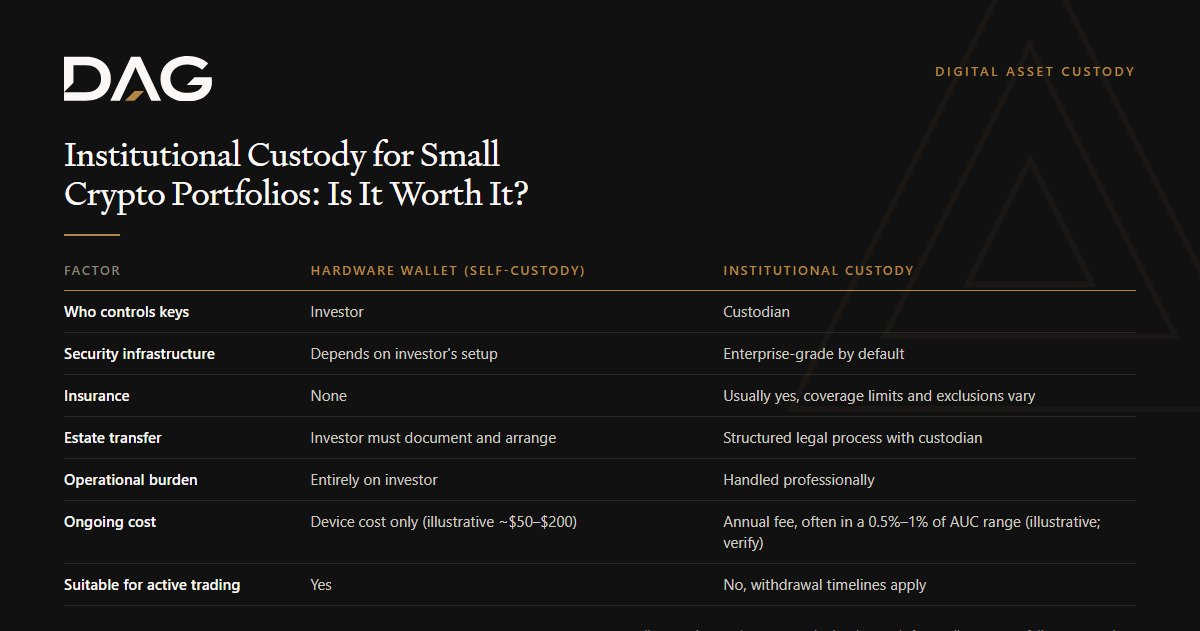
| Factor | Hardware Wallet (Self-Custody) | Institutional Custody |
|---|---|---|
| Who controls keys | Investor | Custodian |
| Security infrastructure | Depends on investor's setup | Enterprise-grade by default |
| Insurance | None | Usually yes, coverage limits and exclusions vary |
| Estate transfer | Investor must document and arrange | Structured legal process with custodian |
| Operational burden | Entirely on investor | Handled professionally |
| Ongoing cost | Device cost only (illustrative ~$50–$200) | Annual fee, often in a 0.5%–1% of AUC range (illustrative; verify) |
| Suitable for active trading | Yes | No, withdrawal timelines apply |
Neither approach is universally better. The right choice depends on technical ability, hold duration, and how much operational risk you are willing to manage personally.
How to Evaluate a Custodian
Before committing, verify these items:
- What percentage of assets remains in cold storage? (Many custodians target a high share, such as 95%+)
- What insurance carrier, coverage limit, and exclusions apply?
- Is the custodian regulated, state trust charter, OCC charter, or equivalent?
- What is the withdrawal approval process and timeline?
- How does the custodian handle estate claims and beneficiary access?
- What security audits or SOC reports are available?
- What is the fee schedule, including minimums?
For a structured framework, see how to choose a crypto custodian and crypto custody due diligence checklist.
The Cost Question: When Does Custody Pay?
Custody fees commonly fall in a range such as 0.5%–1% annually on assets under custody, sometimes with account minimums. On a $100,000 portfolio, that would be roughly $500–$1,000 per year (illustrative; verify current custodian fee schedules before relying on these figures).
Whether that cost makes sense depends on what you compare it to:
- If there is a meaningful probability of key loss, device failure, or estate inaccessibility over a multi-year hold, the expected cost of those outcomes may exceed the custody fee.
- If you are actively trading and need rapid execution, custody creates friction, withdrawal timelines may not fit that use case.
- At very small portfolio sizes (roughly under $25K–$50K), the annual fee as a percentage of holdings may be high relative to the benefit.
This is not a recommendation for or against custody at any particular portfolio size. The appropriate decision depends on individual circumstances and should be evaluated with a qualified professional.
Related Questions
Does institutional custody protect against exchange insolvency?
Qualified custodians that hold assets in segregated accounts, separate from the custodian's own assets, may provide some protection if the custodian enters bankruptcy. Assets held in omnibus or commingled accounts may have weaker protections. Ask any custodian directly about account segregation structure and how client assets are treated under insolvency. Custody is not a guarantee against all loss scenarios.
Can I still earn yield on assets held in institutional custody?
Some custodians offer staking or lending programs on select assets, but these may reduce security controls or introduce counterparty risk. Yield-generating arrangements in custody are not equivalent to holding assets in cold storage, evaluate each program's risk profile separately. Not all custodians offer yield programs, and participation may affect insurance coverage.
What happens if I need to move assets quickly from a custodian?
Institutional custodians require withdrawal approval processes that may take hours to days depending on asset size, verification requirements, and time of day. This is by design, it prevents unauthorized transfers. If rapid execution is a regular requirement, self-custody or exchange holdings may be more practical for that portion of the portfolio.
Is institutional custody only for long-term holders?
Primarily, yes. Custody infrastructure is designed for investors who transact infrequently and prioritize security and record-keeping over execution speed. Investors with active trading needs typically use exchanges or self-custody for the portion of assets they trade, and consider custody for long-term holdings. For a framework on how to structure this split, see the crypto custody decision tree.
Sources
- Securities and Exchange Commission, Custody of Funds or Securities of Clients by Investment Advisers, Rule 206(4)-2 under the Investment Advisers Act of 1940. https://www.sec.gov/rules/final/ia-2176.htm
- Office of the Comptroller of the Currency, Interpretive Letter 1170. National Banks and Trust Companies May Provide Cryptocurrency Custody Services for Customers (July 22, 2020). https://www.occ.gov/topics/charters-and-licensing/interpretations-and-actions/2020/int1170.pdf
- Wyoming Statute, Wyoming Qualified Custodian Rule, W.S. 13-12-101 et seq. https://wyoleg.gov/statutes/compress/title13.pdf
Compliance Note
This page is for educational purposes only and does not constitute legal, tax, investment, or financial advice. No specific investment outcome is guaranteed or implied. Institutional custody involves fees, counterparty risk, and limitations, including insurance coverage that is not FDIC- or SIPC-equivalent and that may not cover all loss scenarios. Custody may not be cost-effective at smaller portfolio sizes. Consult a qualified legal, tax, and investment professional before making custody decisions. Advisory services are provided by DAG Wealth, an SEC-registered investment adviser. Registration does not imply a certain level of skill or training.