
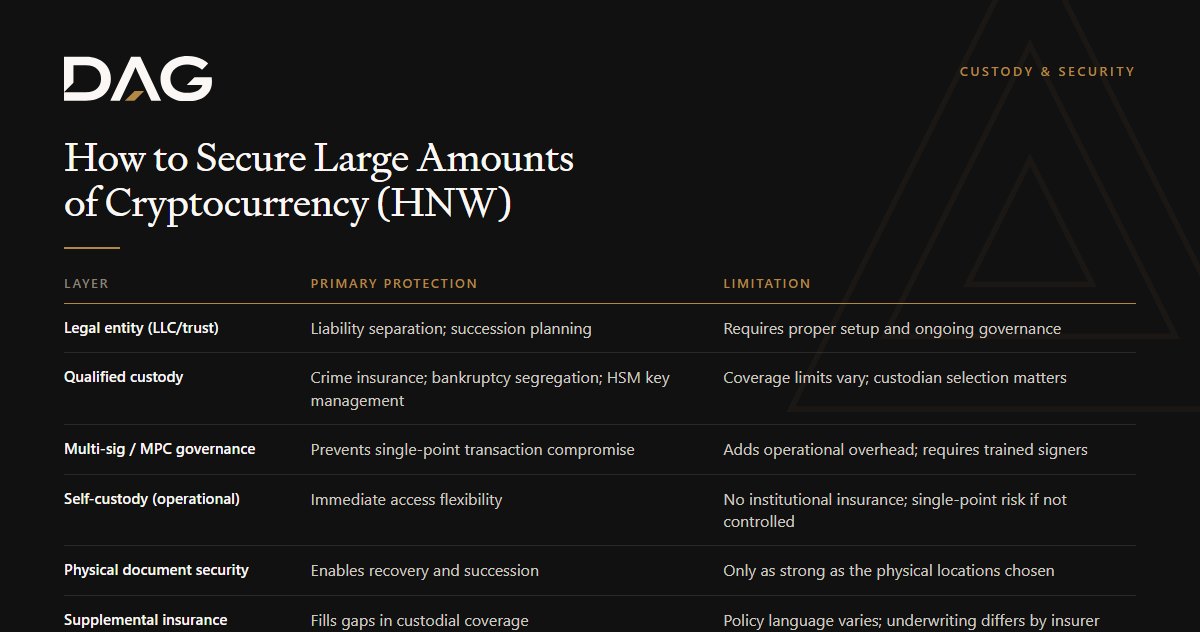
To secure large amounts of cryptocurrency, high-net-worth individuals layer institutional-grade controls rather than relying on hardware alone: legal entity structure, qualified crypto custody with crime insurance, documented governance, and physical security for recovery information. Layering these independent controls means no single failure exposes the entire holding.
What Does "Institutional-Grade" Crypto Security Mean?
For holdings above seven figures, personal hardware wallets introduce a single point of failure for the entire position. Institutional-grade security means building independent layers, legal, custodial, procedural, and physical, that collectively limit the damage any one compromise can cause.
A hardware wallet is a tactical tool. Legal structure, qualified custody, and access governance are the strategic foundation.
How to Structure Security for Large Cryptocurrency Holdings
Step 1: Establish Legal Entity Ownership
Hold significant cryptocurrency through an LLC or trust, not personally.
A properly structured, separately managed LLC can create liability separation between the entity's assets and a member's personal creditors, though no structure makes assets entirely creditor-proof, and the degree of protection varies by state law and how the entity is operated. Trusts differ by type: a revocable trust is generally used for probate avoidance and management continuity, not creditor protection, and its assets remain part of the grantor's estate; only certain irrevocable structures may offer creditor protection. The entity also enables formal succession planning, assets held in trust can transfer to heirs according to documented instructions rather than leaving successors to prove ownership or locate keys. See Should Crypto Be Held Personally, in an LLC, or in a Trust? for a comparison of each structure's protections.
Note that contributing crypto to a disregarded single-member LLC or funding a revocable trust is generally not itself a taxable event; the taxable event is selling or otherwise disposing of the asset. Entity formation and trust drafting are legal services, the firm coordinates these with qualified counsel and does not provide legal advice. Tax treatment is general and current as of 2026; confirm specifics with a tax professional.
Step 2: Use Qualified Institutional Custody for the Bulk of Holdings
Move the majority of assets to a qualified custodian, not an exchange, and not a personal wallet.
Qualified custodians provide:
- Crime insurance covering specified losses such as theft, fraud, and employee misconduct, subject to policy limits and exclusions. This is private commercial coverage, not FDIC or SIPC protection, and it does not insure against market loss. Self-custody and exchange storage generally do not provide equivalent coverage.
- Bankruptcy-remote segregation. Your assets remain legally separate from the custodian's balance sheet. If the custodian encounters financial difficulty, segregated client holdings are not swept into bankruptcy proceedings.
- HSM-grade key management. The custodian operates hardware security modules, multi-party signing, and regulated access controls, operational infrastructure most individuals cannot replicate independently.
For a direct comparison of custody options, see Qualified Custody vs Self-Custody for Crypto Wealth and Cold Storage vs Qualified Custody.
Step 3: Implement Documented Governance and Approval Controls
Even with institutional custody, internal controls prevent unauthorized transactions and operational errors.
Separation of duties: No single person should control the full transaction flow. One person initiates, another approves, a third executes. Multi-signature or MPC wallet configurations enforce this at the protocol layer; written authorization matrices enforce it at the operational layer. See MPC vs Multi-Sig Custody for a technical comparison.
Transaction thresholds: Document tiered approval requirements by amount. As an illustrative structure only, thresholds will vary by organization, a policy might require one approval for smaller transfers, two approvals above a defined level, and written documentation plus three-party sign-off for the largest transfers. Treat these tiers as illustrative; verify and customize specific thresholds with qualified legal and compliance counsel before implementing.
These controls limit damage from both external compromise and internal mistakes: an unauthorized actor who gains access to one layer still cannot move funds without completing the rest of the authorization chain.
Step 4: Maintain a Limited Operational Self-Custody Position
Some assets may need to remain in self-custody for immediate access, active trading, DeFi participation, or liquidity needs that institutional custody timelines do not accommodate.
Keep this position consciously limited to what you genuinely need for near-term use. A useful analogy: institutional custody serves the role of a savings account; self-custody serves the role of an operating account. Everything not needed for active use belongs in the more protected environment.
For self-custody positions, use hardware wallets with institutional-grade reputation. The allocation decision should be documented and revisited on a regular schedule, not left as an afterthought.
Step 5: Secure Physical Documentation and Recovery Information
Institutional custody does not eliminate the need for physical document security.
Store the following in multiple secure physical locations, not in a single place:
- Entity formation documents and operating agreements
- Custody account credentials and authorization records
- Recovery phrases for any self-custodied wallets (physical only; never stored digitally unless encrypted with a memorized passphrase)
- Access instructions for designated successors
Document who knows what, who can access which systems, and what steps a successor should take if you become unavailable. Test these procedures before they are needed. See Seed Phrase Storage for Estate Planning and Crypto Estate Planning for High-Net-Worth Families for detail on succession-safe documentation.
Step 6: Layer Insurance Beyond Custodial Coverage
Qualified custody crime insurance covers assets held at the custodian. Consider additional coverage for remaining exposures:
- Cyber liability for entity-level systems and operations
- Key person coverage if specific individuals are operationally critical
- Umbrella policies for additional liability protection
Work with an insurance professional experienced with digital asset holdings. Standard policies often exclude digital assets or provide materially insufficient coverage for large positions.
Step 7: Schedule Regular Security Audits
Security requires ongoing review. Conduct quarterly assessments covering:
- Current signing authority: are listed signers still appropriate?
- Custody arrangement terms and custodian standing
- Access credentials and recovery procedures for any changes
- Entity document currency
Test recovery procedures with designated successors before they face a real situation. Documented procedures sometimes diverge from operational reality when systems change after the original drafting.
Custody and Security Structure: Comparison
| Layer | Primary Protection | Limitation |
|---|---|---|
| Legal entity (LLC/trust) | Liability separation; succession planning | Requires proper setup and ongoing governance |
| Qualified custody | Crime insurance; bankruptcy segregation; HSM key management | Coverage limits vary; custodian selection matters |
| Multi-sig / MPC governance | Prevents single-point transaction compromise | Adds operational overhead; requires trained signers |
| Self-custody (operational) | Immediate access flexibility | No institutional insurance; single-point risk if not controlled |
| Physical document security | Enables recovery and succession | Only as strong as the physical locations chosen |
| Supplemental insurance | Fills gaps in custodial coverage | Policy language varies; underwriting differs by insurer |
Related Questions
Does institutional custody mean giving up control of my assets?
No. Qualified custody means a regulated third party holds keys on your behalf under segregated, bankruptcy-remote arrangements, your assets remain legally yours. You retain ownership and control transaction authority through your documented governance structure. The custodian executes transfers only on your authorized instructions.
What is the difference between qualified custody and exchange storage?
Qualified custodians operate under regulatory frameworks (trust company charters, state or federal licensing), maintain segregated client accounts, carry crime insurance, and undergo third-party audits. Exchange storage generally provides none of these protections, your assets sit on an exchange's balance sheet, exposed to the exchange's operational and financial risks. See Qualified Custodian vs Crypto Exchange for a detailed breakdown.
How does geographic distribution of keys reduce risk?
Institutional custodians and multi-party custody arrangements can distribute key shards or signing authority across multiple geographic locations and jurisdictions. This means that a physical event, legal action, or compromise affecting one location does not enable unauthorized access to the full position. Geographic distribution is one reason institutional custody offers structural risk reduction that single-location self-custody cannot replicate.
When should a high-net-worth individual move from self-custody to institutional custody?
There is no universal threshold, and the right answer depends on individual circumstances. The calculation tends to shift once a loss from a single-point failure would be financially significant and effectively unrecoverable. For many HNW individuals holding crypto at scale, the ongoing cost of institutional custody (custody fees, onboarding time) may be modest relative to the uninsured exposure of keeping that same position in a personal hardware wallet, but custody carries its own counterparty, fee, and access trade-offs, and the comparison should be made case by case. See How Do I Move From Self-Custody to Qualified Custody? for process detail.
Sources
- SEC, Investment Advisers Act of 1940, Rule 206(4)-2 (Custody Rule): https://www.sec.gov/rules/final/ia-2176.htm
- OCC, Interpretive Letter 1170 (national banks as crypto custodians, 2020): https://www.occ.gov/topics/charters-and-licensing/interpretations-and-actions/2020/int1170.pdf
- NYDFS, Virtual Currency Regulation (23 NYCRR 200): https://www.dfs.ny.gov/apps_and_licensing/virtual_currency_businesses/regulation
- Wyoming Division of Banking, Special Purpose Depository Institution (SPDI) framework: https://wyomingbankingdivision.wyo.gov/banks-and-trust-companies/special-purpose-depository-institutions
Compliance Note
This page is educational only and does not constitute legal, tax, investment, or insurance advice. Cryptocurrency holdings involve material risks including market volatility, regulatory uncertainty, custody provider risk, and the potential for total loss. No custody arrangement, legal structure, or security protocol eliminates all risk; the protections described are designed to reduce specific categories of risk, not to guarantee outcomes. Insurance coverage terms, limits, and exclusions vary by provider and policy; verify current terms directly with any insurer or custodian before relying on coverage descriptions. Entity structuring, trust formation, and succession planning require qualified legal counsel. Consult a licensed attorney, tax professional, and qualified financial adviser before implementing any strategy described here.
Advisory services are provided by DAG Wealth, an SEC-registered investment adviser. Registration does not imply a certain level of skill or training. Entity formation, trust drafting, and operating-agreement preparation are legal services; the firm coordinates these with qualified counsel and does not provide legal advice.