
Institutional crypto custody withdrawal procedures follow a documented multi-step approval process, not an instant click, one practical dimension of the broader institutional crypto custody landscape. Requests typically require authorized signers, compliance screening, and destination verification before execution, with processing ranging from same-day to several business days. All fee and limit figures below are illustrative; verify current terms with your custodian.
What Are Institutional Custody Withdrawal Procedures?
Institutional crypto custody is governed by documented procedures, not exchange-style self-service. When you need to move assets, the sequence generally runs as follows.
How does the withdrawal request process work?
Step-by-step withdrawal flow (illustrative, exact steps vary by custodian):
- Submit the request. Specify the amount, destination wallet address, and business purpose. The request enters the custodian's approval queue.
- Authorized signer review. One or more designated signers verify the destination address, confirm the amount, and check that the transaction aligns with documented authorization controls. This is active review, not a rubber stamp.
- Compliance screening. The custodian runs the destination address against sanctions lists, checks whether the withdrawal triggers reporting requirements, and validates supporting documentation.
- Execution. Once approvals and compliance clear, the custodian executes the transfer. Assets move to the approved destination and you receive confirmation with transaction documentation.
Processing time is hours to business days, not minutes. A simple request to a whitelisted address submitted during business hours may settle same day. A large withdrawal requiring multiple signers, where one is unavailable, can take 24–72 hours or more. Weekends and holidays add delays; institutional custody runs on business-day schedules, not continuous crypto market hours.
What Are Common Withdrawal Threshold Structures?
Your custody agreement specifies approval tiers. The thresholds and signature counts below are illustrative examples only, actual limits vary significantly by custodian and account type. Always verify with your provider.
| Illustrative Tier | Example Threshold | Typical Requirement |
|---|---|---|
| Standard | Below $50,000 | One authorized signature, standard timing |
| Elevated | $50,000–$500,000 | Two signatures, additional documentation |
| Enhanced | Above $500,000 | Three signatures, written business justification, enhanced compliance review |
| Monthly aggregate | Varies by agreement | May require advance notice or additional authorization above a monthly cap |
These tiers are governance controls, not arbitrary restrictions. They slow unauthorized large transactions and give account holders time to verify withdrawals align with investment strategy and estate plans.
What Fees Do Custodians Charge for Withdrawals?
Fee structures vary by custodian and account type. Common models include:
- Per-transaction fees. A flat amount (e.g., $50 per withdrawal) or a percentage of transaction value with minimum and maximum caps. All figures are illustrative, verify current schedules with your custodian before funding.
- Included allowances. Some custody arrangements include a number or dollar value of monthly withdrawals in the base custody fee, with overage charges for excess transactions.
- Tiered pricing. Smaller withdrawals often carry a higher effective percentage; larger withdrawals may qualify for lower rates due to fixed-cost components.
- Network fee pass-through. Blockchain network fees (gas, miner fees) are typically passed through separately at current market rates on top of custodian charges.
The exact fee schedule is in your custody agreement. Read it before committing assets.
How Does Address Whitelisting Speed Up Withdrawals?
Most institutional custodians support pre-approved destination addresses. Whitelisted addresses complete faster because destination due diligence already happened during setup.
To use whitelisting effectively:
- Register frequently-used addresses (operational self-custody wallets, exchange accounts, business partners) during onboarding or through the custodian's formal amendment process.
- Understand that adding a new address still requires a formal approval step, plan ahead for destinations you expect to use.
- Withdrawals to non-whitelisted addresses go through full destination verification and may take longer.
For institutional crypto custody arrangements, whitelisting is one of the most practical ways to reduce routine withdrawal friction while keeping controls intact. Consult your custodian's policy documentation for current whitelisting procedures, these vary.
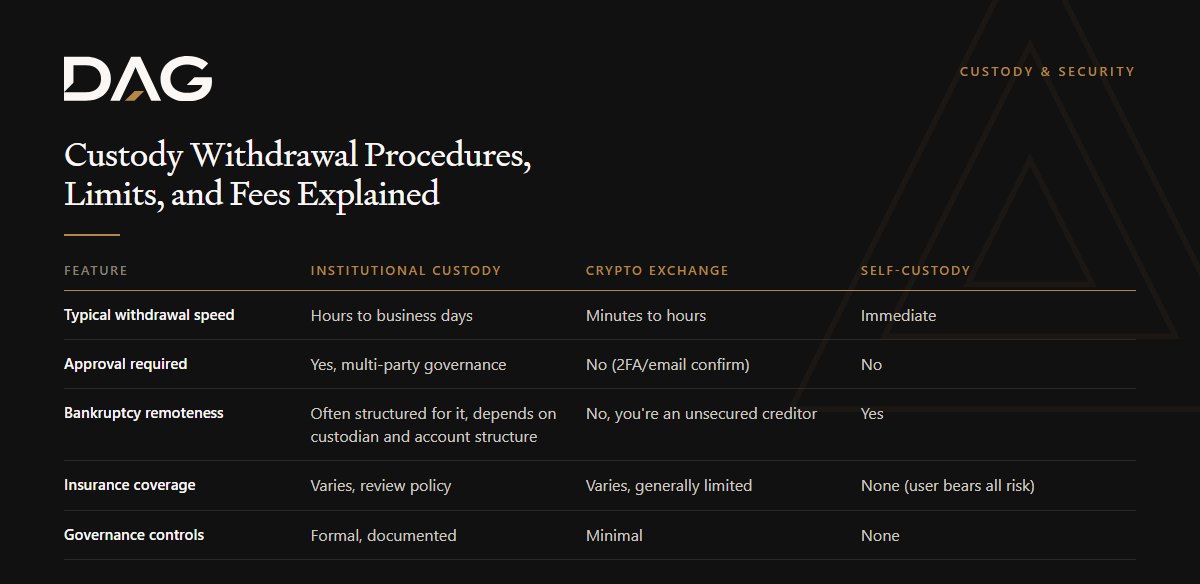
How Does Institutional Withdrawal Compare to Exchange or Self-Custody?
| Feature | Institutional Custody | Crypto Exchange | Self-Custody |
|---|---|---|---|
| Typical withdrawal speed | Hours to business days | Minutes to hours | Immediate |
| Approval required | Yes, multi-party governance | No (2FA/email confirm) | No |
| Bankruptcy remoteness | Often structured for it, depends on custodian and account structure | No, you're an unsecured creditor | Yes |
| Insurance coverage | Varies, review policy | Varies, generally limited | None (user bears all risk) |
| Governance controls | Formal, documented | Minimal | None |
The access delay in institutional custody is a feature of its governance structure. Without approval workflows and compliance checks, institutional custody would offer no meaningful security advantage over exchange storage. For a detailed comparison, see qualified custody vs self-custody for crypto wealth.
Related Questions
Can emergency withdrawals bypass the normal approval process?
Some custody arrangements include expedited procedures for documented emergencies, prioritized processing, after-hours senior approver access, or similar accommodations. These still require authorization; they do not bypass governance. They exist for genuine emergencies (medical crisis requiring immediate liquidity, serious business disruption), not market-timing. Confirm whether your agreement includes an emergency clause and what it requires.
How should I plan large withdrawals in advance?
If you know you need a significant amount by a specific date, initiate the request well before the deadline. A withdrawal needed for a real estate closing in 30 days should be started two weeks early to allow time for multi-signer approvals, compliance review, and execution without last-minute pressure. Maintain a separate liquidity reserve in faster-access arrangements so custody withdrawals are never under emergency time pressure.
What documentation do custodians typically require for large withdrawals?
Requirements vary, but common documentation for large transactions includes written business purpose or investment rationale, board or committee resolutions (for entity accounts), beneficial ownership confirmation, and evidence that the destination address belongs to an authorized counterparty. Your crypto transfer approval policy should document these requirements in advance so authorized signers know exactly what's needed.
How do custodians handle first-time withdrawals to new addresses?
First-time withdrawals to unwhitelisted addresses generally take longer. The custodian may require test transactions, additional ownership verification, and extra scrutiny before approving a large transfer. Budget at least one full business day, often more for large amounts, and review your custodian's address verification procedures. See also crypto address verification policy.
Planning Custody Liquidity Correctly
Don't structure holdings so that 100% of your liquid assets require institutional custody withdrawals to access. A practical approach:
- Keep operational working capital in faster-access arrangements (exchange accounts, self-custody hardware wallets) sized to cover several months of anticipated liquidity needs.
- Park long-term holdings in institutional custody where governance controls, insurance, and bankruptcy remoteness justify the access tradeoff.
- Review your family office crypto custody policy to ensure withdrawal procedures and liquidity buffers are explicitly documented.
For families managing digital assets across multiple custody arrangements, DAG Wealth coordinates custody operations oversight and liquidity planning as part of broader digital asset family office services.
Before committing assets to any custodian, test the withdrawal process with a small transaction. Understand the approval chain, timing, and documentation requirements while the stakes are low, not when you need access urgently.
Sources
- Financial Industry Regulatory Authority (FINRA). Qualified custody guidance: https://www.finra.org
- U.S. Securities and Exchange Commission. Investment Advisers Act, Section 206(4)-2 (Custody Rule): https://www.sec.gov/rules/final/ia-2176.htm
- Office of Foreign Assets Control (OFAC). Sanctions compliance for virtual currency: https://ofac.treasury.gov/faqs/added/2021-10-15
Compliance Note
This article is educational only and does not constitute legal, tax, investment, or compliance advice. All fee figures, dollar thresholds, and timing estimates are illustrative examples only; actual procedures, limits, and fees vary by custodian and account agreement, verify all specifics directly with your custodian before funding or initiating withdrawals. Custodian terms and fee schedules change; figures cited here may be outdated. Institutional custody is subject to regulatory requirements that vary by jurisdiction and entity structure. Consult qualified legal and financial professionals before making custody decisions. DAG Wealth does not guarantee any investment outcome, custody arrangement performance, or access timeline. Advisory services are provided by DAG Wealth, an SEC-registered investment adviser. Registration does not imply a certain level of skill or training.