
Generating monthly income from crypto without selling means producing variable cash flow from holdings through staking, covered calls, collateralized loans, and crypto lending and yield strategies, without triggering a taxable sale. No approach guarantees a fixed monthly amount; income fluctuates and each method carries counterparty, liquidation, or smart-contract risk. This page explains the mechanics, trade-offs, and tax treatment.
Why Not Just Sell?
Selling appreciated crypto creates a taxable event. If you bought Bitcoin at $15,000 and it is now trading at higher prices, each withdrawal forces a recognition of gain. The tax drag means each dollar of lifestyle spending requires more than a dollar of gross proceeds. Selling also permanently reduces your position, future appreciation on the sold units is forfeited.
The strategies below address this problem by generating cash flow from existing holdings. They do not eliminate volatility or guarantee income.
What Does "Income From Crypto Without Selling" Mean?
Generating income from crypto without selling means using your holdings as a productive asset, earning staking rewards, selling option premiums, borrowing against collateral, or lending through protocols, while retaining legal ownership of the underlying tokens. The key distinction from selling: you do not dispose of the asset, so no capital gain is recognized (though other tax events, such as ordinary income, may occur).
How Do the Main Strategies Work?
Staking
Proof-of-stake blockchains pay holders to validate transactions. You delegate tokens to a validator; the validator participates in consensus; you receive a share of newly issued tokens as reward.
Rates vary by network and fluctuate over time. Reward levels differ by protocol design, so check each network's current published rate before acting:
| Network | Relative yield profile | Primary risk |
|---|---|---|
| Ethereum | Lower among major networks | Validator slashing, ETH price decline |
| Solana | Moderate | Higher volatility, validator downtime |
| Cosmos, Polkadot, Cardano | Often higher, with longer lock-ups | Network-specific governance risk, lock-up periods |
Tax treatment: Staking rewards are generally taxable as ordinary income at fair market value when you gain dominion and control over them, per IRS Revenue Ruling 2023-14 and the Jarrett litigation backdrop (though guidance remains incomplete for some edge cases). The value at receipt becomes your cost basis for future capital-gain calculations. Consult a crypto-qualified tax professional for your specific facts.
Material risks: Slashing (validator misbehavior can result in loss of a portion of staked tokens); lock-up periods that prevent withdrawal during drawdowns; token price decline that erodes the dollar value of rewards even if the token yield percentage holds.
Covered Calls on Bitcoin and Ethereum
You own BTC or ETH and sell call options against your position. The buyer pays you a premium for the right to purchase your crypto at a set strike price by a set date.
Mechanics: If the market price stays below the strike, the option expires worthless. You keep the premium and retain your tokens. If the market price exceeds the strike, your tokens are called away at the strike, you keep the premium and the gain up to the strike, but forfeit further upside.
What this strategy does: It converts a portion of potential upside into current income. It makes sense when you expect the asset to trade flat or rise modestly, and you are comfortable capping gains above the strike.
Tax treatment: Option premium is generally recognized as income when the option expires, is exercised, or is closed. If the underlying crypto is called away, that triggers a taxable sale. The interplay of option premium and asset holding period is complex; work with a tax professional who understands Section 1256 contracts and crypto-specific issues.
Platform risk: Crypto options trade on specialized exchanges. Counterparty and exchange risk are real considerations. Understand margin requirements and settlement mechanics before using this strategy.
Collateralized Loans for Liquidity
You pledge crypto as collateral; a lender advances cash or stablecoins; you fund expenses from the loan proceeds. No taxable sale occurs at the time of borrowing.
Typical terms: Lenders advance only a fraction of the collateral's value (a conservative loan-to-value ratio), charge interest that often runs well above traditional secured-loan rates, and set fixed terms. Specific LTV limits, rates, and durations vary by lender and shift with market conditions, obtain current terms directly from any lender before relying on them.
Why this can work: If your crypto appreciates faster than the interest rate, the strategy preserves full exposure while providing liquidity. Interest payments may be fundable from staking or other income streams, creating a layered structure.
Critical risks:
- Liquidation: If the collateral value drops below the lender's maintenance threshold, you face a margin call. You must add collateral or the lender liquidates your position, a taxable event.
- Accumulating debt: Interest compounds; if income streams are disrupted simultaneously with a price decline, debt can become unmanageable.
- Platform insolvency: Centralized lenders can fail (several centralized crypto lenders that failed in 2022 illustrate this risk).
Tax treatment: Loan proceeds are not taxable. Interest paid is generally not deductible for personal expenses. If the lender liquidates collateral, that liquidation is a taxable sale.
DeFi Lending and Yield Protocols
Decentralized protocols allow you to deposit crypto into smart contracts; borrowers pay interest; you receive a share of that interest. Rates fluctuate based on supply and demand.
Stablecoin lending generally offers the most straightforward risk profile within DeFi: you deposit USDC or USDT rather than volatile assets, avoiding price-change exposure on the deposited asset while earning yield. Rates float with protocol supply and demand and can change daily, check the live rate on the protocol before depositing.
Risks unique to DeFi:
- Smart contract vulnerabilities (bugs and exploits have drained hundreds of millions from protocols)
- Liquidity crunches during market stress that prevent timely withdrawal
- Oracle manipulation attacks that can trigger cascading liquidations
- Incomplete or absent regulatory protections compared to centralized lenders
Tax treatment: DeFi interest income is generally ordinary income when received. IRS guidance on all DeFi mechanics is incomplete as of the updated date; consult a tax professional.
Liquidity Pool Participation
You deposit two tokens into a decentralized exchange liquidity pool, earning a share of trading fees.
Impermanent loss: When the price ratio of the two deposited tokens shifts, the pool's rebalancing mechanism results in you holding a different ratio than you deposited, often worth less than simply holding both tokens. Fee income must exceed impermanent loss for the strategy to generate net positive return.
This strategy carries compounding complexity: LP token accounting, impermanent loss tracking, and ambiguous tax treatment. For most holders focused on generating reliable monthly cash flow, liquidity pools are higher-effort and higher-risk than staking or collateralized lending. Consider this approach only with deep familiarity with DeFi mechanics.
How Do I Build a Monthly Income Structure?
- Quantify your actual monthly cash need. Be specific, lifestyle spending plus tax reserve. Vague targets produce over- or under-engineered portfolios.
- Work backwards from yield assumptions. Use conservative yield estimates, not historical highs. The lower the realistic blended yield you can sustain, the more income-producing capital you need to fund a given annual draw. Run the arithmetic with a deliberately cautious assumption so a yield shortfall does not break the plan.
- Diversify across strategies. Concentrating in a single income source (e.g., all DeFi lending) concentrates platform and smart-contract risk. A portfolio spread across staking, options premiums, and loan-backed liquidity has different failure modes for each tranche.
- Build a cash buffer. Maintain 6–12 months of expenses in cash or stablecoins. Market disruption, protocol failures, or lock-up periods can interrupt any income stream. A buffer prevents forced selling at the worst time.
- Review regularly. Staking rates, option volatility, and DeFi yields change monthly. A strategy calibrated in January may be misaligned by July. Schedule regular reviews.
What Are the Tax Implications of Each Strategy?
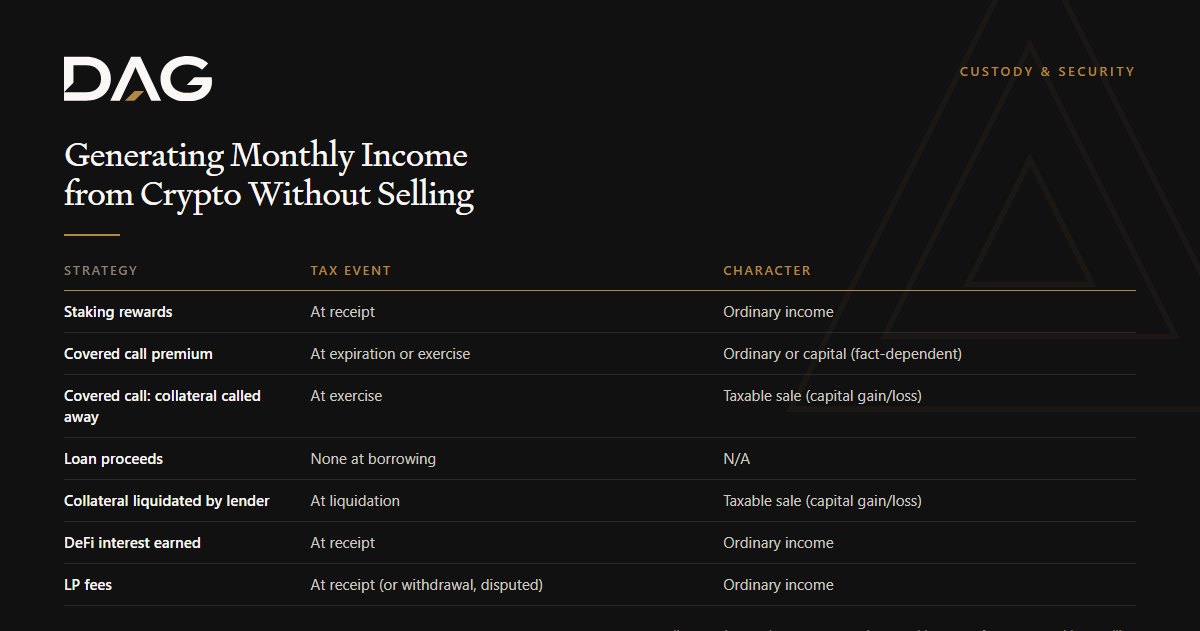
| Strategy | Tax event | Character |
|---|---|---|
| Staking rewards | At receipt | Ordinary income |
| Covered call premium | At expiration or exercise | Ordinary or capital (fact-dependent) |
| Covered call: collateral called away | At exercise | Taxable sale (capital gain/loss) |
| Loan proceeds | None at borrowing | N/A |
| Collateral liquidated by lender | At liquidation | Taxable sale (capital gain/loss) |
| DeFi interest earned | At receipt | Ordinary income |
| LP fees | At receipt (or withdrawal, disputed) | Ordinary income |
IRS guidance on several DeFi mechanics is incomplete. Work with a tax professional who tracks crypto-specific IRS notices and proposed regulations.
For related context, see crypto staking tax reporting and crypto tax planning for HNW investors.
When Income Generation Strategies Are Not Appropriate
- Insufficient position size. A $100,000 crypto position cannot reliably generate $5,000 monthly. The required yield (~60% annually) exists only in high-risk or fraudulent protocols.
- Low volatility tolerance. These strategies do not eliminate crypto price risk. A $2 million portfolio can decline to $1 million in a severe drawdown. If that scenario would force you to abandon the strategy, build larger reserves or reduce income targets.
- Need for guaranteed cash flow. No crypto income strategy guarantees fixed monthly payments. Yields fluctuate; protocols fail; markets close. If certainty is required, traditional fixed-income instruments are the appropriate tool.
- Unfamiliarity with mechanics. Covered calls, DeFi protocols, and collateralized lending involve complexity that can cause significant loss when misunderstood. Use only strategies you can explain and monitor yourself.
Is Strategic Selling Sometimes Better?
Sometimes a planned selling program is the cleaner choice:
- Tax-loss harvesting: Sell positions with unrealized losses alongside appreciated positions to reduce net gain.
- Low-income years: Realized long-term capital gains may be taxed at lower rates in years with reduced ordinary income.
- Charitable giving: Donating appreciated crypto directly to a qualified charity avoids capital gains recognition entirely and generates a fair-market-value deduction (subject to AGI limits). See crypto charitable giving for high-net-worth investors.
- Simplicity premium: Complex income strategies require ongoing management. Paying capital gains tax to achieve clean, predictable cash flow has real value and may produce comparable after-tax results.
For a broader framework, see how wealthy crypto investors diversify without tax surprises and crypto-backed loans for high-net-worth investors.
How Does DAG Wealth Coordinate This?
Advisory services are provided by DAG Wealth, an SEC-registered investment adviser. Registration does not imply a certain level of skill or training. DAG coordinates the surrounding logistics; it does not itself provide investment, tax, or legal advice.
In practice, that coordination can include:
- Helping clients assess total holdings, income requirements, and risk capacity
- Coordinating with DAG Wealth for investment advisory services on strategy allocation and implementation
- Managing custody arrangements and platform relationships
- Coordinating with independent tax professionals on reporting for each income stream
- Monitoring validator performance, loan LTV ratios, and DeFi protocol health
Related Questions
Are staking rewards taxed differently from crypto interest income?
Both are generally ordinary income when received, but the underlying mechanics differ. Staking rewards come from network validation; DeFi interest comes from a lending arrangement. The IRS has addressed staking income in Revenue Ruling 2023-14 and prior guidance but has not issued comprehensive rules for all DeFi interest scenarios. The cost-basis and timing rules may differ depending on how rewards are distributed. Consult a tax professional familiar with IRS crypto guidance.
Can a crypto-backed loan eliminate my capital gains tax permanently?
No. A loan defers the taxable event, it does not eliminate it. If you hold the loan indefinitely and never sell, the gain remains unrealized. But if the lender liquidates your collateral, that is a taxable sale. Upon your death, heirs may receive a stepped-up cost basis under current law (subject to change), which could reduce embedded gain, but that is an estate-planning consideration, not a current tax strategy. See crypto estate planning for high-net-worth families.
What happens to my income strategies if a DeFi protocol is hacked?
If a smart-contract exploit drains a protocol you have deposited assets into, whether you can claim a loss is unsettled and fact-specific. The 2017 Tax Cuts and Jobs Act suspended most personal theft and casualty loss deductions through 2025 (except federally declared disasters), so the analysis often turns on whether the loss qualifies as a transaction entered into for profit; Rev. Rul. 2009-9 and related theft-loss guidance may inform the question by analogy. You are not protected by FDIC or SIPC insurance. Recovery depends on whether the protocol has insurance coverage, a DAO treasury, or legal recourse against identifiable bad actors, which is often unavailable. This is a material risk that must be sized accordingly.
How does covered call taxation differ from staking income?
Staking rewards are ordinary income at receipt regardless of how long you hold the underlying asset. Covered call premiums are generally ordinary income when the option expires worthless or is closed; if the underlying is called away, the premium and disposition proceeds must be analyzed together to determine capital gain holding period and character. The interaction with the underlying asset's holding period (short-term vs. long-term) adds complexity. Work with a tax professional who handles derivatives.
Sources
- IRS Revenue Ruling 2023-14 (staking rewards taxable as ordinary income on receipt): https://www.irs.gov/pub/irs-drop/rr-23-14.pdf
- IRS Notice 2023-34 (technical update to Notice 2014-21): https://www.irs.gov/pub/irs-drop/n-23-34.pdf
- IRS Notice 2014-21 (general crypto tax treatment): https://www.irs.gov/pub/irs-drop/n-14-21.pdf
- IRS Rev. Rul. 2009-9 (theft loss treatment, applicable by analogy): https://www.irs.gov/pub/irs-drop/rr-09-9.pdf
- Ethereum Staking Documentation (beacon chain mechanics): https://ethereum.org/en/staking/
Compliance Note
This page is educational only and does not constitute investment, tax, or legal advice. No income strategy described here guarantees a fixed return; all yields are variable and may be zero or negative. Staking, lending, liquidity pools, and collateralized borrowing each carry material risks including loss of principal, forced liquidation, smart-contract exploits, platform insolvency, and regulatory uncertainty. Collateralized loan liquidation is a taxable event. This page does not quote specific yields; actual rates vary by network, lender, and protocol and change continuously, verify current rates before making any decision.
Tax treatment of crypto income strategies is subject to evolving IRS guidance and may vary based on individual facts. Consult a qualified tax professional and a licensed investment adviser before implementing any strategy. Digital Ascension Group does not provide investment advice; investment advisory services are provided by DAG Wealth, an SEC-registered investment adviser. Registration does not imply a certain level of skill or training. Nothing on this page should be construed as a guarantee of any outcome.