
Transferring traditional IRA funds to crypto assets means opening a self-directed IRA with a qualified crypto custodian and executing a trustee-to-trustee transfer from your existing account. The funds stay inside the tax-deferred wrapper and no tax is triggered. A trustee-to-trustee transfer avoids the withholding and 60-day deadline risks of an indirect rollover.
What Is a Self-Directed IRA for Crypto?
A self-directed IRA (SDIRA) is a standard individual retirement account whose custodian permits alternative assets, including digital assets such as Bitcoin and Ethereum, rather than limiting holdings to stocks, bonds, and mutual funds. The IRS has long recognized that IRAs may hold a wide range of assets; what matters is that the custodian is IRS-compliant and the account owner avoids prohibited transactions under IRC §4975.
Within a crypto SDIRA, the custodian (not the account holder personally) must control and hold the digital assets. Self-custody arrangements, where the account holder holds private keys directly, generally constitute a prohibited transaction and can trigger immediate distribution treatment on the full account balance.
Trustee-to-Trustee Transfer vs. 60-Day Rollover
These two methods are not interchangeable.
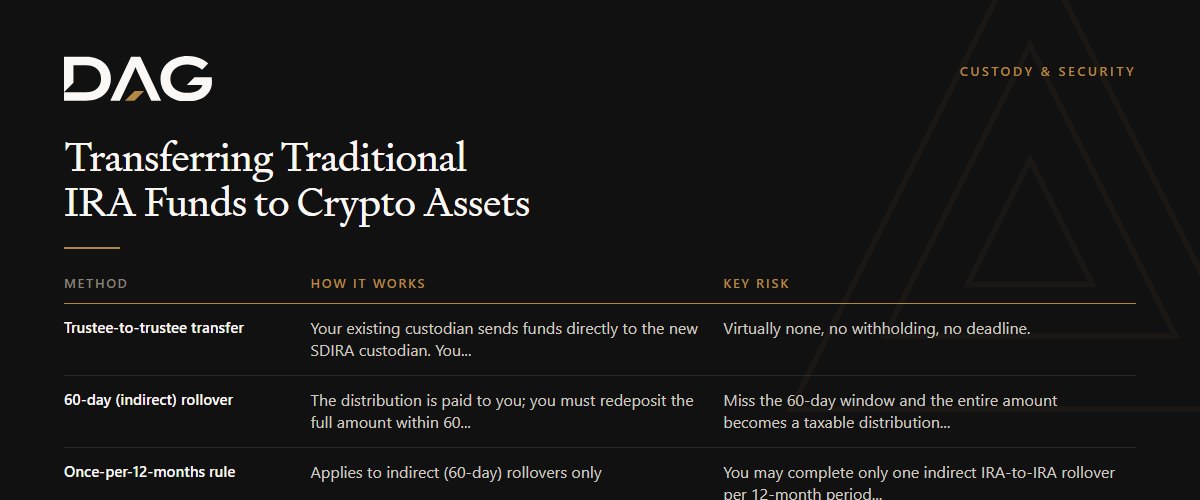
| Method | How It Works | Key Risk |
|---|---|---|
| Trustee-to-trustee transfer | Your existing custodian sends funds directly to the new SDIRA custodian. You never receive or handle the funds. | Virtually none, no withholding, no deadline. |
| 60-day (indirect) rollover | The distribution is paid to you; you must redeposit the full amount within 60 days. | Miss the 60-day window and the entire amount becomes a taxable distribution, plus a 10% early-withdrawal penalty if you are under 59½. Note: distributions from an employer plan such as a 401(k) carry a 20% mandatory federal withholding, which you must replace out of pocket to roll over the full amount and reclaim at tax time. |
| Once-per-12-months rule | Applies to indirect (60-day) rollovers only | You may complete only one indirect IRA-to-IRA rollover per 12-month period across all your IRAs (IRS Notice 2014-54, Bobrow v. Commissioner). Trustee-to-trustee transfers are not subject to this limit. |
For most people moving retirement savings into a crypto SDIRA, a trustee-to-trustee transfer is the correct method. The 60-day rollover introduces unnecessary risk and a strict one-per-year cap.
How to Transfer Traditional IRA Funds to a Crypto SDIRA
Select an IRS-compliant SDIRA custodian. Confirm the custodian is authorized to hold digital assets, supports the specific tokens you intend to purchase, and has clear custody infrastructure (cold storage for the majority of assets, multi-signature authorization for transactions). Ask who actually holds the private keys and what happens to your assets if the custodian fails, several crypto custodians have failed in recent years.
Open the new SDIRA. Complete the custodian's account application. Have your existing account details (custodian name, account number, account type) ready.
Submit transfer paperwork. Your existing custodian will require a distribution request or transfer authorization form authorizing the direct transfer. The receiving custodian may supply its own transfer-in forms. Missing a signature or submitting an outdated form version is the most common reason transfers stall.
Specify intended asset purchases. Some custodians require you to designate which digital assets you intend to buy before the transfer arrives; others allow you to hold the incoming balance in cash and decide afterward.
Confirm the transfer and verify year-end reporting. Once funded, confirm the receiving custodian will produce Form 5498 (contributions/fair market value) and Form 1099-R (any distributions). Unclear or vague answers on tax reporting are a red flag.
What a Rollover Does Not Do
It is not a new contribution. A rollover does not count against the annual IRA contribution limit (verify the current limit with the IRS, it is periodically adjusted for inflation). A large 401(k) balance can be rolled over in full regardless of the annual cap, and a separate annual contribution may still be made if you are otherwise eligible.
It does not change the account's tax character. Funds moved from a pre-tax traditional IRA remain pre-tax. Distributions in retirement, including any crypto gains realized inside the account, are taxed as ordinary income. They are not treated as long-term capital gains.
A Roth conversion is a separate, taxable decision. If you want Roth treatment (tax-free growth, tax-free qualified distributions), you would need to convert traditional IRA funds to a Roth IRA. That conversion is a taxable event in the year it occurs, the converted amount is included in your gross income. Conversions are not covered by the rollover rules and have their own planning considerations. Consult a qualified tax professional before converting.
Prohibited Transactions Under IRC §4975
The IRS prohibits certain transactions between a retirement account and "disqualified persons" (the account owner, lineal family members, certain fiduciaries, and entities they control). Inside a crypto SDIRA, examples of prohibited transactions include:
- Personally holding the private keys to IRA-owned crypto (self-dealing)
- Purchasing crypto from yourself or a disqualified person's entity
- Using IRA assets to guarantee a personal loan
- Transacting with a business you or a disqualified person own or control
A prohibited transaction does not merely generate a penalty, it disqualifies the entire IRA for the tax year, causing the full fair market value to be treated as a taxable distribution. The stakes are high. Get guidance from a qualified tax attorney or CPA before any transaction you are uncertain about.
Custodian Due Diligence Checklist
Before opening a crypto SDIRA, verify:
- Custodian is a qualified custodian under applicable regulations (bank, trust company, or IRS-approved non-bank trustee)
- Cold storage used for the majority of assets
- Multi-signature or MPC key management in place
- Clear answer to "what happens to my assets if you fail?"
- Produces Form 5498 and accurate fair market value reporting at year-end
- Produces Form 1099-R for any distributions
- Written explanation of fee structure (setup, annual, transaction, storage), verify current fees directly with the custodian
- Lists which assets it supports (not all SDIRAs support the same tokens)
For a broader framework on evaluating crypto custodians, see how to choose a crypto custodian and the crypto custody due diligence checklist.
Portfolio Management After the Transfer
Once the SDIRA is funded and assets are purchased, the management questions resemble those of any concentrated position. Crypto is volatile. An allocation that represented 10% of your retirement portfolio at purchase can become 25% or more after a strong run, materially shifting overall portfolio risk.
Most investors holding crypto inside a retirement account treat it as a long-term position. The tax-deferred structure offers less benefit to frequent short-term trading than to long-term appreciation, and active rebalancing inside a self-directed custodian creates operational friction that most traditional brokerages do not.
How much crypto to hold, which assets, and how the position fits your broader retirement picture are investment advisory questions. DAG coordinates with qualified tax professionals and works with clients on portfolio construction, including how digital assets fit the overall retirement plan, through the dag.com platform.
For context on how a crypto IRA compares to other holding structures, see crypto IRA vs. crypto family office structure and should crypto be held personally, in an LLC, or in a trust?.
Related Questions
Can I roll over a 401(k) from a current employer into a crypto SDIRA?
In-service rollovers from an active employer plan are restricted by the plan document, most 401(k) plans do not permit them before age 59½ or separation from service. Check your plan's summary plan description. If you are no longer with that employer, the plan's rules typically allow a rollover. Confirm directly with the plan administrator.
Does moving money into a crypto SDIRA trigger taxes?
A trustee-to-trustee transfer between traditional IRA accounts is not a taxable event. The indirect (60-day) rollover is also not taxable if completed correctly and within the deadline. What would be taxable: missing the 60-day window, a prohibited transaction that disqualifies the account, or choosing to convert to a Roth IRA.
Are crypto gains inside an IRA taxed differently than crypto gains held personally?
Yes. Crypto traded or appreciated inside a traditional IRA is not subject to capital gains tax at the time of the transaction. Gains accumulate tax-deferred and are taxed as ordinary income only upon distribution in retirement. This differs from personally held crypto, where each sale or exchange is a taxable event potentially subject to capital gains rates. Consult a qualified tax professional for guidance on your situation.
What happens if the crypto SDIRA custodian fails?
SDIRA assets are typically held in the account owner's name and are not the property of the custodian. However, recovery from a failed custodian is not automatic, it depends on how assets were held and whether the custodian maintained proper segregation. Several crypto custodians have failed in recent years with materially different recovery outcomes. Qualified custody standards exist precisely to address this risk; ask every prospective custodian about their failure protocol before opening an account.
Sources
- IRS Publication 590-A, Contributions to Individual Retirement Arrangements (IRAs), https://www.irs.gov/publications/p590a
- IRS Publication 590-B, Distributions from Individual Retirement Arrangements (IRAs), https://www.irs.gov/publications/p590b
- IRC §4975, Prohibited Transactions, https://uscode.house.gov/view.xhtml?req=granuleid:USC-prelim-title26-section4975
- IRS Notice 2014-54, Guidance on Allocation of After-Tax Amounts, https://www.irs.gov/pub/irs-drop/n-14-54.pdf
- Bobrow v. Commissioner, T.C. Memo 2014-21 (one-per-year rollover rule), https://www.ustaxcourt.gov/UstcInOP/OpinionViewer.aspx?ID=10039
- IRS Self-Directed IRA FAQ, https://www.irs.gov/retirement-plans/retirement-plans-faqs-regarding-iras
- IRS List of Approved Nonbank Trustees and Custodians, https://www.irs.gov/retirement-plans/approved-nonbank-trustees-and-custodians
Compliance Note
This page is for educational purposes only and does not constitute legal, tax, or investment advice. Retirement account transfers, rollover rules, prohibited transaction analysis, and Roth conversion decisions involve complex legal and tax considerations that vary based on individual circumstances. Consult a qualified tax attorney, CPA, or financial advisor before making any decisions about your retirement accounts.
DAG Wealth and its affiliates do not guarantee investment outcomes. Digital assets are speculative, subject to significant price volatility, and may lose value. Holding digital assets inside a retirement account does not eliminate those risks. Annual contribution limits, early withdrawal penalties, and other figures referenced in this page reflect rules in effect at the time of writing; verify current figures directly with the IRS before acting.
Advisory services are provided by DAG Wealth, an SEC-registered investment adviser. Registration does not imply a certain level of skill or training. DAG coordinates with qualified tax and legal professionals and does not itself provide legal or tax advice.