
Removing single points of failure in crypto storage means distributing control so that no single device, person, password, or custodian can cause total loss, a core concern in institutional crypto custody. Multisig wallets, geographic key distribution, layered legal structures, and split custody each reduce, though cannot fully eliminate, the risk that one failure cascades into complete loss of assets.
What Is a Single Point of Failure in Crypto Storage?
A single point of failure is any component whose loss or compromise alone causes total asset loss. One hardware wallet holding all keys. One person controlling all passwords. One exchange holding all holdings. When that component fails, through theft, death, hardware failure, or platform collapse, there is no fallback.
Most consumer crypto setups have multiple single points of failure built in. Standard wallets issue one seed phrase; whoever holds it controls everything. CEX accounts tie access to one email and password. The binary outcome, perfect access or total loss, is the defining characteristic. For modest amounts, some holders accept this. For significant or generational wealth, it is not a viable risk model.
How Does Multisig Remove Single Points of Failure?
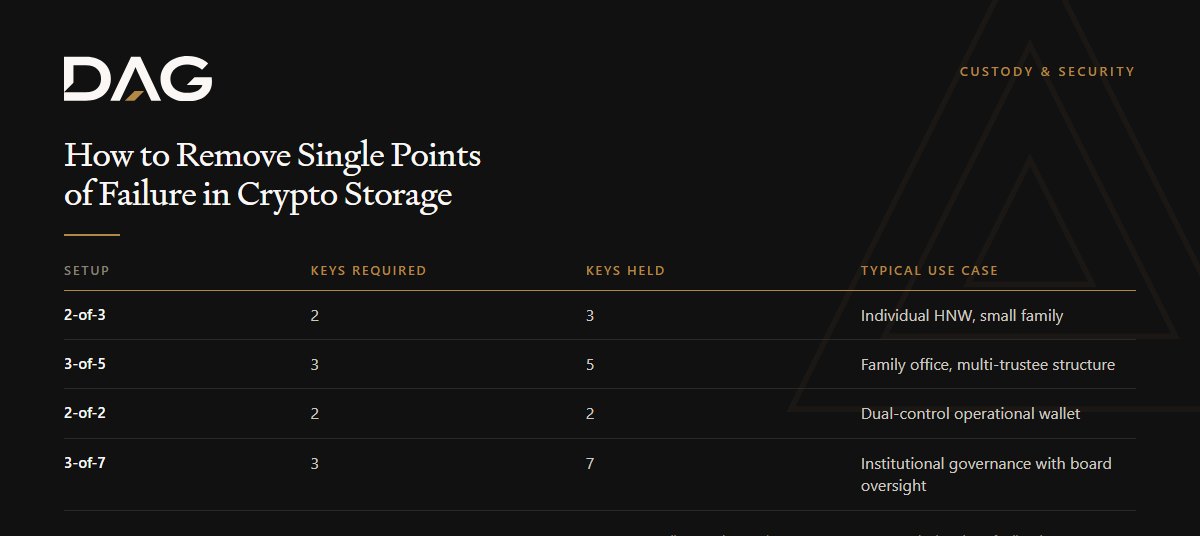
Multi-signature wallets require M-of-N private keys to authorize any transaction. A 2-of-3 setup means any two of three authorized keys must sign before funds move. No single keyholder can transact alone, so compromising one key alone is not enough to move funds, reducing, though not eliminating, the risk of a single-point compromise.
M-of-N configurations commonly used:
| Setup | Keys Required | Keys Held | Typical Use Case |
|---|---|---|---|
| 2-of-3 | 2 | 3 | Individual HNW, small family |
| 3-of-5 | 3 | 5 | Family office, multi-trustee structure |
| 2-of-2 | 2 | 2 | Dual-control operational wallet |
| 3-of-7 | 3 | 7 | Institutional governance with board oversight |
Even with single-signature wallets, dual control is achievable through process separation: one person holds the hardware device, another holds the PIN or passphrase. Neither can transact without the other. This is operational multisig without on-chain enforcement, weaker than true multisig but substantially better than no separation.
For information on how MPC custody differs from on-chain multisig, see MPC vs Multi-Sig Custody.
How Should Keys Be Distributed Geographically?
Key distribution across physical locations means a single disaster, fire, flood, theft, or jurisdictional seizure, cannot compromise enough keys to authorize a transaction.
Practical principles:
- Never store two signing devices in the same building.
- Separate across cities or regions, not just rooms.
- Store recovery material (seed phrases, backup keys) separately from the devices used for routine signing.
- Document locations in a form accessible to successors without exposing the keys themselves.
Institutional custodians with geographic redundancy spread vault infrastructure across multiple data centers and regions. Verify this during due diligence, geographic redundancy in custody is a feature worth confirming, not assuming. See Crypto Custody Due Diligence Checklist for what to ask.
How to Remove Single Points of Failure: Step-by-Step Framework
- Audit your current failure points. List every device, password, custodian, and person whose loss alone would cause total asset loss.
- Implement multisig for significant holdings. Choose an M-of-N scheme appropriate to your governance structure. 2-of-3 is a common starting point.
- Distribute keys geographically. Place signing devices and backup material in separate physical locations across at least two regions.
- Separate custody from governance. Use institutional custody for core holdings; keep the entity structure (LLC or trust) as the governance layer. See Should Crypto Be Held Personally, in an LLC, or in a Trust?.
- Split holdings by use case. Core long-term assets go to institutional custody; operational amounts stay in self-custody hardware wallets sized to near-term needs only.
- Designate operational redundancy. Multiple people must be able to execute critical custody functions. Document procedures so continuity survives any individual's departure or incapacity.
- Test recovery procedures. Run through successor-access scenarios before they become emergencies. Confirm that backup keyholders know locations, procedures, and authorization steps.
- Review annually. Custody arrangements, personnel, and key locations change. Schedule a formal review at least once per year.
Why Legal Structure Is a Custody Control
Holding cryptocurrency through an LLC or trust, rather than personally, adds a legal layer that distributes governance independently of who physically holds the keys.
An entity can have multiple authorized signers with defined roles: a manager for day-to-day operations, a financial decision-maker, a compliance overseer. Authority is distributed across individuals, with succession built into the operating agreement or trust instrument. If the primary manager becomes incapacitated or dies, the entity continues operating under documented procedures rather than grinding to a halt.
The entity layer can also help separate personal liability from asset liability. A properly structured LLC or irrevocable trust may help insulate assets from certain personal creditor claims, a distinct function from custody redundancy. Asset protection is never absolute, depends on how and when the structure is formed, and varies by state and circumstance; a revocable trust, by contrast, offers no creditor protection and is included in the estate. Entity formation and trust drafting are legal services: DAG coordinates with qualified legal counsel and does not provide legal advice or draft legal documents. For structure options, see Crypto LLC vs Trust.
How Does Institutional Custody Complement Self-Custody?
The goal is not to pick one or the other but to use each where it fits best.
Institutional custody (qualified custodian) for core, long-term holdings can provide:
- Crime insurance that may cover certain theft and hacking events (coverage scope, limits, and exclusions vary by custodian, verify the actual policy)
- Bankruptcy-remote segregation, assets intended to be held separately from the custodian's own balance sheet
- Professional key management, the custodian bears much of the key-storage burden
- Regulatory oversight that can provide audit visibility and certain legal protections
Self-custody (hardware wallet) for operational amounts you need for active use provides flexibility and direct control, without counterparty exposure, but at the cost of personal key-management responsibility.
The split means no single custody solution holds everything. If the institutional custodian has an operational problem, self-custody holdings remain accessible. If the hardware wallet is compromised, long-term holdings at the institutional custodian are unaffected. For a structured comparison, see Qualified Custody vs Self-Custody for Crypto Wealth.
What Happens If You Don't Separate Governance from Custody?
When the same person or entity holds assets and controls all decisions about them, governance failure and custody failure happen simultaneously. A custodian that controls both the keys and the transaction approval process has unilateral power over your assets. An individual who manages both the hardware wallet and the approval process is a single point of failure by definition.
Separating custody (who stores the keys) from governance (who decides what to do with assets) means problems in one layer don't automatically propagate to the other. A custodian operational issue doesn't affect your entity's governance; a governance dispute doesn't compromise the custodian's key management.
Related Questions
Does multisig eliminate the risk of losing access to crypto?
No. Multisig reduces the risk that one failure causes total loss, but it introduces its own risks: losing too many keys can lock funds permanently if below the M threshold, and more complex signing procedures can delay time-sensitive transactions. The M-of-N parameters must be chosen carefully, the threshold for access should be reachable even if one or two keyholders are temporarily unavailable.
How should successor access work in a multisig arrangement?
Successors need documented procedures, physical locations of keys, and clear authority to use them. Without documentation, a multisig arrangement can become a recovery problem for heirs. Estate planning integration, naming successors as authorized signers or documenting recovery procedures in a trust instrument, is essential. See Private Key Succession Planning and Hardware Wallet Estate Planning for specifics.
Can a family office use more than one institutional custodian to reduce single-custodian risk?
Yes, and for larger or more complex holdings this is worth evaluating. Using two custodians means a single custodian failure, whether operational, regulatory, or financial, does not affect all assets. The trade-off is operational complexity: two sets of accounts, relationships, reporting, and due diligence. See Should a Family Office Use More Than One Crypto Custodian? for a fuller analysis.
What does key person risk mean in a custody context?
Key person risk is the risk that one individual's unavailability (death, incapacity, departure, or legal hold) compromises custody operations. In crypto, this is especially acute because access may be technically impossible without the right person's involvement. Policies that designate backups, document procedures, and distribute signing authority reduce key person risk. See Crypto Key Person Risk Policy.
Sources
- Bitcoin multisig documentation: Bitcoin Wiki. Multisig (accessed 2026)
- NIST SP 800-57 Part 1 Rev. 5 key management guidelines: NIST Key Management (2020)
- SEC Custody Rule, Investment Advisers Act of 1940 §206(4)-2: SEC.gov
- Wyoming has enacted digital-asset-friendly entity statutes (Wyoming Limited Liability Company Act, Wyoming Stat. Title 17, Ch. 29; and related digital-asset provisions in Title 34, Ch. 29). Confirm current chapter and section numbers with Wyoming-licensed counsel before relying on any specific citation.
Compliance Note
This page is educational only and does not constitute legal, tax, investment, or custody advice. Custody and governance arrangements for significant digital asset holdings involve legal, regulatory, and technical considerations specific to each situation. Consult qualified legal counsel, a licensed custodian, and a registered investment adviser before making custody decisions.
Multisig, geographic distribution, and layered structures can reduce, but not eliminate, the risk of loss. No custody arrangement provides absolute security guarantees.
Advisory services are provided by DAG Wealth, an SEC-registered investment adviser. Registration does not imply a certain level of skill or training. Entity formation, trust, and estate-planning matters are legal services; DAG coordinates with qualified legal counsel and does not provide legal advice.