
HBAR staking yield comes from Hedera's native proxy staking: you point tokens at a network node without transferring custody, locking assets, or selling, for context on how custody choices affect yield access, see crypto lending and yield. Reward rates vary and are not guaranteed, and rewards are generally treated as ordinary income at receipt under IRS Rev. Rul. 2023-14. This is educational content, not investment or tax advice.
What Is HBAR Proxy Staking?
Hedera's proxy staking lets you designate a network node to receive credit for your HBAR's participation in consensus. Your tokens stay in your wallet throughout. The node validates transactions; Hedera distributes rewards based on delegated balance and network participation rates.
This differs from most proof-of-stake networks, which require a lockup period or transfer of tokens to a validator. With Hedera proxy staking, you maintain full custody the entire time.
How to Set Up HBAR Staking
Step 1: Confirm your wallet or custody platform supports staking
Not every wallet enables Hedera staking. Hardware wallets, select exchanges, and institutional crypto custody providers may offer this feature. If you hold through an exchange, verify the platform passes staking rewards through to you rather than retaining them.
Step 2: Select a node
Hedera's network runs on nodes operated by major enterprises. Google, IBM, Boeing, Deutsche Telekom, and others. Reward rates do not vary dramatically between nodes, but uptime affects your actual earned amount. Some wallets auto-select a node; others allow manual selection. Prioritize nodes with documented uptime and transparent operations.
Step 3: Enable staking in your wallet settings
This is typically a toggle or configuration option, not a token transfer. You are designating which node receives credit for your balance's participation, not sending HBAR anywhere.
Step 4: Track accrued rewards
Most wallets display accrued rewards in the dashboard. Network explorers such as Dragonglass and Ledger Works also show staking activity and reward distribution. Rewards compound as your HBAR balance increases, since the larger balance earns on the new total.
Key Risks to Understand Before Staking
| Risk | Description |
|---|---|
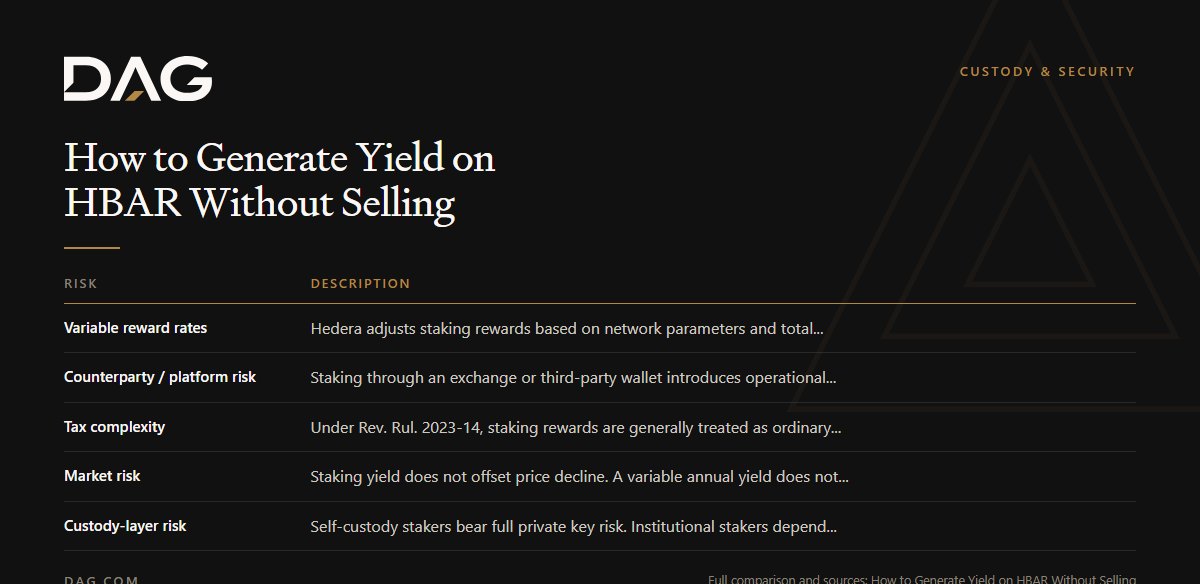
| Variable reward rates | Hedera adjusts staking rewards based on network parameters and total participation. Rates can decrease as more holders stake. No specific APY is guaranteed, verify current rates before relying on projections. |
| Counterparty / platform risk | Staking through an exchange or third-party wallet introduces operational risk. Exchanges can freeze withdrawals, change terms, or fail. This is a counterparty problem, not a Hedera protocol problem. |
| Tax complexity | Under Rev. Rul. 2023-14, staking rewards are generally treated as ordinary income at the time of receipt, regardless of whether you sell. Record the fair market value of each reward batch at receipt. Some jurisdictions treat rewards differently, consult a qualified tax professional. |
| Market risk | Staking yield does not offset price decline. A variable annual yield does not protect against significant drops in HBAR's market value. |
| Custody-layer risk | Self-custody stakers bear full private key risk. Institutional stakers depend on their custodian's staking support and pass-through policy. |
Why Long-Term Holders Use This Strategy
Selling HBAR to generate cash flow triggers capital gains taxes and ends your upside exposure. Proxy staking does neither, you accumulate more HBAR while maintaining your position.
Institutional holders sometimes incorporate staking into treasury management to improve the return profile of a held position without changing risk exposure. The crypto custody options compared page covers how custodian selection affects access to staking features.
For holders with complex structures, multi-signature wallets, trust-owned entities, or positions across multiple networks, custody coordination is a material consideration. See crypto custody for trusts for trust-specific issues, and can a Wyoming LLC stake crypto if the position is held in a business entity. Tax reporting obligations are covered in crypto staking tax reporting.
The Core Trade-off
Staking trades liquidity timing for yield. HBAR is not locked, but moving it quickly may cause you to miss a reward period or wait for the next distribution cycle. For most long-term holders this is a minor friction. For active traders or those anticipating near-term rebalancing, it is worth factoring into the decision.
The strategy works best for holders who planned to hold HBAR regardless, have custody arrangements that support staking and reward pass-through, and have addressed the tax record-keeping requirements before rewards begin accruing.
Related Questions
Does Hedera staking require locking my HBAR?
No. Hedera's proxy staking does not lock tokens or transfer them to a validator. Your HBAR remains in your wallet or custody account throughout the staking period. You can unstake at any time, though you may forfeit rewards for the current distribution period.
Are HBAR staking rewards taxable income?
Under IRS Rev. Rul. 2023-14, staking rewards for proof-of-stake protocols are generally treated as ordinary income at the time of receipt. The taxable amount is the fair market value of the HBAR received at the moment it hits your wallet. State tax treatment varies. This is an area where a crypto-specialist CPA can materially affect your outcome, do not assume your general tax preparer is current on this ruling. See crypto staking tax reporting for more detail.
Can a trust or LLC stake HBAR?
Potentially, yes, subject to the custodian and entity structure involved. A trust or LLC holding HBAR needs a custody arrangement that both supports Hedera staking and passes rewards through to the entity. The trustee or manager also has documentation and record-keeping obligations. See can a trust receive staking rewards and can a Wyoming LLC stake crypto for entity-specific considerations.
What should I do if my exchange doesn't pass through staking rewards?
Some exchanges retain staking rewards as part of their custody terms. If your current platform does not pass through rewards, your options are to move to a platform that does, or to self-custody. Moving assets to a different custodian may itself be a taxable event if the transfer is structured as a sale. Review your custodian's terms carefully and consult a tax professional before switching. The how do I move from self-custody to qualified custody page covers the transition process.
Sources
- IRS Rev. Rul. 2023-14 (staking reward income treatment): https://www.irs.gov/pub/irs-drop/rr-23-14.pdf
- Hedera network documentation, staking: https://docs.hedera.com/hedera/core-concepts/staking
- Hedera Council member list: https://hedera.com/council
- Dragonglass network explorer: https://app.dragonglass.me
Compliance Note
This page is educational only and does not constitute investment, tax, or legal advice. HBAR staking rewards are variable and not guaranteed; past reward rates are not indicative of future rates. Staking involves counterparty risk (exchange or custodian failure), market risk (HBAR price decline), and tax complexity (ordinary income at receipt under Rev. Rul. 2023-14, confirm current guidance with a qualified tax professional). No specific APY figures are cited on this page; any figures you encounter elsewhere should be verified against current network parameters before relying on them. DAG provides coordination and educational support. Advisory services are provided by DAG Wealth, an SEC-registered investment adviser. Registration does not imply a certain level of skill or training. Consult a qualified financial, tax, and legal professional before making decisions based on this content.