
Crypto custody options for retirees center on reducing exposure to loss, from platform failure, key mismanagement, or estate confusion, rather than maximizing yield. The three main paths are self-custody (hardware wallet), institutional crypto custody (qualified custodians), and exchange storage, each with distinct trade-offs in control, operational burden, and counterparty risk.
What Is Crypto Custody, and Why Does It Matter More in Retirement?
Custody refers to who controls the private keys that grant access to your digital assets. In traditional finance, your bank or broker holds your assets. In crypto, custody can rest with you, a professional custodian, or an exchange, each arrangement carrying different risks.
Retirement changes the risk calculus significantly. Younger investors can absorb a platform collapse or a lost seed phrase and rebuild over time. Retirees generally cannot. A significant loss in the early years of retirement, due to exchange insolvency, lost access credentials, or a security breach, may permanently reduce available income. Sequence-of-returns risk is real; reducing the probability of a large custody-related loss takes priority over chasing higher yields.
Your crypto custody arrangement should be:
- Resistant to platform insolvency and external theft
- Accessible when you need funds for living expenses
- Simple enough for you or a trusted family member to operate
- Documented and integrated with your estate plan
What Are the Main Custody Options for Retirees?
Self-Custody (Hardware Wallets)
Self-custody means you hold the private keys, typically via a hardware wallet. No third party can freeze your account, go bankrupt with your assets, or lock you out.
The trade-off is operational responsibility. You must:
- Store your seed phrase (12–24 words) in multiple secure physical locations
- Protect against loss or theft of the hardware device
- Maintain documented recovery procedures
- Ensure trusted heirs or advisors know where everything is and how to use it
If a seed phrase is lost and no backup exists, the assets are gone permanently, there is no recovery path and no customer service. For tech-confident retirees with robust backup procedures and trusted advisors involved in documentation, self-custody can reduce counterparty risk significantly. For those less comfortable with the operational demands, it introduces a different category of risk.
Many retirees who use self-custody work with a financial advisor or estate attorney to document storage procedures, maintain redundant backups, and establish clear heir access instructions. See hardware wallet estate planning for a detailed treatment.
Institutional Custody (Qualified Custodians)
Institutional custodians store digital assets professionally. Key features:
Segregated accounts. Assets are held in accounts designated specifically as yours rather than pooled with other clients. If the custodian encounters financial difficulties, segregated holdings are generally identifiable and recoverable separately from the custodian's own assets. Confirm this in writing before opening an account.
Insurance coverage. Most institutional custodians carry insurance against certain risks, theft, employee fraud, physical security breaches. Coverage limits vary widely; figures in marketing materials are not the same as per-client limits. Read the actual policy. Exclusions typically include market losses, client-side key mismanagement, and certain smart contract failures. This insurance is commercial crime/specie coverage, not FDIC or SIPC protection. Headline coverage figures sometimes cited for custodians (illustrative ranges in the hundreds of millions) are firm-wide marketing numbers, not per-client limits; verify the current policy and per-client terms with each custodian before relying on them.
Cold storage and multi-signature controls. Assets held offline with multi-layer authorization requirements reduce the attack surface compared to exchange hot wallets.
Compliance reporting. Institutional custodians typically provide transaction histories, cost basis records, and tax documentation that integrates with traditional financial planning.
The trade-off is counterparty risk: you are trusting the custodian's security practices, solvency, and willingness to provide access when needed. The institutional custody industry is maturing, but it remains younger than traditional custodial finance.
Custodial fees are often quoted in basis points on assets under custody and vary by account size and services. Figures cited in this space (for example, ranges around 10–50 basis points annually) are illustrative only; verify current pricing directly with each custodian.
For a structured comparison, see crypto custody options compared and qualified custody vs self-custody for crypto wealth.
Exchange Storage
Holding crypto on major crypto exchanges is convenient for active buying and selling but is not designed as a long-term custody arrangement for retirement assets.
Material risks:
- Exchange insolvency. A major exchange that collapsed in 2022; customers are still recovering partial assets. An exchange that collapsed in 2014 left customers waiting over a decade for partial recovery. Exchanges can and do fail.
- Security breaches. Exchanges are high-value targets; even well-resourced platforms have been hacked.
- Limited insurance. Exchange insurance is generally less comprehensive than institutional custodian coverage and often does not protect individual account balances.
- Account freezes. Exchanges can restrict access for compliance reasons, sometimes without advance notice.
The practical rule: use exchanges for transactions, not long-term storage. Once a purchase is complete, move assets to self-custody or institutional custody.
What Should Retirees Look for When Evaluating a Custodian?
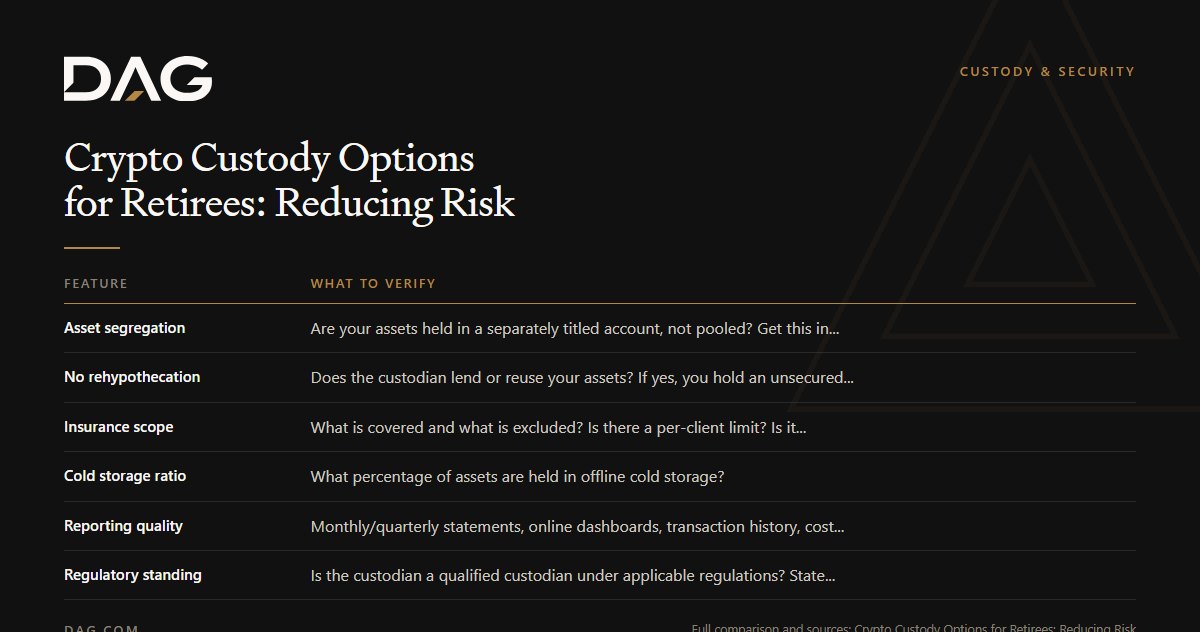
| Feature | What to Verify |
|---|---|
| Asset segregation | Are your assets held in a separately titled account, not pooled? Get this in writing. |
| No rehypothecation | Does the custodian lend or reuse your assets? If yes, you hold an unsecured claim, not custody. Several centralized crypto lenders that failed in 2022 rehypothecated client assets; both went bankrupt. |
| Insurance scope | What is covered and what is excluded? Is there a per-client limit? Is it current? |
| Cold storage ratio | What percentage of assets are held in offline cold storage? |
| Reporting quality | Monthly/quarterly statements, online dashboards, transaction history, cost basis for tax purposes? |
| Regulatory standing | Is the custodian a qualified custodian under applicable regulations? State trust company charter or federal banking charter? |
For a full due-diligence framework, see crypto custody due diligence checklist and questions to ask a crypto custodian.
How Do Trust and Retirement Account Structures Fit In?
Some retirees integrate crypto custody into estate planning vehicles:
Revocable trusts can hold crypto either directly (if the trustee is capable of managing the custody) or through an institutional custodian. This can simplify inheritance and avoid probate.
Self-directed IRAs can hold crypto, with the account's general tax treatment (tax-deferred or, for a Roth, generally tax-free qualified distributions) depending on account type. A qualified custodian that handles self-directed IRA crypto is required, and the account must avoid prohibited transactions and self-dealing under IRC §4975 (for example, you generally cannot personally hold the keys or transact with the IRA). These custodians are specialized and fewer in number. See crypto IRA vs crypto family office structure for a comparison of the structural options.
Irrevocable trusts may offer creditor-protection and estate-tax planning benefits but require giving up control of the assets; protection is never absolute and depends on how and when the trust is structured and funded.
These structures require professional coordination among estate attorneys, tax advisors, and custody providers. DAG coordinates the technical custody aspects, wallet selection, custodian relationships, access procedures, while legal and tax structure work belongs with qualified attorneys and CPAs. For related estate planning detail, see crypto estate planning for high-net-worth families.
Should Retirees Pursue Staking, Lending, or DeFi Yields?
For most retirees, yield-seeking strategies introduce risks that outweigh the income they generate:
Staking locks assets for weeks or months. You cannot liquidate during that period even if the market declines sharply.
Lending introduces counterparty risk. Several centralized crypto lenders that failed in 2022 offered lending yields and went bankrupt; customers who believed they held custody actually held unsecured bankruptcy claims.
DeFi protocols carry smart contract risk, code vulnerabilities, protocol exploits, and liquidity failures. These mechanisms are complex; if you cannot assess the technical risk, the exposure is difficult to manage.
The default posture for retirement assets should be conservative custody with lower operational risk, not yield maximization. Whether any specific yield strategy is appropriate for your situation depends on your overall portfolio, income needs, and risk tolerance, consult a qualified investment advisor before pursuing these strategies.
How Does Estate Planning Connect to Custody?
Custody and estate planning are not separate decisions. Without coordination, crypto can become permanently inaccessible after death.
Document access procedures. Executors and heirs need to know where assets are held, which custodian or wallet type is used, and exactly what steps to take to gain access. Recovery phrases, hardware wallet locations, and custodial account credentials should be documented and stored securely, often with your estate attorney or in a formal digital asset letter of instruction.
Beneficiary designations. For retirement accounts and certain trust structures, beneficiary designations must be current and clearly reflect your intent.
Step-up in basis. Under current law, property held outside retirement accounts, including crypto, generally receives a step-up in cost basis at death, which can reduce capital gains tax on appreciation occurring during the decedent's lifetime when heirs later sell. This can be material for long-term holders. This is a general principle as of 2026-06-02; IRS guidance on digital assets continues to evolve, so verify current treatment with a qualified tax professional before relying on it.
Coordinating advisors. Your estate attorney needs to know about crypto holdings. Your tax advisor needs cost basis documentation. Anyone involved in managing the custody arrangement needs to understand the structure.
See how do heirs access crypto after death and seed phrase storage for estate planning for practical implementation guidance.
Related Questions
Is crypto custody insurance the same as FDIC protection?
No. Crypto custody insurance is commercial coverage, typically crime/specie policies, that protects against specific events like employee theft, hacking, or physical security breaches. It is not government-backed, has policy limits and exclusions, and does not function like FDIC deposit insurance (which covers bank deposits up to $250,000 per depositor per insured institution) or SIPC coverage (which covers certain securities account losses). Read custodian insurance policies directly, not marketing summaries.
What is rehypothecation, and why does it matter for retirees?
Rehypothecation occurs when a custodian lends or reuses client assets for its own trading, lending, or other activities. Custodians may share some of the yield from this activity with clients, but the client's assets are no longer fully reserved, the client holds an unsecured claim rather than segregated property. If the custodian's lending activity fails, client assets can be caught in bankruptcy proceedings. Retirees seeking to reduce counterparty exposure should ask custodians directly whether they rehypothecate and request a contractual commitment to fully reserved custody.
How much crypto would justify institutional custody over self-custody?
There is no fixed threshold, but the cost-benefit calculation shifts as holdings grow. Institutional custody costs (typically 10–50 basis points annually, verify current pricing) may be material on smaller holdings, making self-custody more practical. As holdings become a larger share of retirement assets, or when estate complexity increases, professional custody infrastructure, segregation, insurance, reporting, audit trails, tends to offer trade-offs worth the cost. A $100,000 or greater position is a commonly cited starting point for professional custody evaluation, though individual circumstances vary. This is not a recommendation; consult a qualified advisor for your situation.
Sources
- SEC Marketing Rule (17 CFR § 275.206(4)-1): https://www.sec.gov/rules/final/2022/ia-5653.pdf
- IRS Virtual Currency Guidance (Rev. Rul. 2023-14, Notice 2014-21): https://www.irs.gov/businesses/small-businesses-self-employed/digital-assets
- IRS Publication 559 (Survivors, Executors, and Administrators, step-up in basis): https://www.irs.gov/publications/p559
- FTX bankruptcy proceedings (SDNY Case 22-11068): https://restructuring.ra.kroll.com/FTX/
- Mt. Gox civil rehabilitation proceedings: https://www.mtgox.com/
Compliance Note
This page is educational only and does not constitute investment, legal, or tax advice. Digital asset custody involves material risks including loss of access, platform insolvency, and market volatility. No custody arrangement eliminates risk. Insurance coverage described here is commercial crime/specie coverage, not FDIC or SIPC protection; coverage limits, exclusions, and availability vary by custodian and should be verified directly. Rehypothecation and asset segregation practices differ across providers; confirm contractually before relying on any representation.
Advisory services are provided by DAG Wealth, an SEC-registered investment adviser. Registration does not imply a certain level of skill or training. DAG coordinates technical custody arrangements, wallet selection, custodian relationships, and access procedures, and does not provide legal advice; entity formation, trust and estate drafting, and related structuring are legal services handled by qualified attorneys. Consult a qualified investment adviser, estate attorney, and tax professional before making custody decisions.