
Preserving crypto wealth for family legacy rests on three interlocking elements: institutional-grade crypto custody so heirs can actually access what you hold, a legal trust structure defining who controls the assets and on what terms, and a governance framework that keeps family conflict and volatility from eroding the portfolio. Without all three, even a substantial holding may not survive one generation.
What does it mean to preserve crypto wealth across generations?
Accumulation and preservation require opposite behaviors. Accumulation rewards concentration, high risk tolerance, and the willingness to hold through years-long drawdowns. Preservation requires enough diversification that a single adverse event, a hack, a regulatory action, a catastrophic collapse in one position, cannot wipe out what is meant to last decades.
The families who lose crypto wealth to volatility are usually the ones who held without any structure, so a bad year triggers a forced sale at the worst possible moment. Volatility is real and the tension between preservation goals and crypto's price swings is a design constraint that any family wealth plan has to account for explicitly, not paper over with optimism.
What actually threatens multi-generational crypto wealth?
Three categories of risk dominate in practice.
Volatility and forced liquidation. Unstructured holdings with no liquidity plan can force heirs to sell during a downturn to meet distribution needs. A governance structure with defined distribution rules and a liquidity reserve reduces this risk.
Access failure. Private keys on hardware wallets in desk drawers. Seed phrases in notebooks heirs do not know about. Exchange account passwords that die with the owner. A family can see a portfolio on a block explorer and still be unable to touch it, unlike a brokerage account, there is no customer service number and no legal process that compels anyone to release the funds. See common crypto estate planning mistakes for how often this plays out.
Governance breakdown. When wealth transfers without clear rules about management authority, distribution terms, or dispute resolution, heirs fill the vacuum with family dynamics under financial stress. Assets freeze during disputes. Portfolios get liquidated to fund litigation. The governance structure is what prevents disagreement from becoming destruction.
How do you shift a crypto portfolio from accumulation to preservation?
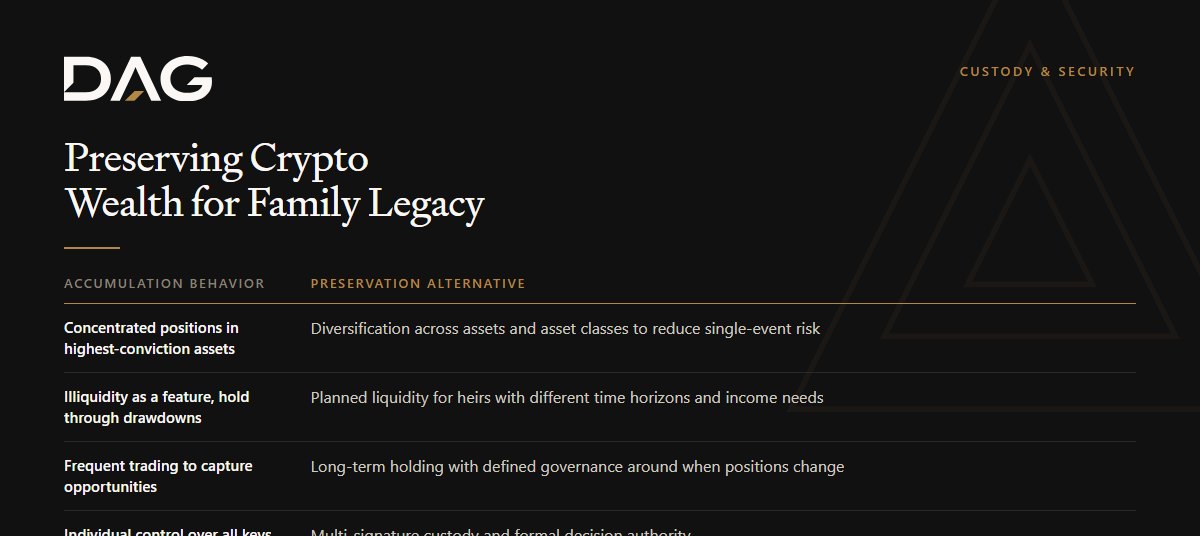
The behavioral shift is clear to describe and genuinely hard to make.
| Accumulation Behavior | Preservation Alternative |
|---|---|
| Concentrated positions in highest-conviction assets | Diversification across assets and asset classes to reduce single-event risk |
| Illiquidity as a feature, hold through drawdowns | Planned liquidity for heirs with different time horizons and income needs |
| Frequent trading to capture opportunities | Long-term holding with defined governance around when positions change |
| Individual control over all keys and decisions | Multi-signature custody and formal decision authority |
Frequent trading is one of the faster ways to destroy crypto wealth across generations. Active management at family-wealth scale requires expertise that does not automatically transfer to heirs, and each trade creates a taxable event. A structure that moves toward long-term holding with clear custody and governance is usually the right direction. Review crypto concentration risk management for portfolio-level framing.
What governance structure works for a multi-generational crypto portfolio?
A family governance structure does not need to be complicated. It needs to answer four questions clearly:
Who has investment authority? Define who can approve a sale, who can approve a new position, and what happens when there is disagreement. A family investment committee or a designated trustee with written authority works better than leaving decisions to whoever has the strongest personality.
What are the distribution rules? When can heirs access funds? How much? Are there conditions, age thresholds, educational goals, or a process for emergency distributions? These questions seem abstract until someone needs money and there is no agreed answer.
How does authority transfer? The person managing crypto today will not do it indefinitely. Succession planning applies to the management role itself, not just the assets. Technical succession matters: whoever takes over needs to be able to manage wallets and custody, not just hold a title. Private key succession planning covers this in detail.
How are disputes resolved? A defined dispute resolution process, formal vote, third-party mediator, or binding arbitration, prevents disagreements from freezing assets while they get resolved.
For a structured template, see crypto governance for family offices.
How do trusts fit into a crypto preservation strategy?
A trust is the most common legal vehicle for multi-generational wealth preservation, and it handles crypto better than most alternatives because it lets you define exactly how assets are managed and distributed, across multiple generations, without those decisions being subject to renegotiation as family dynamics change.
For crypto specifically, the trust document needs to address custody explicitly: who holds the keys, what happens when a key needs to be replaced, how new wallets are set up, and what process governs transaction approvals. A trust that says "the trustee manages the digital assets" without addressing these technical realities is missing the most important part.
A revocable trust gives flexibility to modify terms while you are alive. An irrevocable trust may provide stronger creditor protection but cannot be easily changed. Which structure is appropriate depends on the family's priorities and jurisdiction, this is a legal decision that requires qualified counsel. DAG coordinates the estate and trust drafting process, but the drafting itself is a legal service performed by attorneys. See crypto trust structures compared and revocable vs irrevocable trusts for crypto assets.
Trusts also avoid probate, which matters for crypto because probate is public. A public record of exactly what digital assets an estate holds creates security risks. Keeping the transfer private through a trust structure is worth the setup cost.
What custody setup is appropriate for family legacy holdings?
Multi-signature wallet arrangements are the appropriate foundation for family wealth holdings. Requiring multiple keyholders to approve transactions means no single person can unilaterally drain the portfolio, whether that is an heir acting without authority, a bad actor who gained access to one set of keys, or a mistake. A 2-of-3 or 3-of-5 multisig arrangement where key custody is distributed between the trustee, a backup keyholder, and a professional custodian provides meaningful protection at the cost of modest setup complexity. See MPC vs multi-sig custody for technical tradeoffs.
Cold storage is more appropriate than exchange accounts for long-term holdings. Hardware wallets are more appropriate than software wallets for assets not being actively traded. Institutional custodians exist specifically for the scale where professional security is required rather than home storage. See crypto custody for trusts for custodian selection criteria.
Succession documentation needs to be secure and findable, a genuine tension. If it is stored somewhere too secure, heirs will not find it. If stored somewhere too accessible, it is a security risk. A documented process held with an attorney or professional trustee, with a secondary copy in a sealed envelope in a safety deposit box, and a clear notification system is the standard approach. Never share seed phrases insecurely, in email, or with anyone who does not need access for a defined purpose.
The trustee and any successor keyholders need practical crypto training before they become responsible for a significant portfolio, not just theoretical familiarity.
Related Questions
Can crypto held in a trust be passed to grandchildren without probate?
Yes. Assets held in a properly structured trust transfer to beneficiaries according to trust terms without going through probate, which means the transfer is private, potentially faster, and not subject to the public record of estate proceedings. The trust document needs to explicitly address digital asset custody and key management to make this work in practice.
What happens to a crypto portfolio if the keyholder dies without leaving instructions?
Heirs may be able to see the portfolio on a block explorer but have no way to access the funds. Unlike a brokerage account, there is no institution holding the assets that can be compelled to release them through a legal process. The crypto may be permanently inaccessible. This is why pre-death planning, documented custody arrangements, successor keyholder designation, and a digital asset letter of instruction, is essential. See what happens to crypto when you die.
How often should a family's crypto preservation plan be reviewed?
At minimum annually, and after any significant change: a substantial price move that changes portfolio composition, a regulatory development affecting the assets held, a change in family structure (birth, death, divorce), or a change in the tax environment. The governance document should specify who triggers and conducts the review.
Does diversification within crypto reduce multi-generational risk?
Partially. Bitcoin held through multiple market cycles has shown resilience; an equivalent allocation to a single altcoin carries a different risk profile. A family wealth strategy can hold multiple crypto assets without treating every position equally. However, diversification within crypto does not eliminate the category-level risks, regulatory, technical, or market, that affect crypto assets broadly. Combining crypto with other asset classes (equities, real estate, fixed income depending on the family's situation) provides more structural protection.
Sources
- IRS Notice 2014-21 and Revenue Ruling 2023-14 (federal tax treatment of digital assets): https://www.irs.gov/businesses/small-businesses-self-employed/digital-assets
- SEC guidance on digital assets: https://www.sec.gov/digital-assets
- Uniform Fiduciary Income and Principal Act (UFIPA), provisions relevant to digital asset administration, adopted in multiple states (verify current adoption in your jurisdiction)
- Uniform Trust Code (UTC), framework for trustee duties and digital asset management provisions in adopting states
Compliance Note
This page is for educational purposes only and does not constitute legal, tax, or investment advice. Crypto assets are volatile and carry significant risk of loss; past resilience of any asset does not guarantee future performance. Trust and estate structures vary by jurisdiction and individual circumstances; consult a qualified estate attorney before implementing any structure. DAG coordinates estate and trust planning but does not draft legal documents, that is a legal service performed by licensed attorneys. Advisory services are provided by DAG Wealth, an SEC-registered investment adviser. Registration does not imply a certain level of skill or training. Nothing on this page should be read as a guarantee of outcomes, a promise of preservation, or advice to hold or purchase any specific asset.