
Crypto custody for individuals is real: qualified custody is not limited to institutions. High-net-worth individuals, revocable and irrevocable trusts, and LLCs can open accounts with qualified custodians, though minimum thresholds and onboarding requirements vary by provider, see the crypto custody hub for the full landscape. The same safeguards used by hedge funds and asset managers can apply to private wealth structures.
What Is Qualified Custody for Digital Assets?
A qualified crypto custodian is a regulated entity, typically a state-chartered trust company, federally regulated bank, or licensed broker-dealer, that holds digital assets on behalf of clients under rules designed to segregate client assets, maintain insurance, and provide bankruptcy-remote protections. The term "qualified custodian" originates in SEC rules governing investment advisers, but the underlying concept applies broadly to any secure, regulated third-party holding arrangement.
What qualifies as a qualified custodian for crypto? Qualified custodians include federally chartered digital asset banks, regulated trust companies, and licensed broker-dealers. Each holds assets under state or federal oversight and maintains crime insurance policies, though coverage limits, terms, and what is and is not covered differ materially. Digital asset custody is not covered by FDIC insurance or SIPC protection; those programs apply to bank deposits and securities accounts respectively.
Who Can Access Institutional-Grade Crypto Custody?
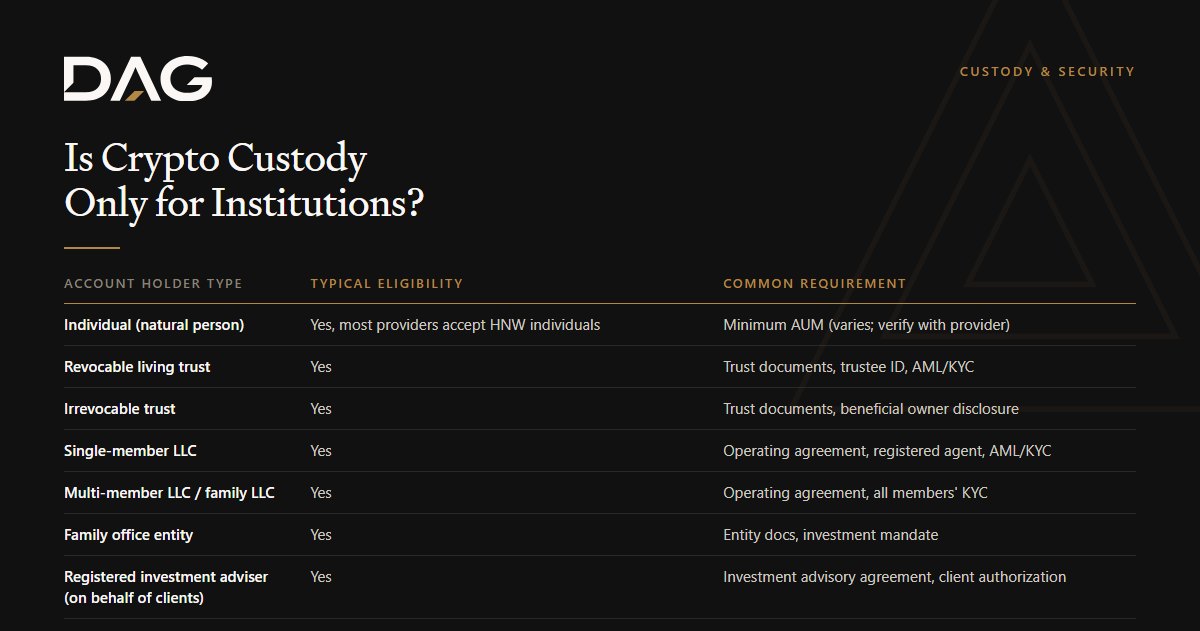
The following entity types can typically open qualified custody accounts, subject to each provider's eligibility requirements:
| Account holder type | Typical eligibility | Common requirement |
|---|---|---|
| Individual (natural person) | Yes, most providers accept HNW individuals | Minimum AUM (varies; verify with provider) |
| Revocable living trust | Yes | Trust documents, trustee ID, AML/KYC |
| Irrevocable trust | Yes | Trust documents, beneficial owner disclosure |
| Single-member LLC | Yes | Operating agreement, registered agent, AML/KYC |
| Multi-member LLC / family LLC | Yes | Operating agreement, all members' KYC |
| Family office entity | Yes | Entity docs, investment mandate |
| Registered investment adviser (on behalf of clients) | Yes | Investment advisory agreement, client authorization |
Opening an account on behalf of a trust or LLC, rather than personally, can provide structural benefits, including clearer succession, liability separation, and governance documentation. See crypto custody for trusts and crypto custody for LLCs for entity-specific considerations.
What Minimums Apply?
Minimums vary widely and change over time. As an illustrative example only (verify current figures with each provider), qualified custodians have historically fallen into ranges such as:
- No stated minimum for some retail-adjacent qualified custodians
- Roughly $100,000–$500,000 in assets under custody for some mid-tier providers
- $1M or more for providers focused on institutional and private wealth clients
These figures are illustrative and dated, not current quotes. Minimums, fee structures, and eligibility criteria change at each provider's discretion, so confirm current terms directly with each custodian before relying on them.
Fees are a separate consideration. Annual custody fees, transaction fees, and withdrawal fees exist at most qualified custodians. Depending on fee structure, paying fees in kind (with the custodied asset) rather than in cash may create taxable events; consult a qualified tax professional before selecting a fee payment method.
How Private Clients Access Institutional Custody
Private clients, individuals, trusts, and LLCs, typically access qualified custody through one of two paths:
Direct account opening. Open an account directly with a qualified custodian. This path requires completing the custodian's onboarding, KYC/AML verification, entity documentation (if applicable), and meeting any stated minimum.
Through a crypto wealth manager or RIA. A registered investment adviser or crypto wealth management firm may custody client assets at a qualified custodian as part of a managed relationship. The adviser handles onboarding coordination and ongoing reporting. This is common for clients who want active wealth management alongside secure custody.
The crypto account opening checklist for trusts and LLCs outlines the documentation typically required.
Qualified Custody vs. Self-Custody: Key Differences
| Feature | Qualified custody | Self-custody (hardware wallet) |
|---|---|---|
| Regulatory oversight | Yes (state or federal) | None |
| Crime insurance | Generally yes (verify limits) | None |
| Bankruptcy remoteness | Generally yes | N/A |
| Key management | Custodian (MPC or multi-sig) | Owner |
| Succession planning | Custodian facilitates | Requires separate estate plan |
| Minimum AUM | May apply | None |
| Annual fees | Yes | Hardware cost only |
Neither option eliminates all risk. Qualified custodians can fail, be hacked, or face regulatory action; self-custody creates key-loss and succession risks. For a fuller comparison, see qualified custody vs. self-custody for crypto wealth.
Related Questions
Can a trust hold crypto in a qualified custody account?
Yes. Trusts, both revocable and irrevocable, can open accounts with most qualified custodians. The trustee acts as the authorized party. Required documents typically include the trust agreement (or a certification of trust), trustee identification, and beneficial ownership information. Some custodians require that the trust be formed in a specific jurisdiction or meet additional governance requirements.
Do I need a large portfolio to access qualified crypto custody?
Not necessarily. Minimums vary significantly by provider. Some qualified custodians serve clients with portfolios in the low six figures; others focus exclusively on portfolios above $1M or $5M. The right custodian depends on portfolio size, entity type, asset mix, and desired services. Verify current minimums with each provider; the landscape continues to evolve as more custodians enter the market.
Is qualified crypto custody the same as a crypto exchange account?
No. A qualified custodian holds assets in segregated, bankruptcy-remote accounts under regulatory oversight. A crypto exchange holds assets in omnibus accounts and is not typically a qualified custodian under SEC rules, though some exchanges have affiliated trust companies that function as qualified custodians. See qualified custodian vs. crypto exchange for a detailed breakdown.
What entity structure should I use before opening a custody account?
The most common options for private wealth are personal accounts, trust accounts, and LLC accounts. Trusts provide estate planning and succession advantages; LLCs offer operational flexibility and liability separation. The right choice depends on your estate plan, tax situation, and governance preferences. See should crypto be held personally, in an LLC, or in a trust? and consult a qualified attorney and tax professional before structuring.
Sources
- OCC Interpretive Letter 1170 (2021). National banks may provide cryptocurrency custody services: https://www.occ.gov/topics/charters-and-licensing/interpretations-and-actions/2021/int1170.pdf
- SEC & FINRA Joint Staff Statement on Broker-Dealer Custody of Digital Asset Securities (2019): https://www.sec.gov/newsroom/speeches-statements/joint-staff-statement-broker-dealer-custody-digital-asset-securities
- SEC Rule 206(4)-2 (Custody Rule), governs qualified custodian requirements for registered investment advisers
Compliance Note
This article is for educational purposes only and does not constitute legal, tax, investment, or financial advice. Advisory services are provided by DAG Wealth, an SEC-registered investment adviser. Registration does not imply a certain level of skill or training. Qualified custody products, minimums, fees, insurance coverage, and regulatory requirements change over time, verify all details directly with custodians and qualified professionals before making any decisions. Digital asset custody accounts are not FDIC-insured or SIPC-protected. Custody does not guarantee against loss. Consult a qualified financial adviser, attorney, and tax professional before selecting a custody structure.