
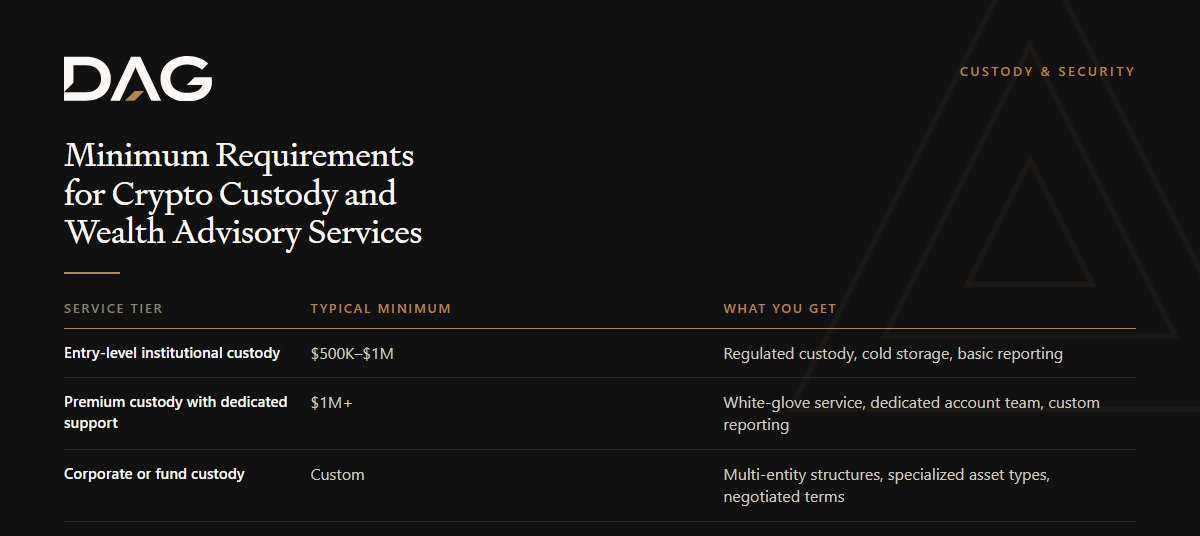
Minimum requirements for crypto custody typically start in the mid-to-high six figures, and professional wealth advisory carries similar thresholds. These minimums exist because the security infrastructure, insurance, compliance, and dedicated advisor time behind these services have largely fixed costs that do not scale economically below a certain asset level. Exact thresholds vary by provider.
What Institutional Custody Actually Is
Institutional crypto custody means a regulated, specialized firm holds your digital assets, managing private keys, maintaining security infrastructure, carrying insurance against certain losses, and providing compliance-grade documentation. You do not hold keys directly; a hardware wallet in your desk is not involved.
Two broad approaches exist:
Self-custody: You control private keys and bear all operational security risk. Lower direct costs, no third-party dependency, but full responsibility for key management and no insurance backstop.
Institutional custody: A professional firm manages keys and security. You get regulated infrastructure, insurance coverage, and reduced operational burden, at meaningful cost.
Most investors begin with self-custody. As portfolio value grows, the risk-adjusted case for institutional custody strengthens.
Why Minimums Exist
The fixed costs of operating at institutional standards include:
Security infrastructure. Multi-signature vaults, segregated cold storage systems, physical security, and cybersecurity operations are expensive to build and maintain regardless of any single client's asset size.
Insurance premiums. Custodians carrying specie or crime coverage pay premiums that scale with total assets under custody but include base costs spread across the client base.
Compliance and licensing. Regulatory licensing, audit requirements, reporting standards, and legal frameworks are ongoing operational investments.
Dedicated advisor time. A genuine advisory relationship, a named advisor who understands your portfolio in context, coordinates on tax, and responds when circumstances change, cannot be delivered economically below a minimum asset level.
Because these costs exist regardless of account size, providers set minimums below which the economics of the relationship don't work for either party.
What the Minimums Actually Look Like
Thresholds vary by provider, service tier, and portfolio complexity. The ranges below are illustrative of the broader market and are not DAG or provider-specific pricing:
| Service Tier | Typical Minimum | What You Get |
|---|---|---|
| Entry-level institutional custody | $500K–$1M | Regulated custody, cold storage, basic reporting |
| Premium custody with dedicated support | $1M+ | White-glove service, dedicated account team, custom reporting |
| Corporate or fund custody | Custom | Multi-entity structures, specialized asset types, negotiated terms |
| Crypto wealth advisory (full service) | High six figures to low seven figures | Dedicated advisor, investment strategy, tax coordination, custody |
Complexity also matters. A straightforward BTC and ETH position at $750K may qualify where a $750K portfolio spread across DeFi protocols, staking positions, illiquid tokens, and multiple chains may require a higher minimum because of operational and reporting complexity.
What Professional Custody Costs
Understand the full cost structure before committing. The figures below reflect general industry ranges, not DAG's fees, and any specific provider's schedule may differ materially:
Setup fees. Initial onboarding, KYC/AML verification, wallet infrastructure setup. Range: a few thousand to tens of thousands depending on entity complexity.
Annual custody fees. Typically a percentage of assets under custody. Across the market these commonly fall in a 0.5%–2% annual range, though they vary significantly by provider and asset size. As an illustration, a $500K portfolio charged 1% would pay $5,000 per year.
Transaction fees. Some providers charge for withdrawals, deposits, or asset movements.
Administrative fees. Reporting, statements, and account maintenance may carry separate charges.
Insurance costs. May be bundled into custody fees or charged separately; confirm what is and is not covered.
Do the math before committing. The question is whether the reduction in security risk and operational burden justifies the all-in annual cost at your portfolio size.
Who Actually Needs Institutional Custody
Institutional custody is designed for situations where the cost-benefit shifts materially:
High-net-worth individuals with six- or seven-figure crypto holdings. Security risk of self-custody becomes financially material at these levels.
Family offices managing multi-generational wealth. Governance, succession planning, and compliance requirements favor institutional infrastructure.
Companies with crypto on the balance sheet. Corporate governance standards typically require institutional-grade custody and controls.
Funds and investment entities. Regulatory and fiduciary requirements often mandate institutional custody with qualified custodian standards.
Anyone with estate planning complexity. Passing crypto to heirs through self-custody is operationally difficult; institutional custody simplifies the process.
For a portfolio of $50K, the cost-benefit typically does not support institutional custody. Self-custody remains the more practical choice.
What the Advisory Relationship Adds
Crossing the minimum threshold for wealth advisory changes more than access to custody. It changes the nature of the relationship:
Dedicated advisor contact. You have a named person who knows your situation, not a support queue. Someone who can look at your portfolio, understand context, and give a considered response when you face a decision.
Investment strategy tailored to your holdings. This means thinking through yield generation, concentrated position risk, how crypto holdings interact with traditional assets, and how decisions now affect your tax position at exit or year-end. DAG Wealth, DAG's affiliated registered investment adviser, handles investment advisory and portfolio strategy for digital asset clients.
Tax coordination. At higher portfolio values, particularly with staking, DeFi participation, and potential liquidity events, the coordination between investment decisions and tax outcomes becomes a meaningful part of the advisory work. DAG coordinates with qualified tax professionals as part of the broader service model.
Custody infrastructure. Segregated accounts mean assets are not pooled with other clients. They sit in custody arrangements structured for your holdings, with appropriate controls over access and authorization. DAG manages custody coordination through its platform, including multi-signature arrangements for clients requiring governance over transactions.
Self-Custody vs. Institutional Custody: The Trade-Offs
Self-custody advantages:
- You control private keys (direct ownership)
- Lower ongoing costs
- Immediate asset access
- No third-party counterparty risk
Self-custody disadvantages:
- All security responsibility falls on you
- Key management complexity scales with portfolio size
- No insurance if you make an error
- Succession planning is complicated
Institutional custody advantages:
- Professional security infrastructure
- Insurance coverage against certain defined losses
- Reduced operational burden
- Compliance-grade documentation for entities and funds
- Simplified succession and estate planning
Institutional custody disadvantages:
- Significant setup and ongoing costs
- Third-party counterparty risk (custodian failure)
- Less direct control
- Liquidity access may be slower
The shift makes sense when the value of reduced risk exceeds the cost of the service. There is no universal portfolio threshold, it depends on your risk tolerance, estate plan, entity structure, and how much operational complexity you are currently managing.
How to Evaluate Custody Providers
Before committing to any institutional custodian, conduct formal crypto custody due diligence:
Security practices. What percentage of assets are in cold storage? What is the multi-signature architecture? Have they experienced a breach? How was it handled?
Insurance coverage. What is covered, what is excluded, who is the underwriter, and what are the claim procedures? Require specifics, not marketing language. See the overview of crypto insurance and custody standards.
Regulatory status. Are they licensed, in which jurisdictions, and by which regulators? What is their compliance track record?
Fee transparency. Get the complete fee schedule in writing, all-in costs with no ambiguity.
Operational track record. How long have they operated? What is their uptime record? How are withdrawals processed?
Client support model. Do you get a dedicated contact or a general support queue? What are response time commitments?
Questions to ask a crypto custodian should cover all of these areas before you sign.
What Happens When You Make the Switch
The transition from self-custody to institutional custody is not immediate:
- Start the evaluation early. Compliance checks, account setup, and entity verification take weeks, not days.
- Gather documentation. Source of funds, identity verification, entity formation documents if applicable, and beneficiary designations.
- Plan the asset transfer. Moving large amounts of crypto requires careful coordination to avoid errors. Develop a transfer protocol in advance.
- Understand fee timing. Custody fees typically begin once assets are transferred, regardless of trading activity.
- Confirm insurance coverage. Verify exactly what events are covered before your assets leave self-custody.
For more detail on the transition workflow, see how to move from self-custody to qualified custody.
Related Questions
What is the typical minimum for institutional crypto custody?
Entry-level institutional custody generally starts between $500K and $1M in digital assets. Premium tiers with dedicated account teams typically require $1M or more. Corporate and fund minimums vary based on complexity and are usually negotiated. Some providers differentiate thresholds based on portfolio complexity, not just total value.
Does portfolio complexity affect the minimum?
Yes. A straightforward BTC/ETH holding at a given value may qualify where the same dollar amount spread across DeFi positions, multiple chains, staking arrangements, and illiquid tokens may require a higher minimum due to operational and reporting overhead.
What is included in professional crypto wealth advisory that self-custody does not provide?
Professional advisory adds a dedicated advisor, investment strategy tailored to your specific holdings and tax situation, coordination with qualified tax professionals, segregated institutional custody, and documentation systems for compliance, estate planning, and governance. Self-custody provides none of these by default.
When does the cost-benefit of institutional custody make sense?
The shift generally makes sense when: (1) portfolio value is large enough that a security failure would be financially catastrophic; (2) key management complexity is creating real operational risk; (3) your estate plan or entity structure requires institutional-grade documentation; or (4) regulatory or fiduciary requirements mandate it. A rough signal: if annual custody fees represent a small fraction of what a single security failure would cost, professional custody is likely worth it.
What does DAG Wealth coordinate for custody clients?
DAG coordinates the operational setup: entity structure selection, custody provider evaluation, account opening, and ongoing relationship management. Investment advisory and portfolio strategy decisions for advisory clients are handled by DAG Wealth, the affiliated SEC-registered investment adviser. The two teams work together on client engagements.
Sources
- SEC, Custody Rule under the Investment Advisers Act of 1940 (Rule 206(4)-2), 17 CFR 275.206(4)-2: https://www.ecfr.gov/current/title-17/chapter-II/part-275/section-275.206(4)-2-2)
- SEC, Investment Adviser Regulation and the Custody Rule (Division of Examinations resources): https://www.sec.gov/investment
- FinCEN, Bank Secrecy Act statutes and regulations: https://www.fincen.gov/resources/statutes-and-regulations/bank-secrecy-act
Compliance Note
This page is for educational purposes only and does not constitute investment, legal, tax, or custody advice. Custody minimums, fee structures, and service terms vary by provider and are subject to change. Investment advisory services for digital asset clients are provided by DAG Wealth, an SEC-registered investment adviser. Custody arrangements involve material risks, including counterparty risk, insurance coverage limitations, and operational risk. Consult a qualified financial, legal, and tax professional before making custody or advisory decisions. Registration does not imply a certain level of skill or training.