
Asset protection trusts for crypto, properly structured irrevocable trusts, including Domestic Asset Protection Trusts (DAPTs) in favorable jurisdictions, may create legal separation between your crypto holdings and future creditor claims. Revocable trusts provide no creditor protection whatsoever. Protection is never absolute: fraudulent-transfer law, seasoning periods, and court discretion all apply.
What Is an Asset Protection Trust for Crypto?
An asset protection trust is a legal structure that transfers ownership of assets from you to the trust. Once assets are inside, a trustee, not you, controls them. Beneficiaries (which may include you, your family, or others) receive distributions only under conditions set in the trust document.
The protective logic is separation. A legal claim against you personally targets you. If the assets belong to the trust, the trust is a distinct legal entity, not the same target. Spendthrift provisions in the trust document prohibit the trustee from honoring forced distributions to satisfy creditor claims, and courts in favorable jurisdictions will respect those provisions.
Two categories matter most for creditor protection:
- Irrevocable trusts: Once assets transfer in, you generally cannot reclaim them unilaterally. That loss of control is the mechanism, a court cannot order you to hand over assets you do not control.
- Domestic Asset Protection Trusts (DAPTs): Available in roughly 20 states (Nevada, South Dakota, Delaware, Alaska among them), DAPTs allow the settlor to also be a discretionary beneficiary while still obtaining creditor protection. Protection strength varies significantly by state statute.
Revocable trusts provide zero creditor protection. Because you retain the right to revoke and reclaim assets, courts treat those assets as still yours.
Does Trust Type Determine Creditor Protection?
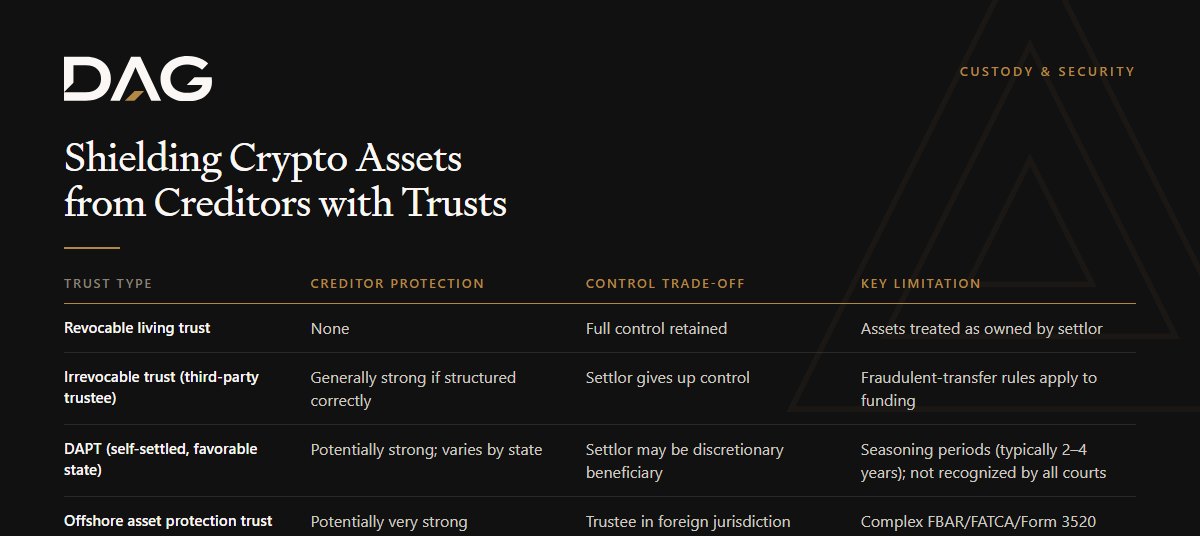
| Trust Type | Creditor Protection | Control Trade-Off | Key Limitation |
|---|---|---|---|
| Revocable living trust | None | Full control retained | Assets treated as owned by settlor |
| Irrevocable trust (third-party trustee) | Generally strong if structured correctly | Settlor gives up control | Fraudulent-transfer rules apply to funding |
| DAPT (self-settled, favorable state) | Potentially strong; varies by state | Settlor may be discretionary beneficiary | Seasoning periods (typically 2–4 years); not recognized by all courts |
| Offshore asset protection trust | Potentially very strong | Trustee in foreign jurisdiction | Complex FBAR/FATCA/Form 3520 reporting; higher cost and compliance burden |
Verify current state statutes; trust law changes. This table is illustrative only and not legal advice.
Why Crypto Specifically Creates Higher Exposure
Traditional asset classes have built-in shields: 401(k) accounts carry federal ERISA creditor protection, homestead exemptions cover primary residences in many states, and insurance covers specific liability categories.
Crypto has none of those protections by default. Holdings in a self-custody wallet are directly accessible to anyone who obtains the private keys, including under court order. Crypto investors have become targets in civil litigation partly because visible on-chain wealth signals liquidity, and partly because the regulatory gray areas in this space generate disputes.
The custody dimension adds urgency: private keys are final. A judgment requiring you to hand over keys or seed phrases has the same effect as handing over cash. There is no bank to act as a buffer. This is why crypto custody for trusts involves specific protocols for key management that differ fundamentally from traditional asset custody.
Estate planning compounds the risk. Without a trust and documented access instructions, heirs may not know crypto exists, or may know it exists but have no access. A properly structured trust with clear private key succession planning solves both the creditor-exposure problem and the inheritance-access problem simultaneously.
How to Structure a Crypto Asset Protection Trust
Step 1: Determine the trust type and jurisdiction
Choose based on your objectives. A DAPT in Nevada, South Dakota, or Delaware allows you to remain a discretionary beneficiary. An irrevocable trust with a fully independent trustee typically offers cleaner protection. Offshore trusts offer potentially stronger barriers but add significant compliance burden.
Step 2: Engage qualified legal counsel before transferring assets
This is drafting legal documents that create legally binding ownership transfers. That is legal work. DAG coordinates access to attorneys who specialize in asset protection structures for crypto holders, it is not legal advice from DAG itself.
Step 3: Fund the trust while clean, not under threat
Timing is the single most consequential factor. Transfers made to hinder a creditor with an existing or imminent claim will be unwound under the Uniform Fraudulent Transfer Act (UFTA) or Uniform Voidable Transactions Act (UVTA), whichever your state applies. Most DAPT statutes impose a seasoning period, typically two to four years, before protection attaches against creditors whose claims arose before the transfer. Fund the trust when there is no pending litigation, no known imminent claims, and no reason to anticipate a specific creditor.
Step 4: Establish proper crypto custody for the trust
The trust must actually hold the assets. For crypto that means:
- Designating how private keys are held (institutional custodian, multi-sig, cold storage under trustee control)
- Ensuring the trustee has the technical knowledge to manage digital assets
- Documenting custody protocols in writing
A trustee who does not understand crypto custody, key management, fork handling, staking decisions, tax reporting for digital assets held in a fiduciary account, creates operational risk. See crypto trust administration for the ongoing obligations that apply.
Step 5: Maintain compliance and separation
The trust must be maintained as a genuinely separate legal entity. Commingling assets, treating trust assets as your own, or retaining informal control you did not disclose will invite courts to pierce the structure. Trusts have their own tax-filing obligations; crypto transactions inside a trust still generate taxable events. See crypto tax reporting for trusts for the filing requirements.
What These Trusts Cannot Do
- Cannot protect assets from existing claims. Any transfer made after a lawsuit is filed, or after you had reason to expect a claim, is vulnerable to fraudulent-transfer unwinding.
- Cannot guarantee protection. Jurisdictional recognition, court discretion, and the specific facts of a transfer all affect whether the protection holds.
- Cannot eliminate reporting obligations. The IRS requires trust tax returns. Foreign trusts trigger additional obligations: FBAR if the trust holds foreign financial accounts, Form 3520/3520-A for foreign trusts, and FATCA reporting. Ignoring these creates a separate legal problem that can be worse than the original exposure.
- Cannot substitute for legal structuring. An informal arrangement, "my friend holds my keys", is not a trust and carries none of the legal protections.
Related Questions
Does a revocable trust protect crypto from creditors?
No. A revocable trust provides no creditor protection for crypto or any other asset. Because you retain the right to revoke the trust and reclaim assets, courts treat those assets as beneficially yours and available to satisfy judgments. Only properly structured irrevocable trusts, and DAPTs in favorable states, create the ownership separation that matters for creditor protection.
Can a DAPT in Nevada or South Dakota protect crypto that is custodied in another state?
Generally yes, though the answer depends on the specific facts, the law of the jurisdiction where litigation occurs, and whether that court respects the DAPT state's statutes. Not all states recognize DAPTs established in sister states. Choice-of-law provisions in the trust document matter, but they are not always dispositive. A qualified attorney should analyze the specific multi-state or multi-jurisdictional exposure before you fund the trust.
How does multi-signature custody interact with trust creditor protection?
Multi-sig arrangements where the trust holds the threshold key share and a third party (co-trustee or key agent) holds another can reinforce the separation argument, no single party controls the assets, which mirrors the structural point of an irrevocable trust. However, if you retain effective unilateral control over the signing threshold, courts may disregard the technical structure. The legal structure and the custody structure need to match. See MPC vs multi-sig custody for how these arrangements differ operationally.
What is the difference between an asset protection trust and simply holding crypto in an LLC?
An LLC provides charging-order protection in many states, a creditor who wins a judgment against you can only get a charging order on LLC distributions, not seize LLC assets directly. That is meaningful but narrower than irrevocable trust protection in favorable jurisdictions, and it does not solve the estate-planning access problem. The two structures are not mutually exclusive; a trust owning an LLC is a common layered approach. See crypto LLC vs trust for a direct comparison.
Internal Links
This page links up to the cluster hub: crypto trust structures hub.
Relevant siblings:
- Revocable vs irrevocable trusts for crypto assets
- Trust structures for crypto wealthy individuals
- Should crypto be held personally, in an LLC, or in a trust?
- How to fund a trust with crypto
Sources
- Uniform Voidable Transactions Act (UVTA), Uniform Law Commission, 2014, https://www.uniformlaws.org/committees/community-home?communitykey=1ade0dd1-bcd5-4ba9-9b4b-2cd49aa01577
- Nevada Spendthrift Trust Act, NRS 166, https://www.leg.state.nv.us/nrs/NRS-166.html
- South Dakota Codified Laws, SDCL ch. 55-16 (South Dakota Asset Protection Trust), https://sdlegislature.gov/Statutes/55-16
- Delaware Qualified Dispositions in Trust Act, 12 Del. C. § 3570 et seq., https://delcode.delaware.gov/title12/c035/
- IRS, Abusive Trust Tax Evasion Schemes. Facts (distinguishes legal trust use from abusive schemes), https://www.irs.gov/businesses/small-businesses-self-employed/abusive-trust-tax-evasion-schemes-facts
- IRS Form 3520, Annual Return to Report Transactions with Foreign Trusts, https://www.irs.gov/forms-pubs/about-form-3520
- FinCEN, FBAR Filing Requirements, https://www.fincen.gov/report-foreign-bank-and-financial-accounts
Compliance Note
This page is educational only and does not constitute legal, tax, or investment advice. Asset protection planning involves complex legal structures that vary significantly by jurisdiction, individual circumstances, and the timing of asset transfers. Nothing here should be relied upon as a guarantee or prediction of legal outcomes. Creditor protection through trusts is not absolute and depends on proper drafting, correct jurisdiction selection, timely funding, and ongoing compliance.
Trust drafting and formation is a legal service. DAG coordinates access to qualified legal professionals who specialize in digital asset trust structures; DAG does not itself provide legal advice or draft trust documents.
Consult a qualified estate attorney and tax professional before establishing any trust structure for creditor protection purposes.