
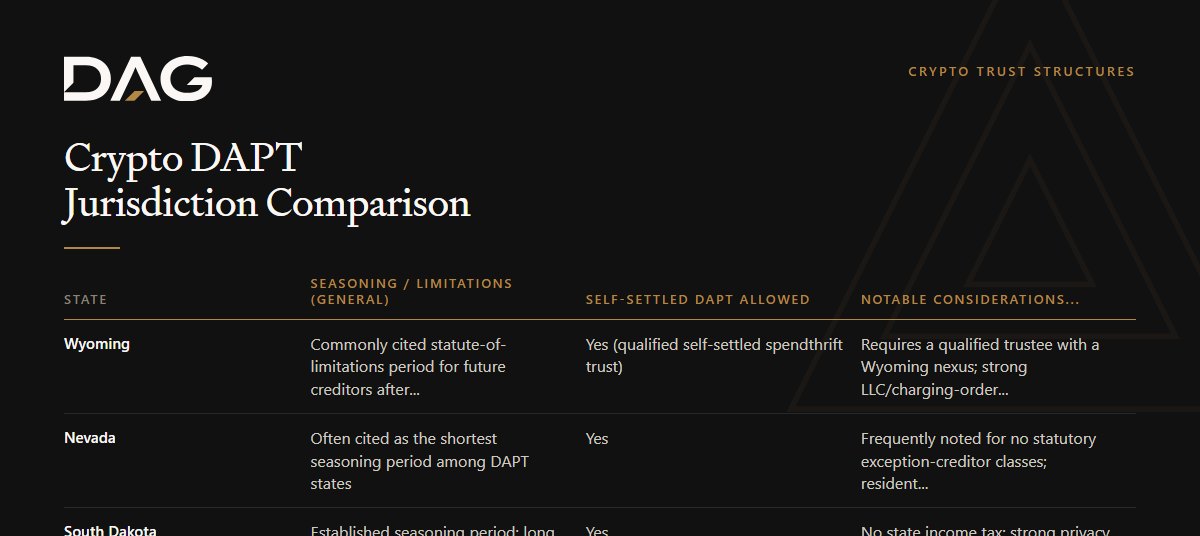
A domestic asset protection trust (DAPT) lets a crypto holder be a discretionary beneficiary of an irrevocable trust they funded while still shielding the assets from many future creditors, subject to state-specific rules. Among the leading DAPT states, Nevada is generally cited for the shortest seasoning period, while Wyoming, South Dakota, and Alaska differ on exception creditors, statutes of limitation, and case-law certainty. Protection is never absolute and depends heavily on facts and timing.
What a DAPT Is and Why Crypto Holders Use One
A DAPT is a self-settled irrevocable trust: the person who creates and funds it can also be a permitted (discretionary) beneficiary, yet the assets can still be placed beyond the reach of many future creditors. Ordinary irrevocable trusts in most states do not allow this, being both settlor and beneficiary usually leaves assets exposed. DAPT states changed that by statute. For crypto holders facing concentrated, high-value, and litigation-attractive wealth, a DAPT is one tool for putting digital assets behind a statutory barrier while retaining a beneficial interest.
Two concepts drive the comparison. The seasoning period (or statute of limitations) is how long the assets must sit in the trust before a future creditor's claim is generally cut off. Exception creditors are claimants (such as certain child-support, alimony, or pre-existing claims) that some states still let reach trust assets despite the DAPT. The crypto-specific wrinkle is funding proof: because on-chain transfers are pseudonymous, documenting when and what was contributed, to start the seasoning clock and rebut fraudulent-transfer claims, is critical. For how funding is documented, see how to fund a trust with crypto.
DAPT Jurisdiction Comparison Table
Treat the entries below as a general orientation, not legal advice; statutes change and the details are fact-specific. Verify current law in each state with qualified counsel.
| State | Seasoning / limitations (general) | Self-settled DAPT allowed | Notable considerations (illustrative, verify current) |
|---|---|---|---|
| Wyoming | Commonly cited statute-of-limitations period for future creditors after transfer | Yes (qualified self-settled spendthrift trust) | Requires a qualified trustee with a Wyoming nexus; strong LLC/charging-order law often paired with the trust |
| Nevada | Often cited as the shortest seasoning period among DAPT states | Yes | Frequently noted for no statutory exception-creditor classes; resident trustee/administration required |
| South Dakota | Established seasoning period; long track record | Yes | No state income tax; strong privacy and perpetuities law; mature trust-company industry |
| Alaska | One of the first DAPT statutes (enacted in the 1990s) | Yes | Longstanding statute; resident-trustee and Alaska-situs requirements apply |
The leading distinctions are the length of the seasoning period, whether the state recognizes exception creditors, residency/situs requirements for the trustee, and the maturity of supporting case law. Nevada is often selected for its short seasoning and limited exception creditors; South Dakota and Alaska are chosen for established statutes and tax/privacy features; Wyoming is frequently paired with its LLC law. For a narrower Wyoming-vs-South Dakota view tailored to crypto trusts, see best states for crypto trusts: Wyoming vs South Dakota.
Case Law and Why Protection Is Not Absolute
DAPT protection rests on statutes that are younger and less tested than offshore equivalents, and several limits recur:
- Fraudulent transfer. Funding a DAPT after a claim arises, or to defeat a known creditor, can be unwound as a fraudulent (voidable) transfer regardless of state. The seasoning clock protects future, not existing, creditors.
- Full faith and credit / non-resident settlors. Courts in other states are not bound to honor a DAPT state's law, and outcomes for non-resident settlors are less certain. Federal bankruptcy law also includes a long look-back (commonly cited as ten years) for self-settled trusts.
- Exception creditors. Even within a DAPT state, certain claims (child support, alimony, some tort or pre-existing claims) may pierce the trust depending on the statute.
- Crypto-specific exposure. If the settlor retains practical control of the private keys, a court may treat the protection as illusory. Custody and signing authority must match the legal structure, see private key succession planning and consider holding keys through a trust-owned LLC for crypto assets.
A DAPT reduces and complicates creditor exposure; it does not make assets untouchable. The structure must be funded well before any claim, properly seasoned, and operated so the settlor does not retain disqualifying control. For how a DAPT fits the broader menu of structures, see trust structures for crypto wealthy individuals and the crypto trust structures hub.
Related Questions
Which state has the best crypto DAPT?
There is no single best state; the right choice depends on the seasoning period, exception-creditor rules, tax and privacy goals, trustee residency requirements, and where the settlor lives. Nevada is often cited for short seasoning and limited exception creditors, while South Dakota and Alaska have long-established statutes. Decide with qualified counsel based on your facts.
How long does crypto need to be in a DAPT to be protected?
Each DAPT state sets a seasoning period (statute of limitations) that must pass before many future creditors are barred, and the periods differ by state. The clock generally starts at a properly documented transfer, which is why dated proof of the crypto contribution matters. Confirm the current period for your chosen state with counsel.
Can a creditor still reach crypto in a DAPT?
Yes, in several situations: a transfer made to defeat an existing or known creditor can be voided, exception creditors may reach assets in some states, other states' or federal courts may decline to honor the DAPT, and retained key control can undermine the structure. A DAPT lowers exposure but is not absolute protection.
Sources
- State domestic asset protection trust statutes. Wyoming, Nevada, South Dakota, Alaska
- Uniform Voidable Transactions Act (formerly Uniform Fraudulent Transfer Act)
- 11 U.S.C. § 548(e) (bankruptcy look-back for self-settled trusts)
Compliance Note
This article is for general educational purposes and is not legal, tax, fiduciary, or estate advice. Establishing a domestic asset protection trust and choosing situs are professional services that Digital Ascension Group coordinates with qualified attorneys; the firm does not provide legal advice. Advisory services are provided through DAG Wealth. Seasoning periods, exception-creditor rules, and other figures are illustrative, dated, and vary by state; verify current law with counsel. Asset protection is not absolute, can fail against existing or fraudulently-evaded creditors, and no outcome is guaranteed. Registration does not imply a certain level of skill or training.