
Yes, a trust can hold Bitcoin, Ethereum, or other digital assets, but trust ownership must be implemented, not assumed. The trust document needs explicit authority to administer digital assets, the assets must be properly titled or assigned, and the trustee needs a documented, secure way to access them. Generic trust language cannot be assumed to cover cryptocurrency.
What "Holding" Crypto in a Trust Actually Means
A trust is a legal arrangement in which a trustee holds title to property for beneficiaries under the terms of a trust document. With digital assets, "holding" splits into two parts that must align: legal ownership (the trust is named as the account holder or assignee) and practical control (someone connected to the trust can actually move the assets, through a custodian or by controlling private keys).
Crypto exposes a gap most traditional assets do not. Control follows the keys, not a recorded title. The trust document may be valid and the assets may be substantial, but if a successor trustee cannot locate wallets, accounts, or access credentials, the assets are unreachable. For context on how trust structures fit into broader crypto wealth planning, see the Crypto Trust Structures Hub.
Why This Must Be Implemented Explicitly
Many estate plans were drafted before digital assets became meaningful wealth. Generic trust language from prior years may include broad "all property" provisions, but it does not mean:
- The trustee knows where wallets or custody accounts are located
- Custody accounts are titled to the trust
- Private key access is documented for succession
- Tax records reflect trust ownership
This implementation gap applies whether the trust is revocable or irrevocable: the document only governs assets that were actually titled into it. A trust cannot manage assets it does not legally hold, and assets it legally holds cannot be administered if no one has access.
Four Ways a Trust Can Hold Digital Assets
The right structure depends on the type of trust, custodian requirements, tax treatment, state law, asset type, and family goals.
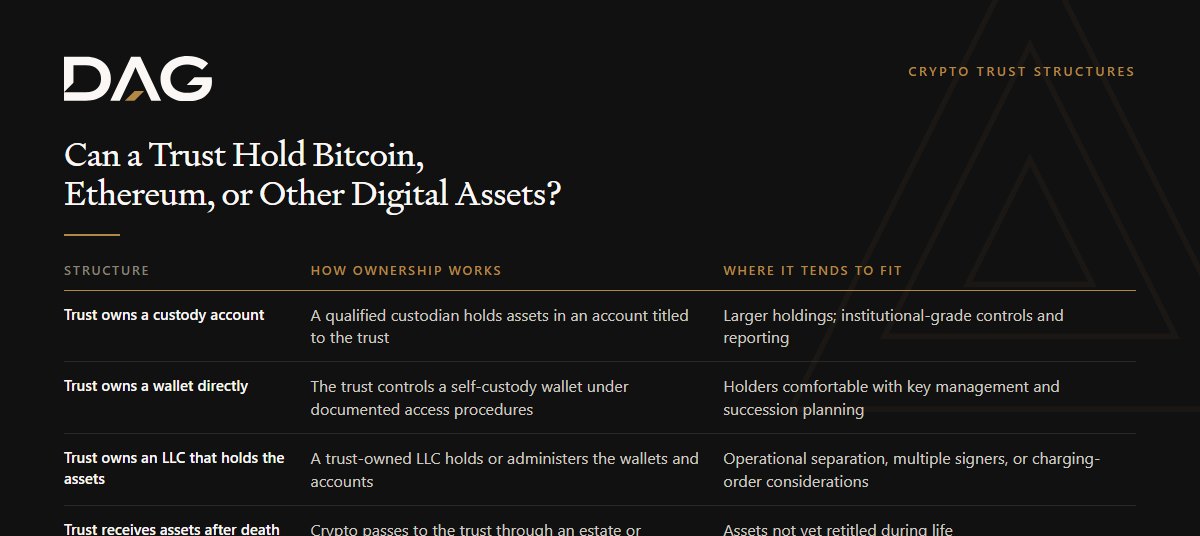
| Structure | How ownership works | Where it tends to fit |
|---|---|---|
| Trust owns a custody account | A qualified custodian holds assets in an account titled to the trust | Larger holdings; institutional-grade controls and reporting |
| Trust owns a wallet directly | The trust controls a self-custody wallet under documented access procedures | Holders comfortable with key management and succession planning |
| Trust owns an LLC that holds the assets | A trust-owned LLC holds or administers the wallets and accounts | Operational separation, multiple signers, or charging-order considerations |
| Trust receives assets after death | Crypto passes to the trust through an estate or assignment process | Assets not yet retitled during life |
Self-custody and entity options carry succession risk: if no one can locate or reconstruct the keys, the assets are permanently unreachable. The question of whether a trust should own crypto directly or through an LLC is a structuring decision worth resolving before funding.
How to Put Cryptocurrency Into a Living Trust
A living (revocable) trust can hold crypto in two primary ways:
Direct wallet assignment. The trust document is amended to include cryptocurrency holdings. Specific wallets (identified by public addresses) are documented as trust property. The private keys do not change hands, the holder continues controlling them but now does so as trustee rather than individually. When the grantor dies, the successor trustee gains legal authority to control those wallets per the trust terms.
LLC transfer. An LLC that owns the cryptocurrency has its membership interest transferred into the living trust. The trust owns the LLC, the LLC owns the crypto, and the grantor continues managing everything as trustee. Succession becomes a handoff of a membership interest with defined operating procedures, rather than a list of wallet addresses and seed phrases.
Either approach keeps custody secure while giving the successor trustee a legal path to act, without requiring that private key information sit in an envelope somewhere accessible before death. The trust structure replaces informal "key-sharing" arrangements with documented legal authority.
What the Trust Document Must Cover
Generic trust language drafted before 2015 generally does not address digital assets adequately. An updated or newly drafted trust should:
- Grant the trustee explicit authority to own, hold, buy, sell, and transfer digital assets
- Address how private keys, hardware wallets, and custody account credentials are managed and succeeded
- Name who may act on custodian accounts and under what conditions
- Include contribution documentation requirements (dates, values, wallet addresses or account identifiers)
- Specify reporting obligations so heirs have clean tax records
See what trust provisions should cover digital assets for the standard drafting points.
When Trust Ownership May Help
- Probate avoidance and privacy are goals
- A successor trustee needs a documented legal path to act without court involvement
- Crypto holdings are substantial enough to require professional administration
- The family wants digital and traditional assets integrated in a single estate plan
- The trust owns an LLC or entity connected to the digital asset accounts
When Trust Ownership May Not Be Enough
A trust document does not substitute for access. If no one has the private keys or custody account authority, a trust cannot reach the assets.
A trust also does not automatically:
- Change the tax treatment of holdings or distributions (the IRS treats digital assets as property; sales and some distributions can be taxable events)
- Eliminate market, custody, or protocol risk
- Protect assets from every potential claim
Funding and administration are what make the structure real. Naming the right trustee and confirming that the trustee has legal authority and practical ability to manage a crypto wallet matters as much as the document itself. Tax reporting for digital assets held in trust also requires separate attention, see crypto tax reporting for trusts.
Related Questions
Can I put cryptocurrency into a living trust?
Yes. A living (revocable) trust can hold Bitcoin, Ethereum, or other digital assets either through direct wallet assignment or by transferring an LLC that holds the crypto into the trust. The trust document must explicitly grant authority to manage digital assets, and access procedures must be documented so a successor trustee can act.
Does moving crypto into a trust trigger a taxable event?
Transferring assets into a revocable living trust generally does not trigger a taxable event because the grantor remains the tax owner. Transfers to an irrevocable trust may be treated differently, consult a qualified tax professional before funding an irrevocable structure. The IRS treats digital assets as property, so the classification of a transfer matters.
Can a trustee manage crypto held in a trust?
A trustee may be authorized to manage crypto if the trust document, applicable state law, and custody arrangements all permit it. The trustee also needs the competence or access to qualified professional support to act prudently, since fiduciary duties apply to volatile, hard-to-recover assets.
Should a trust hold crypto directly or through an LLC?
Both are workable structures. A trust-owned LLC can make operations and succession cleaner and may add a layer of liability separation, but it requires more administration and careful drafting. The better fit depends on the specific facts. A qualified professional should evaluate both options before the structure is funded.
Can a trust hold staking assets?
Possibly, but staking raises additional questions around fiduciary authority, tax reporting, custody support, and protocol risk. Whether a trust can receive staking rewards depends on the trust terms, state law, and how rewards are reported and valued.
What provisions should a trust include for digital assets?
At minimum: explicit authority to own and transfer digital assets, documented private key access and succession procedures, contribution records, and reporting obligations for heirs. See what trust provisions should cover digital assets for a full list of drafting points.
Does a trust protect crypto from lawsuits or creditors?
A revocable living trust generally does not provide asset protection from the grantor's creditors because the grantor retains control and beneficial interest. An irrevocable trust may offer more protection depending on how it is structured, funded, and governed under applicable state law. Asset protection outcomes depend heavily on jurisdiction and structure.
Sources
Compliance Note
This article is for general educational purposes and is not legal, tax, fiduciary, or investment advice. Trust ownership of digital assets involves jurisdiction-specific legal, tax, and custody requirements that vary significantly. Consult a qualified attorney, tax professional, and financial adviser before structuring or funding a trust with digital assets.