
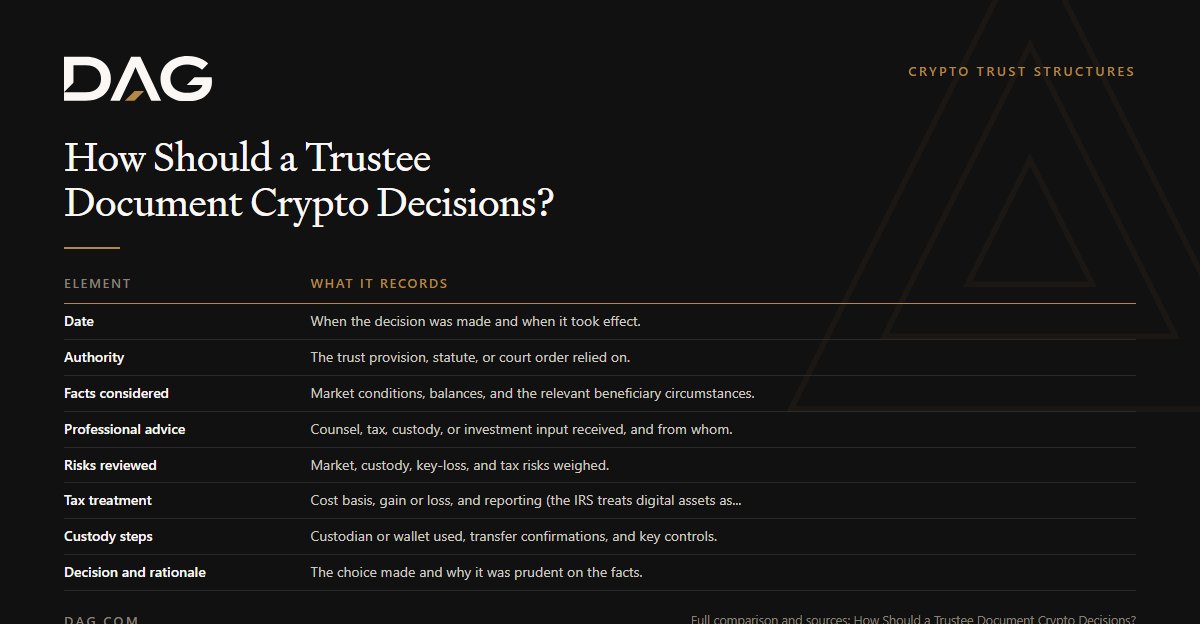
A trustee should document crypto decisions in a contemporaneous written record that shows the authority relied on, the facts and professional advice considered, the custody and tax steps taken, and the reason for the choice. This is how a trustee documents crypto decisions in a way that holds up if beneficiaries, auditors, or a court later review the administration.
Documenting a crypto decision means creating a dated, durable record, a memo, log, or minute, that captures why a fiduciary acted, what they reviewed, and what they did. For digital assets, that record also has to cover technical facts a traditional trust file never needed: which custodian or wallet held the keys, how the asset was valued, and how the transaction was reported. The duty to keep records is the same prudent-administration standard that applies to any trust asset; crypto just raises the bar on the detail.
Good documentation matters most when the decision is contested. Beneficiaries question a sale price, an auditor asks how a token was valued, a tax preparer needs the cost basis, or a court reviews whether the trustee acted prudently. A clear file is the trustee's primary evidence that the duties owed to beneficiaries were met, and it sits at the center of sound crypto trust administration within the broader discipline of crypto trust structures.
Decisions to Document
Document any decision that affects the value, control, or reporting of the trust's digital assets:
- Holding or selling crypto, including the rationale and the price source.
- Choosing a custodian (and whether it is a qualified custodian with SOC 1 / SOC 2 reporting).
- Using self-custody, including the key-management and multi-sig setup.
- Approving or declining staking and how rewards are handled.
- Hiring a crypto advisor and the scope of the engagement.
- Moving assets into a trust-owned LLC.
- Valuing assets as of a given date.
- Making distributions to beneficiaries.
- Communicating with beneficiaries about crypto holdings or risk.
What to Include in Each Record
For each decision, a complete entry generally captures:
| Element | What it records |
|---|---|
| Date | When the decision was made and when it took effect. |
| Authority | The trust provision, statute, or court order relied on. |
| Facts considered | Market conditions, balances, and the relevant beneficiary circumstances. |
| Professional advice | Counsel, tax, custody, or investment input received, and from whom. |
| Risks reviewed | Market, custody, key-loss, and tax risks weighed. |
| Tax treatment | Cost basis, gain or loss, and reporting (the IRS treats digital assets as property; see Form 1099-DA). |
| Custody steps | Custodian or wallet used, transfer confirmations, and key controls. |
| Decision and rationale | The choice made and why it was prudent on the facts. |
| Supporting records | The underlying documents that back the entry. |
Records a Trustee Should Preserve
Keep the source material that lets an outsider reconstruct the decision later:
- On-chain transaction IDs (hashes) and block confirmations.
- Wallet statements and address records.
- Custodian statements and account agreements.
- Valuation sources and the timestamps used.
- Tax workpapers and filed forms.
- Meeting notes, advisor correspondence, and beneficiary communications.
Where keys or access could be lost between trustees, pair the file with a private key succession plan so the record and the means to act stay together.
Related Questions
How long should a trustee keep crypto decision records?
Record-retention periods depend on state trust law, the trust instrument, and tax rules, so the answer varies by jurisdiction. As a general matter, trustees often retain records well beyond the year of a transaction because tax basis, gain or loss, and the statute of limitations can be examined years later. Confirm the right period with qualified counsel.
Does documentation protect a trustee from liability?
No record removes fiduciary, market, custody, or tax risk, and documentation alone does not guarantee a favorable outcome. A clear, contemporaneous file generally helps a trustee show that a decision followed a prudent process, which is the standard courts typically apply. Whether it is sufficient depends on the facts and applicable law.
Should a trustee document advice from a crypto advisor?
Generally, yes. Recording who was engaged, the scope of the advice, and how the trustee weighed it helps show that the trustee gathered competent input before acting. Note that hiring an advisor does not transfer the trustee's own duties unless the trust or governing law allows delegation, so the trustee's reasoning still belongs in the file.
Sources
Compliance Note
This article is educational and does not provide legal, tax, fiduciary, investment, trust administration, or custody advice. Trustee documentation should be reviewed with qualified counsel.