
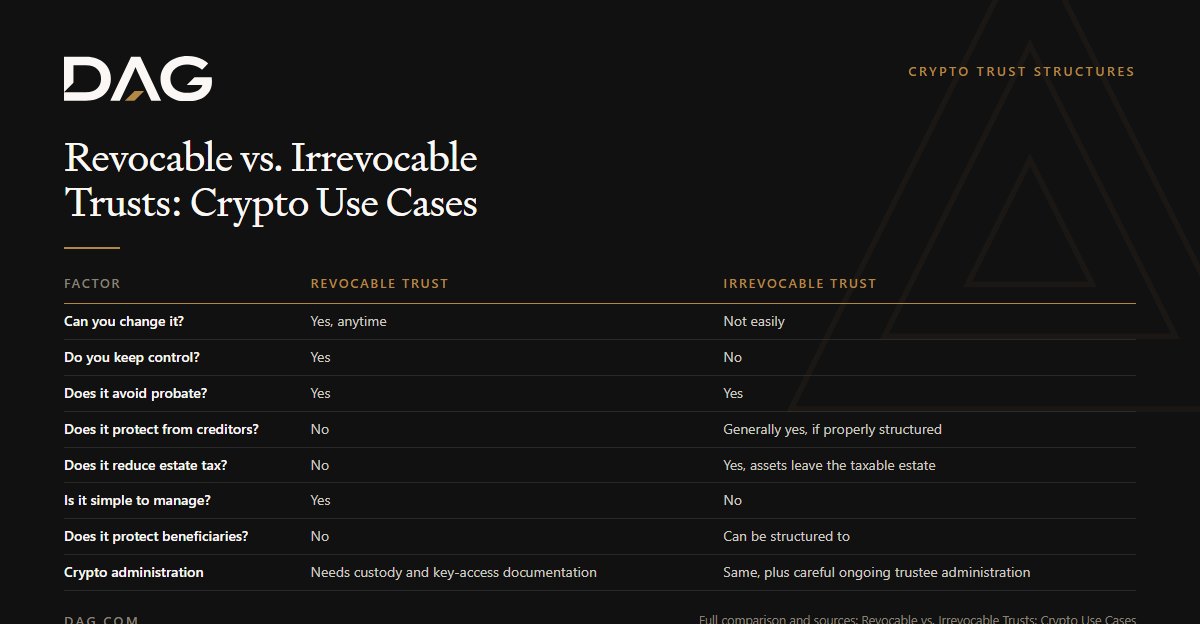
A revocable trust keeps control with the grantor and solves probate and inheritance access for crypto; an irrevocable trust removes assets from the estate and can add creditor protection and estate tax reduction. The choice depends on portfolio size, litigation risk, and willingness to give up control. Both still require coordinating private key access with the trust terms.
What These Two Trust Types Mean
A trust is a legal structure where a trustee holds assets for beneficiaries under rules set at formation. For crypto, this matters because private keys need a secure handoff mechanism, probate courts handle digital assets poorly, and heirs cannot access locked wallets without documented instructions.
A revocable trust (often called a revocable living trust) can be amended or revoked by the grantor at any time. The grantor typically serves as trustee and retains full control. When the grantor dies, a successor trustee distributes assets according to the trust terms, no court involvement required.
An irrevocable trust generally cannot be changed once established. The grantor transfers assets out of personal ownership and gives up direct control. In return, those assets are removed from the grantor's taxable estate and, depending on the structure, shielded from creditors.
Both trust types are funding-dependent: assets only receive trust treatment once they are formally titled into the trust. For crypto, that means coordinating custody accounts, wallet titling, and private key access procedures with the trust document.
How They Compare
| Factor | Revocable Trust | Irrevocable Trust |
|---|---|---|
| Can you change it? | Yes, anytime | Not easily |
| Do you keep control? | Yes | No |
| Does it avoid probate? | Yes | Yes |
| Does it protect from creditors? | No | Generally yes, if properly structured |
| Does it reduce estate tax? | No | Yes, assets leave the taxable estate |
| Is it simple to manage? | Yes | No |
| Does it protect beneficiaries? | No | Can be structured to |
| Crypto administration | Needs custody and key-access documentation | Same, plus careful ongoing trustee administration |
Both structures require the same underlying crypto-specific work: documented private key succession, custody account titling in the trust's name, and clear trustee authority over digital assets. The trust label matters less than whether those operational details are resolved. For how these trusts sit within the broader set of options, see the crypto trust structures hub.
Revocable Trusts for Crypto Holders
What you get
Probate avoidance. Assets titled in a revocable trust pass directly to beneficiaries without court involvement. For crypto, this means heirs can access holdings without waiting months or years for probate to resolve, and without courts trying to value or transfer assets they do not understand.
Flexibility. You can add assets, remove them, change beneficiaries, or modify distribution terms at any time. If your portfolio shifts from Bitcoin to staking positions to other digital assets, you can update the trust accordingly.
Privacy. Trust documents do not become public record the way wills do. Holdings and distribution instructions stay private.
Simplicity. Day-to-day management does not change. You continue to manage assets as trustee during your lifetime.
What you do not get
Asset protection. None. The IRS and creditors treat revocable trust assets as yours. A judgment against you can reach assets held in a revocable trust.
Estate tax reduction. Revocable trust assets remain in your taxable estate. No gift or estate tax benefit accrues from the structure alone.
When a revocable trust fits
- Your primary concern is making sure heirs can access crypto after your death
- You want probate avoidance and clear distribution instructions
- Your portfolio changes frequently and you need flexibility to adjust
- Creditor risk and estate tax are not material concerns
- Your estate is below the federal estate tax exemption (roughly $15 million per individual for 2026 under current law, adjusted annually for inflation, confirm the current figure)
Irrevocable Trusts for Crypto Holders
What you get
Asset protection. Once assets transfer into an irrevocable trust, they generally are no longer yours. Creditors cannot reach them, subject to fraudulent transfer rules, timing, and state law. This protection is real if the trust is set up correctly and well in advance of any claim.
Estate tax reduction. Assets removed from your estate stop appreciating inside your taxable estate. Future gains, including significant crypto appreciation, accumulate outside the estate and pass to beneficiaries without inclusion in your federal estate tax calculation.
Creditor protection for beneficiaries. Depending on structure, trust assets can be shielded from a beneficiary's own creditors: divorce settlements, lawsuits, or poor financial decisions do not necessarily reach trust property.
What you do not get
Control. The trustee, not you, makes asset decisions according to the trust terms. You cannot liquidate holdings on demand.
Flexibility. Modifying an irrevocable trust is difficult. Some jurisdictions allow modification by court order or with beneficiary consent, but it requires legal process.
Simplicity. Irrevocable trusts require careful drafting, ongoing trustee administration, and documentation of every material decision.
When an irrevocable trust fits
- You hold multi-million dollar crypto portfolios and want estate tax efficiency
- You face creditor exposure, litigation-prone profession, business liabilities, or anticipated disputes
- You want to protect assets from beneficiaries' creditors or spending decisions
- You are planning a generational wealth transfer
- You are willing to give up control in exchange for protection and tax efficiency
What Actually Drives This Decision
Portfolio size. At $200K in crypto, a revocable trust handles inheritance cleanly without complexity. At $10M or above, estate tax exposure alone may require irrevocable structures.
Litigation risk. Professionals in high-liability fields, business owners, or anyone facing an active dispute should weigh irrevocable protection more heavily.
Age and health. Younger holders often prioritize flexibility; those with a clear estate plan in place may prefer the protection an irrevocable structure provides.
Family complexity. Blended families, beneficiaries with their own creditor issues, or concerns about heirs mismanaging assets push toward irrevocable structures with tighter control provisions.
How crypto is held. If holdings are in a qualified custody account, the trust structure affects account titling. If self-custodying, the trust needs explicit provisions for private key succession, who holds the seed phrase, how they access it, and under what conditions. See private key succession planning for the operational specifics.
Practical Scenarios
Scenario 1: You are 45, holding $800K in crypto, married with children. Primary concern is ensuring your spouse can access holdings if you die. You want probate avoidance but do not need asset protection.
Revocable trust. Name yourself trustee, your spouse as successor trustee, children as contingent beneficiaries. Maintain control and flexibility while solving the inheritance access problem.
Scenario 2: You are 52, holding $8M in Bitcoin from early positions. You are in a profession with regular lawsuit exposure and want to protect wealth for your family while reducing estate tax.
Irrevocable trust. Transfer crypto into the trust with a professional or trusted family member as trustee. Structure for creditor protection and estate tax exclusion. You surrender control and gain protection and tax efficiency.
Scenario 3: You are 38, holding $2M in actively managed crypto across DeFi protocols. You want some asset protection but need flexibility to adjust positions.
Hybrid approach. A revocable trust for actively managed holdings that require flexibility, and an irrevocable trust for core long-term positions that can be locked in. Alternatively, a revocable trust now with a documented plan to convert portions to irrevocable structures as portfolio goals and liquidity needs clarify.
Every scenario depends on facts. These are hypothetical illustrations, not advice.
Common Mistakes
Creating the trust but not funding it. The trust document alone accomplishes nothing. Assets must be formally titled into the trust, for crypto, this means custody accounts named in the trust and wallet procedures documented and coordinated with the trustee.
Not updating custody documentation when holdings change. Moving from self-custody to institutional custody, or changing custodians, can leave trust documents referencing access procedures that no longer exist. The successor trustee needs a current map to the assets.
Choosing based on cost rather than need. Revocable trusts cost less to establish. That does not make them the right choice when asset protection is the actual objective.
Not coordinating with the broader estate plan. Conflicts between a trust, a will, and beneficiary designations on accounts create disputes for heirs. The trust is one component of an integrated plan, not a standalone solution.
Ignoring state law. Trust laws vary significantly by jurisdiction. Some states, particularly Wyoming and South Dakota, offer stronger creditor protection and more flexible administration provisions for digital assets. Where the trust is established affects what protections are available.
How DAG Wealth Fits In
DAG coordinates with estate planning attorneys who specialize in digital assets. We handle the operational side of trust-held crypto: how custody accounts get titled in the trust's name, how private keys are documented and succession-planned within the trust framework, how the trustee accesses holdings when needed, and how assets are tracked and reported.
The legal structure comes from your attorney. We make sure the operational details, custody, key access, trustee authority, work with that structure so the trust functions as intended for digital assets. Whether the trust is revocable or irrevocable, the crypto trust administration requirements are the same: documented, tested, and coordinated across all parties.
Related Questions
Can a revocable trust hold crypto?
Generally yes, but implementation controls the outcome. The trust, custodian or wallet setup, and access instructions must work together. More importantly, assets must be titled into the trust, not just referenced in the document. A revocable trust document that was never funded provides no benefit.
Does an irrevocable trust protect crypto from creditors?
Possibly, but not automatically. Asset protection depends on the trust design, timing of transfers, jurisdiction, and applicable law. Transfers made to defraud known creditors may be unwound under fraudulent transfer statutes. Proper timing and qualified legal advice are required before relying on any protection.
Which trust is better for crypto?
There is no universal answer. Revocable trusts are simpler and preserve control; irrevocable trusts offer protection and tax efficiency but require surrendering control. The better question is: what problem are you trying to solve? For many crypto holders, a revocable trust is the right starting point. As wealth grows or circumstances change, irrevocable structures are added for specific objectives.
Can an irrevocable trust own Bitcoin?
Yes. An irrevocable trust can hold Bitcoin and other digital assets. The custodian must accept trust-owned accounts, and the trust document must grant the trustee clear authority to hold, manage, and, when appropriate, liquidate digital assets. See can an irrevocable trust own Bitcoin for specifics.
Do I need a trust for crypto estate planning?
Not necessarily, but some structure is better than none. A trust, revocable or irrevocable, solves probate, access, and distribution in ways a will alone cannot. For crypto specifically, where access depends on private keys that may not survive a disorganized estate, documented trust provisions substantially reduce the risk that holdings become inaccessible.
How does a trust interact with a Wyoming LLC holding crypto?
Some holders use a trust-owned LLC structure: the trust owns the LLC, the LLC holds the crypto, and the LLC provides an additional liability-management layer. Whether this structure makes sense depends on the size of holdings, the trust type, and state law. Not all custodians support LLC-owned accounts, so the custody arrangement must be confirmed before structuring.
Sources
- Kiplinger: Revocable vs irrevocable trusts
- Kiplinger: What is a living trust?
- IRS Publication 559 (Survivors, Executors, and Administrators), estate tax thresholds
- Uniform Trust Code (UTC), trust modification and revocation standards
Compliance Note
This article is for general educational purposes and is not legal, tax, or investment advice. Trust structures vary by state, facts, and applicable law. Consult qualified estate planning counsel and tax professionals before establishing any trust or making decisions about digital asset ownership structures. DAG Wealth does not provide legal advice.