
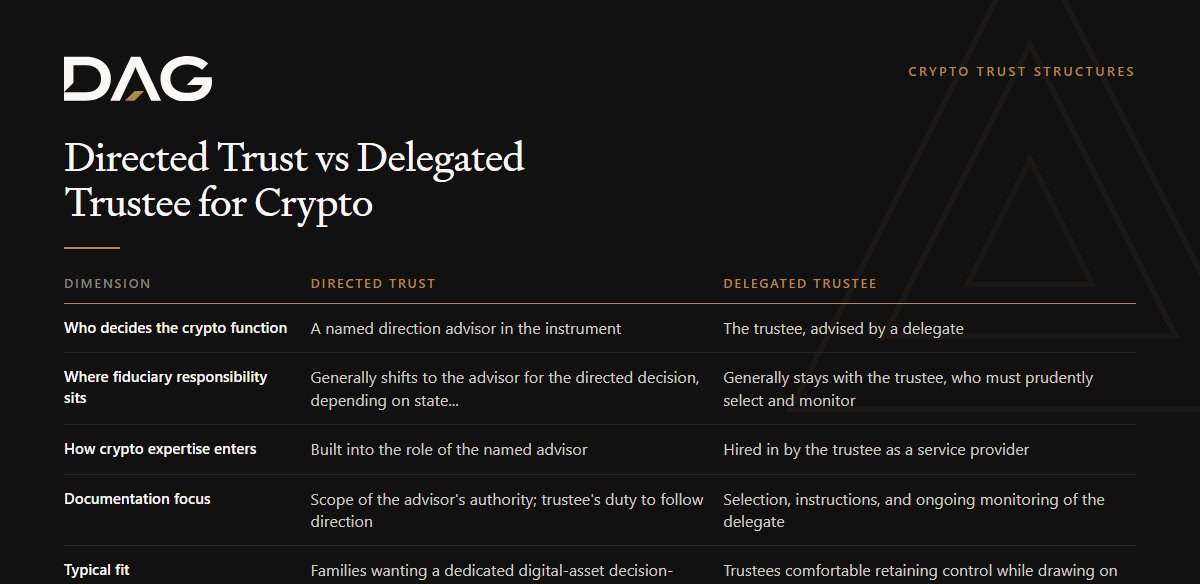
In a directed trust, the instrument assigns specified crypto decisions to a named advisor, and the trustee follows that direction. In a delegated arrangement, the trustee keeps fiduciary responsibility and hires outside specialists it must select and supervise. Which model fits depends on who holds the digital-asset expertise and how the family wants accountability allocated.
Definition: Directed Trust vs Delegated Trustee
A directed trust splits a trustee's traditional role across multiple parties. The trust document names one or more direction advisors (sometimes called a trust advisor, investment advisor, or distribution advisor), and the administrative trustee follows their direction within the limits the instrument and state law allow. Those advisors may hold authority over custody selection, digital-asset investment decisions, wallet governance and signing authority, staking or protocol participation, tax-record coordination, trust modifications, and beneficiary communication. The exact titles, duties, and liability standards are creatures of state law and the trust instrument.
A delegated trustee arrangement keeps the trustee in the lead. The trustee retains fiduciary responsibility and prudently selects, instructs, and monitors a delegate, such as a crypto advisor or portfolio manager, but does not hand off the underlying duty.
The practical difference is where accountability sits. Direction tends to shift responsibility toward the advisor for the directed function; delegation tends to keep it with the trustee, who remains responsible for choosing and supervising the delegate. Either way, the protections vary by state, and the allocation of liability depends on the specific instrument and facts.
Comparison at a Glance
| Dimension | Directed Trust | Delegated Trustee |
|---|---|---|
| Who decides the crypto function | A named direction advisor in the instrument | The trustee, advised by a delegate |
| Where fiduciary responsibility sits | Generally shifts to the advisor for the directed decision, depending on state law | Generally stays with the trustee, who must prudently select and monitor |
| How crypto expertise enters | Built into the role of the named advisor | Hired in by the trustee as a service provider |
| Documentation focus | Scope of the advisor's authority; trustee's duty to follow direction | Selection, instructions, and ongoing monitoring of the delegate |
| Typical fit | Families wanting a dedicated digital-asset decision-maker | Trustees comfortable retaining control while drawing on outside help |
State statutes treat these models differently, and some allow features of both. Confirm the available protections in the trust's governing jurisdiction with qualified counsel before relying on either label.
Why This Structure Matters for Crypto
Digital assets require operational knowledge that traditional fiduciary training often does not cover: private-key management, multi-signature governance, cold-storage protocols, qualified-custodian selection, staking mechanics, and high-volatility risk. A directed structure may let a family separate administrative duties from specialized digital-asset decision-making, depending on state law and the trust document. That separation can give family offices, investment advisers, and trustees a clearer governance model, particularly when the trust holds crypto inside a trust-owned LLC for crypto assets.
Separating roles does not remove market, custody, or tax risk. Whether a directed role limits a trustee's liability depends on the governing statute and how the document is drafted.
When a Directed Trust May Help
A directed structure tends to be worth exploring when several of the following are true:
- A professional trustee administers the trust, but the family wants specialized crypto oversight from a different party.
- A family office wants to retain investment or custody decision authority in-house.
- Digital-asset expertise sits with a specific advisor, committee, or family member rather than the trustee.
- The family wants governance designed to survive across generations.
- The trust owns an LLC or accounts that require ongoing digital-asset decisions.
When It May Not Be Enough
Directed trusts are state-law creatures. The roles, duties, liability standards, and permissible powers depend on the jurisdiction and the document. The structure can add complexity if roles overlap, if directions are ambiguous, or if decision-makers disagree. Clear drafting matters as much as the choice of structure, and a directed role can shift but not erase fiduciary responsibility. Consult qualified counsel to confirm what the governing statute actually permits and protects.
Crypto-Specific Questions Either Model Must Answer
Whichever structure a family chooses, the instrument should make these allocations explicit. Vague drafting is where disputes start.
- Who decides whether the trust can hold crypto at all? See Can a Trust Hold Bitcoin, Ethereum, or Other Digital Assets?.
- Who selects the custodian, and is that party a qualified custodian under the applicable custody framework? See Should a Trust Own Crypto Directly or Through an LLC?.
- Who approves wallet transfers and holds signing authority (single-key, multi-sig, or cold storage)?
- Who monitors tax records and valuation? Trustees still owe a duty to value holdings; see How Should Trustees Value Crypto?.
- Who communicates with beneficiaries about gains, losses, and risk?
- What happens if the crypto advisor or delegate resigns, and who steps in?
These access and key-management questions also feed into Private Key Succession Planning. Neither structure removes market, custody, or tax risk; they assign who is responsible for managing it.
Related Questions
Does a directed trust remove the trustee's liability for crypto losses?
Not automatically. Direction statutes may limit a trustee's exposure for a directed decision, but the scope of that protection depends on the governing state's law and the instrument's wording. A trustee may still owe duties around administration and gross negligence. See Can a Trustee Be Liable for Crypto Losses? and confirm with qualified counsel.
Which model is better for a trust holding Bitcoin?
Neither is categorically better. A directed trust can concentrate digital-asset decisions in a dedicated advisor; a delegated arrangement lets a trustee keep control while hiring help. The fit depends on the family's goals, the trustee's expertise, and state law. This generally calls for legal and tax input rather than a default answer.
Can a trustee hire a crypto advisor under either structure?
Generally yes. Whether the advisor acts as a named direction advisor or as a delegate, a trustee can bring in specialized expertise. See Can a Trustee Hire a Crypto Advisor? for the considerations. The difference is the legal role and where responsibility sits. An advisor's registration alone does not guarantee skill or results; selection and ongoing monitoring still matter.
Is a directed trust the same as a dynasty trust?
No. A directed trust describes who holds which decision-making powers within the trust. A dynasty trust generally describes long-term, multi-generational planning. A single trust can incorporate both concepts, depending on how it is drafted.
Why not use a regular trustee for crypto?
Some trustees are not comfortable administering digital assets. A directed structure may allow specialized decision-making without forcing one party to handle every function, though the viability depends on the facts and the governing law. The alternative is a delegated arrangement, where the trustee retains oversight and hires specialists.
Can an investment adviser direct crypto assets in a trust?
Possibly, but it generally requires legal, regulatory, and fiduciary review. Adviser registration status, custody rules, discretion scope, and conflicts of interest all matter. Registration alone does not guarantee competence in digital assets.
Sources
Compliance Note
This article is educational and does not provide legal, tax, fiduciary, investment, or custody advice. Directed trust and delegation structures vary significantly by state and governing instrument. Review any structure with qualified legal counsel before implementation.