
Yes, a trustee can be liable for crypto losses, but liability turns on conduct rather than price moves. Whether a trustee is liable for crypto losses depends on the trust document, applicable state law, the fiduciary duties owed, the decision-making process, custody controls, any diversification requirement, and the specific facts of the loss, not on volatility alone.
What Trustee Liability for Crypto Means
Trustee liability is personal responsibility for a breach of fiduciary duty, such as the duty of care, the duty of loyalty, or the duty to follow the trust's terms. A decline in a digital asset's market value is not, by itself, a breach. Courts and trust law generally judge the trustee's process: whether holding, buying, selling, or self-custodying the asset was authorized and prudent given the facts known at the time. A trustee who acts within authority and documents a reasonable process is in a stronger position than one who does not, even where the portfolio loses value. This question sits within the broader set of crypto trustee duties and the firm's Crypto Trust Structures Hub.
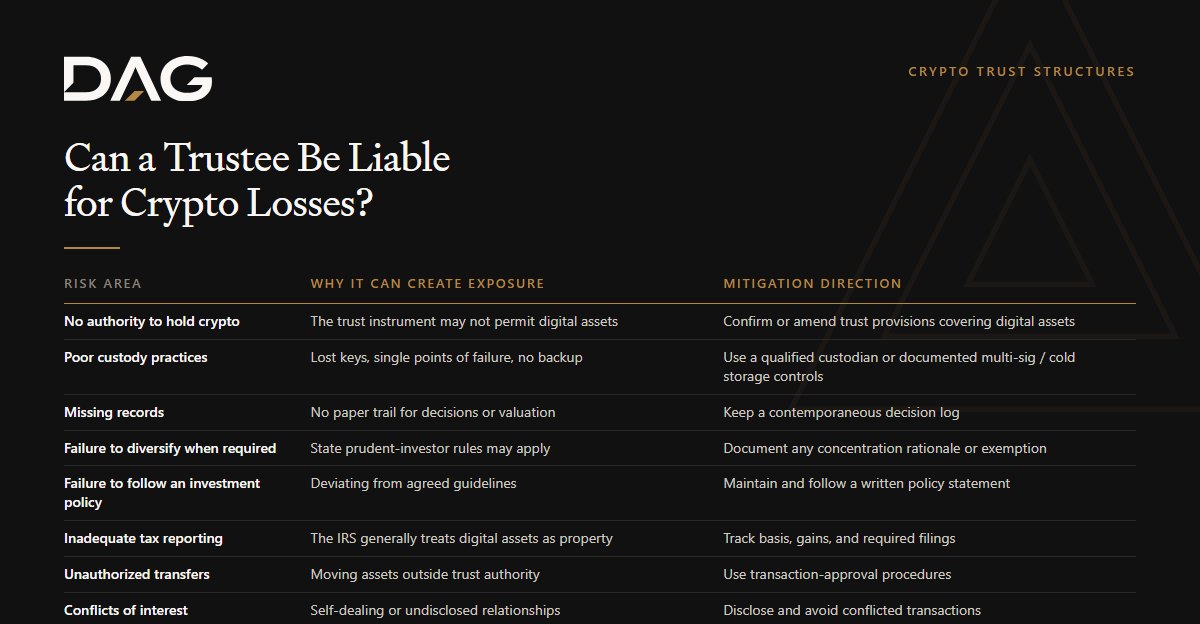
Issues That May Create Risk
| Risk area | Why it can create exposure | Mitigation direction |
|---|---|---|
| No authority to hold crypto | The trust instrument may not permit digital assets | Confirm or amend trust provisions covering digital assets |
| Poor custody practices | Lost keys, single points of failure, no backup | Use a qualified custodian or documented multi-sig / cold storage controls |
| Missing records | No paper trail for decisions or valuation | Keep a contemporaneous decision log |
| Failure to diversify when required | State prudent-investor rules may apply | Document any concentration rationale or exemption |
| Failure to follow an investment policy | Deviating from agreed guidelines | Maintain and follow a written policy statement |
| Inadequate tax reporting | The IRS generally treats digital assets as property | Track basis, gains, and required filings |
| Unauthorized transfers | Moving assets outside trust authority | Use transaction-approval procedures |
| Conflicts of interest | Self-dealing or undisclosed relationships | Disclose and avoid conflicted transactions |
Custody is often the sharpest issue, because self-custodied crypto can be lost irreversibly. A trustee weighing a qualified custodian against self-custody may want to review whether a trustee should hold a hardware wallet and how private key succession is handled.
Documentation Matters
Documentation is how a trustee shows a prudent process after the fact. Trustees should record their review process, professional advice received, custody decisions, beneficiary communications, and the reasons behind major decisions. A contemporaneous record made at the time of a decision generally carries more weight than a reconstruction prepared once a loss has already occurred.
Practical Controls
Trustees can reduce administrative risk with a few specific controls:
- Confirm the trust document authorizes digital assets before acquiring or retaining them.
- Adopt a written custody policy that names the custodian or describes the self-custody control (multi-sig, cold storage, backup, and key recovery).
- Maintain an investment policy statement and follow it, documenting any deviation.
- Require defined transaction-approval procedures for transfers.
- Engage qualified advisors, and note that a trustee can hire a crypto advisor without surrendering fiduciary responsibility.
These controls reduce process risk. They do not remove market, custody, or tax risk, and no structure or advisor can guarantee against loss.
Related Questions
Does crypto volatility by itself make a trustee liable?
Generally no. A loss in market value alone is usually not a breach. Liability tends to follow a flawed process, such as acting without authority or neglecting custody, rather than the asset's price movement. The facts and applicable state law control.
Can a trust document protect a trustee from liability?
A well-drafted trust may grant authority to hold digital assets, set custody standards, and include exculpatory provisions, which can narrow exposure. Such clauses are limited by state law and generally do not excuse bad faith or reckless conduct. Have counsel review the language.
Does using a qualified custodian remove trustee liability?
No. A qualified custodian can strengthen custody practices and recordkeeping, but the trustee still owes fiduciary duties for selection, oversight, and overall administration. Using a custodian is one control, not a release from responsibility.
Sources
Compliance Note
This article is educational and does not provide legal, tax, fiduciary, investment, litigation, or custody advice. Trustee liability questions should be reviewed with qualified counsel.