
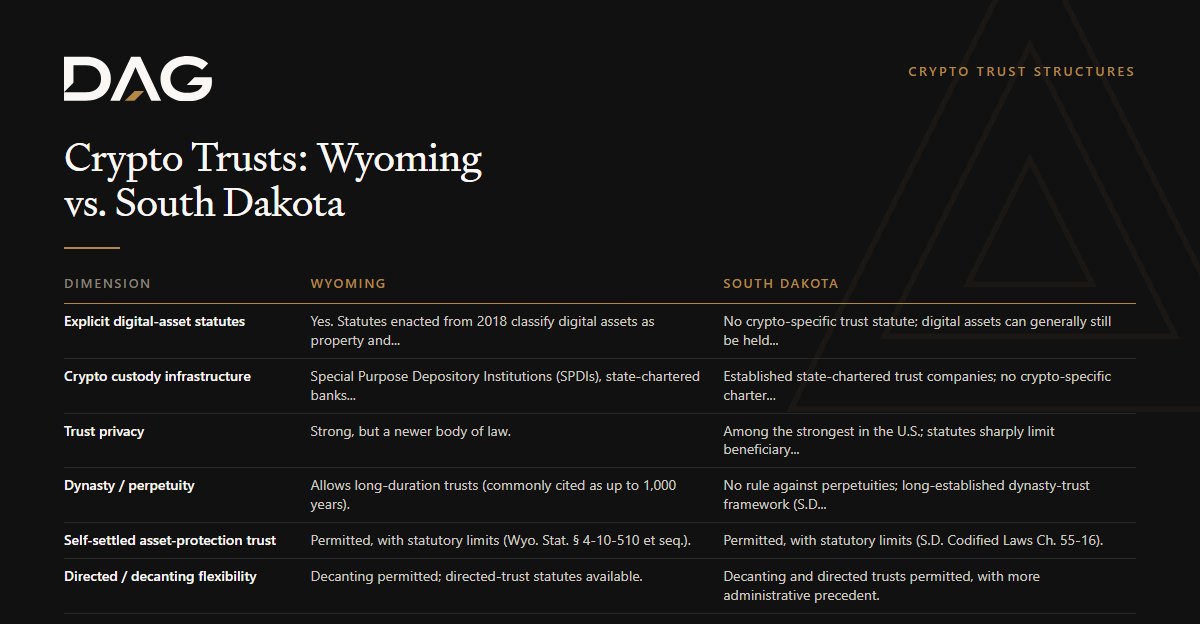
For a crypto trust, Wyoming and South Dakota are two of the strongest U.S. jurisdictions, but they lead in different areas. Wyoming offers explicit digital-asset statutes and crypto-focused custody charters; South Dakota offers the country's strongest trust privacy and a long-established dynasty-trust framework. The right state depends on your goals.
A trust jurisdiction is the state whose law governs how a trust operates: what assets a trustee can hold, what beneficiaries can demand to see, how long the trust can last, and how it can be modified. State law, not the trust document alone, controls these outcomes, so the choice of state matters before any crypto is funded into the trust. If you are still deciding on a structure, start with the broader crypto trust structures hub and the comparison of crypto trust structures.
Why does the trust's state matter for crypto?
Most states have not updated their trust statutes for digital assets, which can leave open questions about whether a trustee may legally hold Bitcoin or other tokens, and how those assets are characterized. Wyoming and South Dakota both rank highly for trusts, but they took different paths. Wyoming wrote crypto-specific law; South Dakota built a deep, traditional trust ecosystem. A mismatch between the state and your actual goal can create problems that may not surface for years, such as a restructuring you cannot make cleanly or privacy protections that do not cover what you assumed.
Wyoming vs. South Dakota crypto trust comparison
| Dimension | Wyoming | South Dakota |
|---|---|---|
| Explicit digital-asset statutes | Yes. Statutes enacted from 2018 classify digital assets as property and address trustee authority to hold them (Wyo. Stat. Title 34). | No crypto-specific trust statute; digital assets can generally still be held, but the law does not address them by name. |
| Crypto custody infrastructure | Special Purpose Depository Institutions (SPDIs), state-chartered banks designed to custody digital assets (Wyo. Stat. § 13-12). | Established state-chartered trust companies; no crypto-specific charter category. |
| Trust privacy | Strong, but a newer body of law. | Among the strongest in the U.S.; statutes sharply limit beneficiary disclosure (S.D. Codified Laws Ch. 55-2). |
| Dynasty / perpetuity | Allows long-duration trusts (commonly cited as up to 1,000 years). | No rule against perpetuities; long-established dynasty-trust framework (S.D. Codified Laws § 43-5-8). |
| Self-settled asset-protection trust | Permitted, with statutory limits (Wyo. Stat. § 4-10-510 et seq.). | Permitted, with statutory limits (S.D. Codified Laws Ch. 55-16). |
| Directed / decanting flexibility | Decanting permitted; directed-trust statutes available. | Decanting and directed trusts permitted, with more administrative precedent. |
| Ecosystem depth | Newer; growing crypto-focused base. | Decades of trustees, law firms, and administrative experience. |
| State income tax on trusts | No state income tax. | No state income tax. |
Statutory citations above point to the controlling state codes; confirm the current text and any amendments with a trust attorney, because state trust law changes frequently.
When is Wyoming the better fit for a crypto trust?
Wyoming may fit when explicit digital-asset recognition is a priority, for example a crypto founder who wants a jurisdiction whose statutes name digital assets and authorize trustees to hold them, and where SPDI custody charters exist. The trade-off is a shorter track record: South Dakota has administered trusts since the 1980s, while Wyoming's crypto-specific framework is more recent and has less case law and administrative precedent. Wyoming's edge narrows if your main goal is privacy rather than statutory crypto recognition.
When is South Dakota the better fit?
South Dakota may fit when privacy and multi-generational planning matter most. Its disclosure-limiting statutes are widely regarded as the strongest in the country, and its dynasty-trust framework supports very long-duration structures. The trade-off is that its statutes do not call out digital assets by name, so crypto can generally be held but the law does not address it as directly as Wyoming's. A founder who wants a state visibly "betting on" digital assets may find South Dakota more traditional.
Related Questions
Can a South Dakota trust hold cryptocurrency even without a crypto statute?
Generally yes. A trust can hold digital assets where the trust document grants the trustee that authority and the trustee is able to custody them. South Dakota lacks a crypto-specific statute, so the authority rests on the trust instrument and the trustee's capabilities rather than a statute that names digital assets. Confirm trustee authority with a trust attorney before funding.
Do Wyoming and South Dakota both protect crypto from creditors?
Both permit self-settled asset-protection trusts with statutory limits, so creditor protection is possible but not absolute. Protection depends on how and when the trust is funded, statutory waiting periods, and fraudulent-transfer rules. Asset-protection planning is fact-specific and should be reviewed by a qualified attorney.
Is there a single best state for a crypto trust?
No. The strongest fit depends on whether you weight explicit digital-asset law and crypto custody charters (Wyoming) or privacy and dynasty-trust depth (South Dakota), plus your tax, custody, and family situation. Other states, including Nevada and Delaware, are also used. Compare the dimensions above with a trust attorney licensed in the relevant state.
How does the trust's state interact with crypto custody?
The state governs the trust; a separate custodian holds the keys. The two need to align: the trustee must be able to legally and operationally custody the assets. See crypto custody for trusts and, before funding, how to fund a trust with crypto.
Sources
- Wyoming Statutes, Title 34 (Property; digital assets)
- Wyoming Statutes § 13-12 (Special Purpose Depository Institutions)
- South Dakota Codified Laws, Title 55 (Fiduciaries and Trusts)
- South Dakota Codified Laws § 43-5-8 (rule against perpetuities)
Compliance Note
This article is educational and does not provide legal, tax, investment, or custody advice, and it does not recommend a specific state, trustee, or structure. State trust statutes change and apply differently to each situation; verify current law and suitability with a trust attorney licensed in the relevant jurisdiction. Digital Ascension Group does not give legal advice; it coordinates between your attorney, custodian, tax, and investment professionals. Investment advisory services are provided through its affiliated SEC-registered investment adviser, DAG Wealth. Registration does not imply a certain level of skill or training.