
An asset protection trust can make sense for high-net-worth individuals with genuine, prospective creditor exposure, professionals facing malpractice liability, leveraged business owners, or real estate investors, and is one of the advanced structures within crypto estate planning. It is never absolute protection, and there is no fixed point where "full protection kicks in": effectiveness depends on state law, transfer timing, and fraudulent-transfer rules.
What Is a Domestic Asset Protection Trust?
A DAPT is an irrevocable trust established under the laws of a DAPT-friendly state. Nevada, Delaware, and South Dakota are frequently cited, in which the grantor transfers assets to an independent trustee while potentially remaining a discretionary beneficiary. Because the grantor does not control the assets, personal creditors generally cannot compel distributions from the trust to satisfy judgments. The trust is typically treated as a grantor trust for income tax purposes, meaning the grantor remains responsible for paying income tax on trust earnings even without the ability to control distributions.
Trust drafting and ongoing administration require qualified legal counsel. DAG coordinates with estate and trust attorneys to integrate these structures into a broader wealth plan.
Who Should Consider a DAPT?
Candidates typically share two traits: meaningful net worth that makes them a litigation target, and creditor risk that is prospective rather than existing or imminent.
Common risk profiles:
- Physicians, surgeons, or other licensed professionals with malpractice exposure
- Business owners or executives with significant personal guarantees or leverage
- Real estate investors holding multiple properties with lender or tenant claims risk
- High-profile individuals with recurring litigation exposure
A DAPT is not appropriate, and the transfer may be voidable, if a lawsuit is already filed or a creditor relationship already exists when assets are transferred.
How Does the DAPT Seasoning Period Work?
The seasoning period is the window after funding during which a creditor may still challenge a transfer as fraudulent under the Uniform Voidable Transactions Act (UVTA) or its predecessor, the Uniform Fraudulent Transfer Act (UFTA), as adopted by the trust's situs state. Once that window closes without a successful challenge, future creditors generally face a higher burden to reach trust assets. Importantly, the close of a seasoning period is not a moment when "full protection kicks in", protection is never absolute, and the figures below are illustrative.
Seasoning periods vary by state, the figures below are illustrative and must be verified with counsel against current statutes:
| State | General DAPT Seasoning Period (illustrative) | Notable Provisions |
|---|---|---|
| Nevada | ~2 years from transfer | Among the shorter windows cited |
| Delaware | ~4 years from transfer (or shorter from discovery) | Generally favorable trust law |
| South Dakota | ~2 years from transfer | No state income tax; directed-trust law |
| Alaska | ~4 years from transfer | First U.S. state to authorize DAPTs |
| Ohio | ~18 months from transfer | Among the shorter windows cited |
These illustrative periods apply to claims by certain future creditors. Existing or known creditors at the time of transfer may have longer rights under applicable fraudulent-transfer law. Specific durations, triggers, and discovery rules differ by statute and change over time, confirm the current law of the chosen situs state with an attorney before relying on any figure here.
What the Seasoning Period Does Not Fix
The seasoning period does not protect transfers that were made with actual intent to defraud. Courts look at "badges of fraud", timing relative to pending claims, insolvency at the time of transfer, transfers to insiders, and similar indicators. Even after the seasoning window closes, a court may still unwind a transfer if actual fraudulent intent is established.
Additionally, certain creditors are typically not barred regardless of seasoning:
- Child support and spousal maintenance obligations
- Tax liabilities owed to the IRS or state taxing authorities
- Pre-existing creditors who acted within any applicable look-back window
- Alimony and divorce settlement claims (varies by state)
Is a Domestic or Offshore Trust Better?
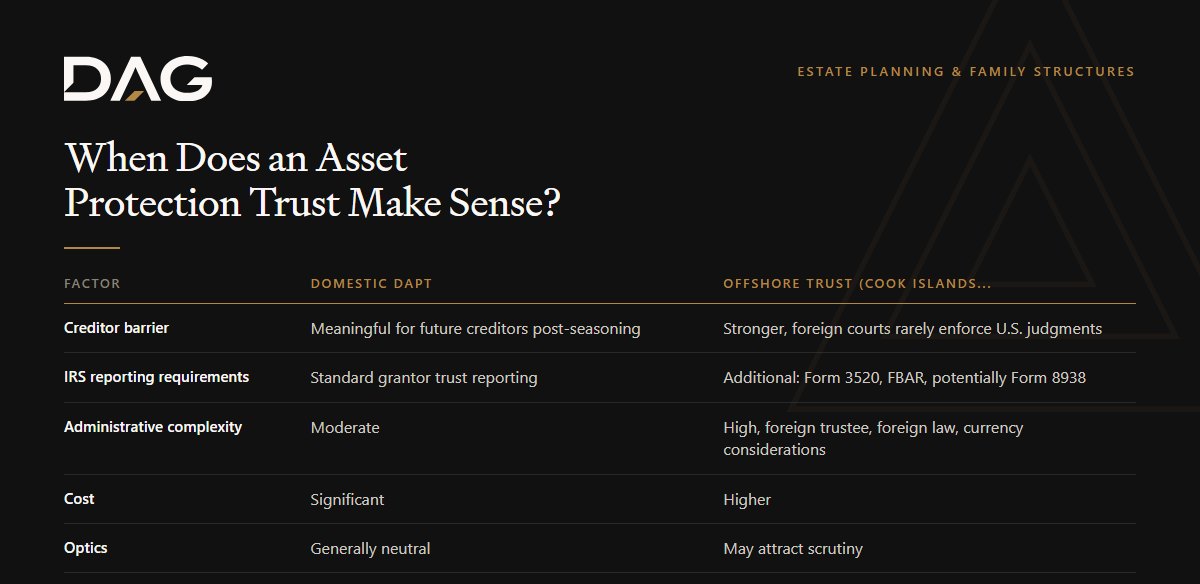
| Factor | Domestic DAPT | Offshore Trust (Cook Islands, Nevis) |
|---|---|---|
| Creditor barrier | Meaningful for future creditors post-seasoning | Stronger, foreign courts rarely enforce U.S. judgments |
| IRS reporting requirements | Standard grantor trust reporting | Additional: Form 3520, FBAR, potentially Form 8938 |
| Administrative complexity | Moderate | High, foreign trustee, foreign law, currency considerations |
| Cost | Significant | Higher |
| Optics | Generally neutral | May attract scrutiny |
For most high-net-worth families, a domestic DAPT in a favorable state offers a reasonable balance of protection and manageability. Offshore structures may be appropriate for individuals with extreme or persistent litigation exposure, but the added complexity, cost, and IRS reporting obligations are material considerations.
How Does an LLC Layer Into This Structure?
A common approach pairs a Wyoming or Delaware LLC, which holds specific assets such as cryptocurrency or business interests, with a DAPT that owns the LLC membership interests. This creates two layers:
- LLC layer: Limited liability protection at the entity level, shielding the LLC's assets from personal claims
- Trust layer: The DAPT owns the LLC interests, shielding those interests from personal creditors of the grantor
For this structure to hold, both entities must be maintained properly. Courts look for reasons to pierce asset protection structures when they are challenged. Commingling personal and entity funds, ignoring operating formalities, or treating the LLC as a personal account are common failure points. See Should a Trust Own a Wyoming LLC for Crypto Assets? and Trust-Owned LLC for Crypto Assets for more on this layered approach.
What About Cryptocurrency in a DAPT?
Cryptocurrency held by a DAPT requires custody arrangements that account for both the legal separation the trust creates and the security protocols assets in a hardware or institutional custody environment demand. The trustee, not the grantor, controls the assets, so any custody arrangement must reflect that authority. See Crypto Custody for Trusts for applicable custody considerations.
Digital asset trust provisions should explicitly address how the trustee is authorized to manage, delegate, or direct crypto custody. See What Trust Provisions Should Cover Digital Assets? for a framework.
Tax Reporting for Asset Protection Trusts
Most DAPTs are structured as grantor trusts for income tax purposes under IRC §§ 671–679. The grantor:
- Reports all trust income on their personal return as though the trust did not exist
- Cannot deduct trust losses beyond their basis
- Does not receive a stepped-up basis on trust assets at death in the same way as with revocable trusts (varies by structure)
This treatment is generally expected and is part of the tradeoff for asset protection. A tax advisor familiar with grantor trust rules should handle the reporting from the first year of funding. For trusts holding digital assets, coordination with a crypto tax specialist is advisable. See Crypto Tax Reporting for Trusts.
How Does This Fit Into a Broader Estate Plan?
For families with substantial wealth, the DAPT is one component in a layered structure that may include:
- A revocable living trust for probate avoidance and incapacity planning
- An irrevocable DAPT for creditor protection
- LLCs holding operating assets or concentrated positions
- Charitable trusts for tax-efficient giving
- Family limited partnerships or family LLCs for multi-generational wealth transfer
Coordinating these structures requires alignment across estate attorneys, CPAs, and wealth managers. See Crypto Estate Planning for High-Net-Worth Families and Trust Structures for Crypto Wealthy Individuals for how digital assets integrate into multi-entity plans.
DAG provides family office-level coordination across legal, tax, and custody considerations for clients whose wealth justifies this level of integration.
Related Questions
Can I set up an asset protection trust after a lawsuit is filed?
Transferring assets to a DAPT after a lawsuit is filed, or in anticipation of a known creditor claim, is likely a fraudulent transfer that a court will unwind. The protection a DAPT offers runs to future, unknown creditors. Courts will examine the timing closely. Consult an attorney before making any transfer if litigation is pending or threatened.
Does a DAPT work in every state?
No. Not all states have DAPT statutes. If you live in a state without one, you can still establish a DAPT under the laws of a DAPT-friendly state (Nevada, Delaware, South Dakota, etc.), but whether your state's courts will respect that situs election is unsettled in some jurisdictions. Full faith and credit analysis and your state's own fraudulent transfer law both apply. This is a fact-specific legal question that requires an attorney with cross-state trust experience.
How much does it cost to establish and maintain a DAPT?
Setup costs are typically several thousand dollars in legal fees to draft the trust instrument, plus trustee fees that vary by state and trustee. Ongoing administrative costs, annual trustee fees, accounting, and any required state filings, add to the total. These structures are cost-justified when the wealth being protected and the creditor risk are both material. For a general sense of scale, total first-year costs commonly run in the low five figures, though this varies significantly. Verify current costs with counsel and any proposed trustee directly.
Is a DAPT the same as a spendthrift trust?
Not exactly. A spendthrift clause (which restricts a beneficiary's ability to alienate or assign trust interests, and restricts creditors from reaching those interests) is a standard provision in most trusts and does not require a dedicated DAPT statute. A DAPT goes further by allowing the grantor to also be a discretionary beneficiary, which traditional spendthrift trust law in many states would not allow, since courts treated the grantor-beneficiary's interest as reachable by creditors. The DAPT statutory framework specifically carves out this exception.
Sources
- Uniform Law Commission, Uniform Voidable Transactions Act (2014): https://www.uniformlaws.org/committees/community-home?CommunityKey=97a4d0a0-5db0-4db3-b821-8e57b3e9cfdc
- Nevada Revised Statutes § 166 (Spendthrift Trusts): https://www.leg.state.nv.us/nrs/NRS-166.html
- Delaware Code Title 12, § 3570–3576 (Qualified Dispositions in Trust): https://delcode.delaware.gov/title12/c035/sc07/index.html
- South Dakota Codified Laws § 55-16 (South Dakota Asset Protection Trust): https://sdlegislature.gov/Statutes/55-16
- IRS, Grantor Trust Rules (IRC §§ 671–679): https://www.irs.gov/publications/p550
Compliance Note
This page is for educational purposes only and does not constitute legal, tax, or investment advice. Asset protection trust law is state-specific, fact-dependent, and subject to change. The protection a DAPT can offer is not absolute, transfers made to defraud known or existing creditors are voidable, seasoning periods vary by state and should be verified with current statutes, and certain creditor classes (child support, IRS, alimony) are typically not barred. Do not fund any irrevocable trust without guidance from a qualified estate planning attorney and, where digital assets are involved, a tax advisor familiar with grantor trust rules and digital asset reporting. Trust drafting and entity formation are legal services; DAG coordinates with licensed legal and tax professionals and does not provide legal advice or draft trust instruments. Advisory services are provided by DAG Wealth, an SEC-registered investment adviser. Registration does not imply a certain level of skill or training.