
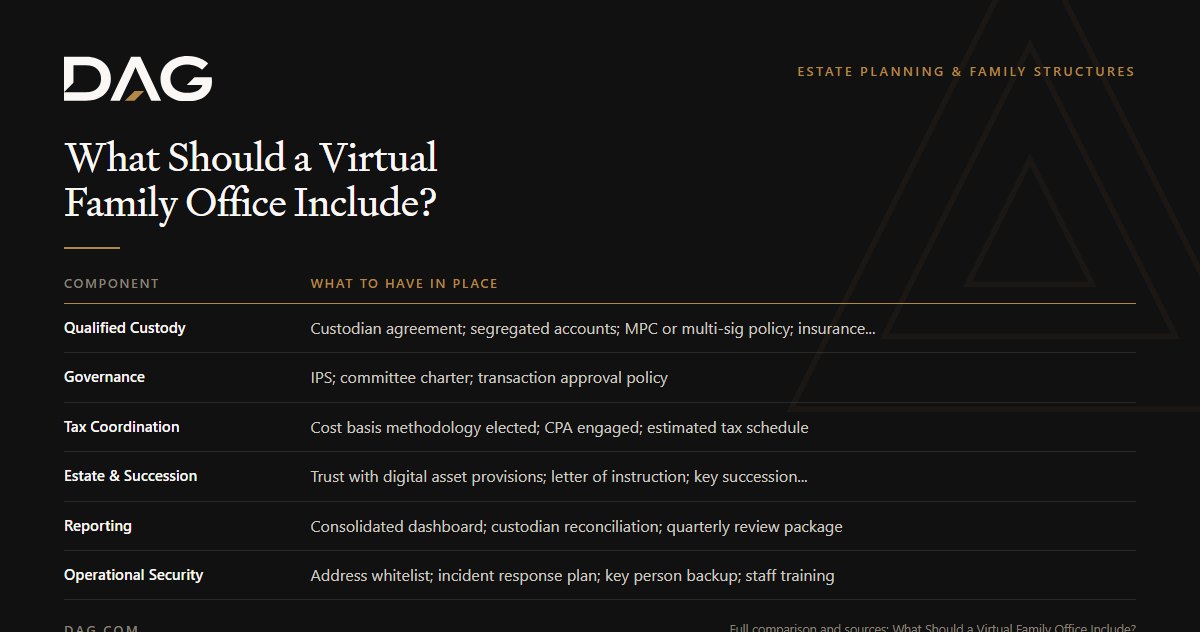
The core virtual family office components are six coordinated functions: qualified custody, governance and decision-making protocols, tax coordination, estate and succession structures, consolidated reporting, and operational security, all mapped in the crypto family office hub. Together they give a crypto-holding family organized infrastructure to protect, administer, and transfer digital asset wealth without necessarily building a full in-house staff.
What Is a Virtual Family Office?
A virtual family office is a coordinated wealth management structure, whether built internally, assembled from specialist advisors, or delivered through an outsourced provider, that integrates the functions a crypto-holding family needs to protect, transfer, and administer substantial digital asset wealth across generations.
It differs from a traditional family office primarily in that custody, governance, and estate documents must account for the technical realities of digital assets: private key control, on-chain transaction finality, and the absence of a central recovery mechanism if access is lost.
For a detailed comparison, see crypto family office vs. traditional family office.
What Are the Core Components of a Virtual Family Office?
1. Qualified Custody
Custody is the foundation. All other functions depend on knowing that assets are secured, segregated, and accessible only under defined authorization conditions.
A virtual family office should address:
- Custodian type: Qualified custodian (bank, trust company, or regulated broker-dealer) vs. self-custody vs. a hybrid
- Key management architecture: Multi-party computation (MPC) or multi-signature (multi-sig), with defined signing thresholds
- Segregation: Assets held in the family's name, not commingled with custodian assets
- Insurance: Crime, cyber, and errors-and-omissions coverage specific to digital assets (verify current terms and limits with each custodian)
- Backup and succession: What happens to custody access if a key person is incapacitated or dies
See crypto custody for family offices and qualified custody vs. self-custody for deeper treatment.
2. Governance and Decision-Making
Without written governance, even well-intentioned families face disputes over who can authorize transactions, how allocation decisions are made, and what happens during a dispute.
A virtual family office governance framework generally includes:
- An Investment Policy Statement (IPS) covering digital asset allocation targets, rebalancing rules, and prohibited asset types
- A governance committee charter or equivalent document defining who has authority over what decisions
- A transaction approval policy: dollar thresholds, required approvers, and verification steps before any transfer executes
- Conflict-of-interest and fiduciary standards for anyone acting in an advisory capacity to the family
See digital asset governance policy and crypto family office governance checklist.
3. Tax Coordination
Crypto generates tax events that traditional wealth management software does not always capture: disposals, staking rewards, airdrops, DeFi activity, and cross-chain transfers. A virtual family office must have a tax coordination layer that covers:
- Cost basis tracking across wallets and exchanges using a consistent methodology (FIFO, HIFO, or specific identification)
- Estimated tax planning so the family does not face a large liability at year-end with insufficient liquidity
- Loss harvesting where available within family risk parameters
- Trust and entity-level reporting if assets are held through LLCs, trusts, or other structures
- CPA coordination: ensuring the family's tax preparer receives complete, reconciled records before the filing deadline
See crypto tax reporting for family offices and crypto tax planning for HNW investors.
4. Estate Planning and Succession Structures
Digital assets require estate documents that go beyond a standard will or trust. At a minimum, a virtual family office should include:
- Updated trust documents with explicit digital asset provisions, authority to hold, transfer, delegate custody, and hire specialist advisors
- A letter of instruction (not filed in probate) that details where assets are held, how to access them, and the step-by-step process for an executor or successor trustee
- Private key succession planning: a documented, tested protocol for transferring cryptographic access to heirs without compromising security during the grantor's lifetime
- Entity structures: trusts, Wyoming LLCs, or directed trusts used to hold assets, with operating agreements that address digital asset specifics
Entity formation, trust and estate document drafting, and operating-agreement preparation are legal services. A virtual family office coordinates these with qualified legal counsel; it does not itself provide legal advice. Do not duplicate the dedicated estate and succession pages; instead see crypto estate planning for high-net-worth families and private key succession planning.
5. Consolidated Reporting
Families with assets across multiple custodians, self-custody wallets, DeFi positions, and traditional accounts need a unified reporting view. A virtual family office reporting function should produce:
- Portfolio-level performance across all digital and traditional holdings
- Custodian reconciliation: confirming on-chain balances match custodian records
- Tax basis exports compatible with the CPA's software
- Quarterly or annual family review packages: allocation, risk, fee, and compliance summaries
See digital asset reporting dashboard for family offices and how should a family office report crypto?.
6. Operational Security
Operational security (OpSec) is a distinct function, not a subset of custody. It covers the human and procedural controls that prevent social engineering, insider risk, and operational errors.
Key elements:
- Address verification policy: whitelisting withdrawal addresses and requiring multi-party confirmation before any new address is approved
- Incident response plan: defined steps if a wallet is compromised, a transaction is sent to the wrong address, or a custodian reports a breach
- Key person risk policy: what happens if the individual who manages day-to-day crypto operations leaves or is unavailable
- Staff and family training: phishing awareness, SIM-swap prevention, and device security for anyone with wallet access
See crypto incident response plan and crypto key person risk policy.
Virtual Family Office Components Checklist
| Component | What to Have in Place |
|---|---|
| Qualified Custody | Custodian agreement; segregated accounts; MPC or multi-sig policy; insurance verified |
| Governance | IPS; committee charter; transaction approval policy |
| Tax Coordination | Cost basis methodology elected; CPA engaged; estimated tax schedule |
| Estate & Succession | Trust with digital asset provisions; letter of instruction; key succession protocol |
| Reporting | Consolidated dashboard; custodian reconciliation; quarterly review package |
| Operational Security | Address whitelist; incident response plan; key person backup; staff training |
Related Questions
How is a virtual family office different from a traditional family office?
A traditional family office manages investments, tax, and estate planning for a single ultra-high-net-worth family. A virtual family office adds custody infrastructure, private key management, and on-chain reporting that traditional platforms do not cover. The governance and estate documents must also address digital asset-specific risks, access loss, key succession, and smart contract exposure, that do not arise with conventional securities.
Does a virtual family office require a full in-house team?
No. Many families use an outsourced or virtual structure: a registered investment adviser handles investment oversight and tax coordination, a qualified custodian holds assets, and estate attorneys draft the documents. The "office" is the coordinated system, not necessarily a dedicated staff. What matters is that each function is covered and that handoffs between advisors are documented.
What size of crypto holdings warrants a formal virtual family office structure?
There is no single threshold. Families generally begin formalizing custody, governance, and estate structures when the complexity of their holdings, multiple wallets, multiple entities, meaningful tax exposure, or the need to plan for heirs, exceeds what ad-hoc management can handle safely. See how much crypto is enough to need a family office? for a more detailed discussion.
Can an existing trust hold digital assets without additional documents?
Most legacy trust documents do not explicitly authorize digital assets, and some provisions (e.g., "readily marketable securities") may inadvertently exclude them. An attorney should review and update the trust language before transferring digital assets in. See what trust provisions should cover digital assets?.
Sources
- IRS Notice 2014-21 (digital asset tax classification): https://www.irs.gov/pub/irs-drop/n-14-21.pdf
- IRS Revenue Ruling 2023-14 (staking income): https://www.irs.gov/pub/irs-drop/rr-23-14.pdf
- SEC Staff Accounting Bulletin No. 121 (accounting for safeguarded crypto-assets): https://www.sec.gov/corpfin/announcement/staff-accounting-bulletin-121
- Wyoming Stat. § 34-29-101 et seq. (Wyoming Digital Assets Act): https://www.wyoleg.gov/
Compliance Note
This page is for educational purposes only. It does not constitute legal, tax, investment, or estate planning advice. Virtual family office structures involve complex legal, regulatory, and tax considerations that vary by jurisdiction, entity type, and individual circumstances. Tax treatment is general and current as of 2026; verify current rules with a professional. Consult qualified legal counsel, a licensed tax professional, and a registered investment adviser before implementing any structure described here. Advisory services are provided by DAG Wealth, an SEC-registered investment adviser. Registration does not imply a certain level of skill or training.