
Moving crypto from a retail app to secure custody, a hardware wallet, multi-signature setup, or qualified institutional custodian, is generally not a taxable event, since transferring between your own accounts is not a sale. For a guide to the custody models available, see the crypto custody hub. Success depends on careful address verification, small test transactions, and a sequenced withdrawal schedule that respects the retail app's per-asset limits and avoids irreversible address errors.
What Does "Secure Custody" Actually Mean?
Retail exchanges and trading apps hold your private keys on your behalf. You are a creditor to the platform. If the platform becomes insolvent, faces regulatory action, or freezes withdrawals, your access to those assets changes with it. A major exchange that collapsed in 2022, when withdrawals halted immediately and many users could not recover the full value of their holdings, illustrates the mechanism. That mechanism applies to any exchange where you do not control the keys.
Secure custody means you or a qualified third party controls the private keys.
Hardware wallet. A physical device that stores keys offline. It signs transactions locally without exposing the key to the internet. Suitable for individuals comfortable managing device security and seed phrase storage.
Multi-signature wallet. Control is distributed across multiple keyholders. A defined threshold of approvals is required before any transaction executes. Reduces single-point-of-failure risk for larger holdings or shared governance structures.
Institutional custody. A qualified custodian holds keys under a formal legal and operational framework, with insurance, reporting, and controls that personal hardware wallets do not provide. Typically required for trust-owned assets, family office structures, or holdings above a threshold where operational risk warrants it. See crypto custody options compared for a side-by-side breakdown.
The right structure depends on the size of your holdings, your technical capacity, and whether you need formal reporting for tax, estate, or compliance purposes.
Is This Transfer Taxable?
Moving crypto between accounts you own is generally not a taxable event under current IRS guidance, it is not a sale or exchange and does not create a gain or loss. The cost basis and holding period carry over to the receiving wallet.
However, the transfer does create a record-keeping obligation. Document each transaction ID, the date, the amount, and the receiving address. Your cost basis does not reset; it follows the asset. If the transfer spans a price movement and your records are incomplete, reconstructing cost basis later becomes significantly harder. See are crypto wallet transfers taxable? for the full tax treatment, and crypto tax records checklist for what to document.
What Makes the Migration Complicated
Withdrawal limits. A retail app typically imposes daily withdrawal limits that vary by asset and account verification level. A large position may require multiple days of sequential transfers. Map out the full schedule before initiating anything, rushed execution creates mistakes on an irreversible system.
Network fees. Every on-chain transfer pays a fee to network validators, not to the platform. Bitcoin and Ethereum fees can be material during high-congestion periods. Assets on networks like XRP or Stellar carry lower fees. Know your fee exposure, especially on smaller positions where network fees represent a meaningful percentage of the value being moved.
Address errors. Blockchain transactions are irreversible. Sending BTC to an ETH address, mistyping one character in a wallet address, or omitting a required memo field on networks like XRP or Stellar permanently destroys the funds. No customer support escalation recovers them. This is not a recoverable error, it is permanent loss.
No recourse. Exchanges cannot reverse confirmed on-chain transactions. You bear full responsibility for the accuracy of every withdrawal.
How to Move Crypto From a Retail App to Secure Custody
Step 1: Inventory your holdings and plan the sequence
List every asset you are moving. Note the retail app's withdrawal limit per asset and calculate how many days the full migration will take. Assets with lower fees and simpler transfer mechanics (stablecoins, XRP, Stellar) can go first as a lower-stakes test run.
Step 2: Set up the receiving wallet completely before moving anything
The receiving wallet must be fully configured and tested before a single withdrawal leaves the retail app.
- Hardware wallet: Complete device setup, back up the seed phrase offline in a secure physical location, and generate a confirmed receive address. Do not proceed until the seed phrase backup is done.
- Institutional custody: Complete custodian onboarding fully. Confirm the receiving address directly with the custodian, do not rely on an address from an email or chat message that could have been intercepted.
Step 3: Send a test transaction for each asset
For every asset, send a small amount first. Confirm arrival in the receiving wallet before continuing. This catches address errors, missing memo fields, and network mismatches before they affect the full balance. The network fee on a test transaction is trivially small compared to the cost of an address error on a large position. This step is not optional.
Step 4: Execute in batches within the retail app's limits
Work through the withdrawal schedule from Step 1. Confirm each batch arrives before initiating the next. Do not queue multiple transfers before verifying receipt.
Step 5: Confirm full receipt and document the transfers
Once all assets have moved, confirm balances in the receiving wallet and record the transaction IDs. These records are necessary for tax reporting and, for estate planning purposes, for your digital asset estate planning checklist. If you are transferring into a hardware wallet that will be part of your estate, review hardware wallet estate planning before you complete the migration, seed phrase storage and succession documentation should be in place before the asset moves.
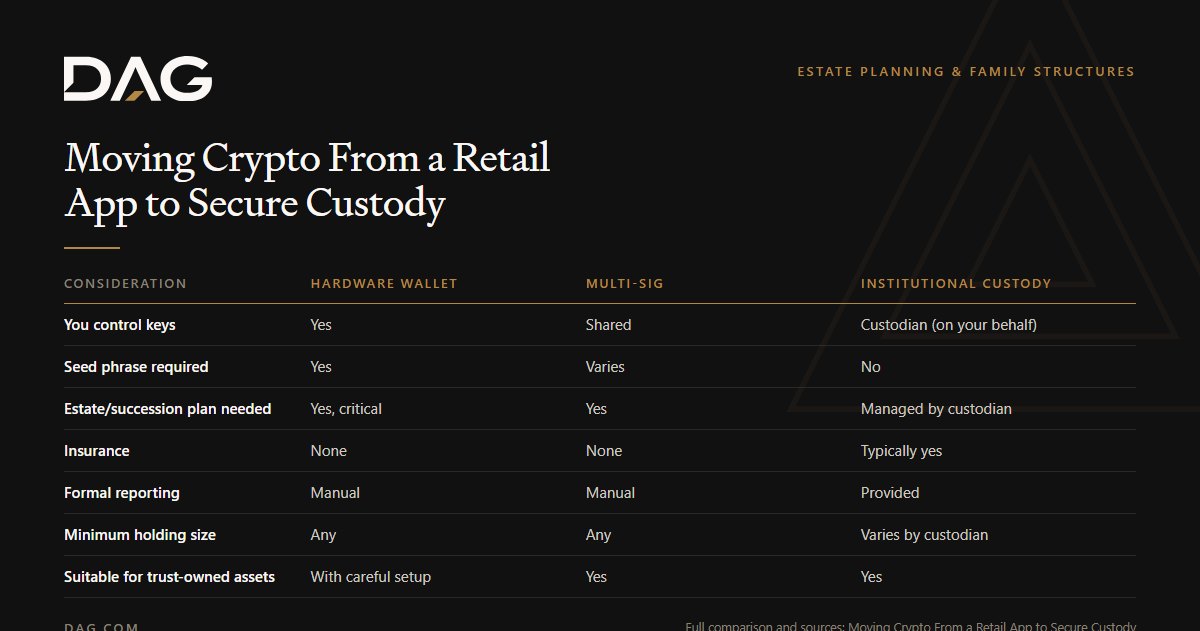
Custody Structure Checklist Before Migrating
| Consideration | Hardware Wallet | Multi-Sig | Institutional Custody |
|---|---|---|---|
| You control keys | Yes | Shared | Custodian (on your behalf) |
| Seed phrase required | Yes | Varies | No |
| Estate/succession plan needed | Yes, critical | Yes | Managed by custodian |
| Insurance | None | None | Typically yes |
| Formal reporting | Manual | Manual | Provided |
| Minimum holding size | Any | Any | Varies by custodian |
| Suitable for trust-owned assets | With careful setup | Yes | Yes |
For institutional custody evaluation criteria, see how to choose a crypto custodian and qualified custody vs self-custody for crypto wealth.
Related Questions
Does transferring crypto from a retail app reset my cost basis?
No. Moving crypto between your own accounts is a non-taxable transfer. Your original cost basis and acquisition date carry over to the receiving wallet. The transfer creates no gain or loss. Keep transaction records to prove the chain of ownership if your cost basis is ever questioned.
What happens if I send crypto to the wrong address on a retail app?
The transaction is irreversible. Blockchain networks do not have a recall mechanism, and a retail app cannot reverse a confirmed on-chain withdrawal. Prevention is the only option: verify the full receiving address character by character, send a test transaction first, and never rely on copy-pasted addresses without re-verifying them. See what happens if I transfer crypto to the wrong address? for a full explanation.
Should I move to a hardware wallet or to institutional custody?
Depends on your holdings and situation. A hardware wallet gives you direct control but places all operational and security responsibility on you, including seed phrase backup, device storage, and succession planning. Institutional custody provides formal controls, insurance, and reporting but involves a third-party relationship and typically requires a more formal onboarding process. Holdings that are meant to pass to heirs, held in a trust, or above a size where operational failure would be material generally warrant institutional custody or at minimum multi-signature architecture.
Do I need to notify the IRS when I move crypto off an exchange?
There is no specific IRS form for a wallet-to-wallet transfer between your own accounts. The obligation is record-keeping: document the date, amount, originating address, and receiving address for every transfer. You may receive a 1099-DA from the retail app reporting the withdrawal; retain that document and reconcile it against your records. See what is Form 1099-DA? for what exchanges are required to report.
Sources
- IRS Notice 2014-21 (foundational virtual currency guidance, characterizing crypto as property): https://www.irs.gov/pub/irs-drop/n-14-21.pdf
- IRS Revenue Ruling 2023-14 (staking income treatment): https://www.irs.gov/pub/irs-drop/rr-23-14.pdf
- IRS FAQ on virtual currencies (wallet transfer treatment): https://www.irs.gov/individuals/international-taxpayers/frequently-asked-questions-on-virtual-currency-transactions
Compliance Note
This page is for educational purposes only and does not constitute legal, tax, or investment advice. Tax treatment of cryptocurrency transfers depends on your specific facts, jurisdiction, and applicable law, which may change. The general statement that wallet-to-wallet transfers between your own accounts are not taxable events reflects current IRS guidance as of the updated date; consult a qualified tax professional before relying on this characterization for your situation. Network fees, withdrawal limits, and platform policies are set by third parties and subject to change without notice, verify all figures directly with your retail app and your custodian before initiating any transfer. DAG Wealth coordinates custody migration through DAG. Advisory services are provided by DAG Wealth, an SEC-registered investment adviser. Registration does not imply a certain level of skill or training.