
In the segregated vs omnibus custody distinction, segregated custody holds each client's digital assets in individually identifiable on-chain accounts; omnibus custody pools all clients' assets in shared wallets tracked by an internal database. The model chosen affects bankruptcy treatment, counterparty risk, and whether ownership can be independently verified on-chain.
What is omnibus custody?
In an omnibus custody arrangement, the custodian or exchange combines client assets into one or more shared wallets. A client's balance exists as a database record, "User A holds 2.5 BTC", but on-chain, that Bitcoin sits alongside every other user's holdings.
Most retail exchanges operate this way: the pooled structure is operationally cheaper, easier to secure at scale, and allows faster internal settlement because trades update records rather than moving assets on-chain.
The critical limitation: ownership is a database entry, not a cryptographic fact. If that database is compromised, corrupted, or the company enters bankruptcy, a client's claim reverts to a legal argument, not a provable on-chain position.
When a major centralized crypto lender froze withdrawals in 2022, clients in omnibus custody became unsecured creditors. Their Bitcoin was treated as part of the bankruptcy estate. Recovery took years and returned a fraction of original holdings.
What is segregated custody?
Segregated custody assigns each client dedicated wallet addresses. Assets are individually identifiable on-chain and legally partitioned from other clients' holdings and from the custodian's own corporate funds. The custodian still holds private keys (absent self-custody), but the client's position is verifiable directly on the blockchain.
Institutional crypto custodians operate on this model.
Bankruptcy-remoteness is the key structural benefit: depending on the specific legal structure and jurisdiction, if a segregated custodian fails, client assets may be treated as separate property that does not become part of the bankruptcy estate. The intended outcome is that clients are not competing with general creditors for recovery because their assets were not commingled. Whether a court reaches that result depends on how the custody and entity documents are drafted and on applicable insolvency law, so the protection is conditional rather than guaranteed.
Reporting and audit also simplify. Holdings can be verified on-chain directly; auditors do not need to rely solely on the custodian's internal records.
The tradeoff: segregated custody carries higher fees. Dedicated wallets, separate security infrastructure, and the legal structures maintaining partition all cost more to operate. Fee structures typically scale with assets under custody.
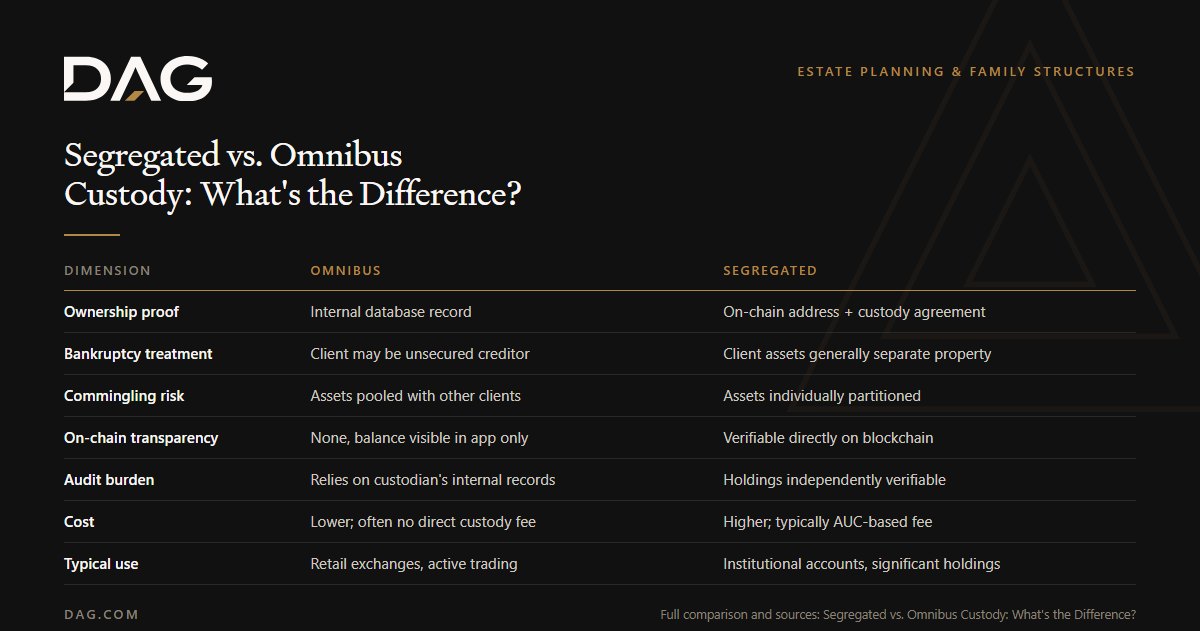
Comparison: segregated vs. omnibus custody
| Dimension | Omnibus | Segregated |
|---|---|---|
| Ownership proof | Internal database record | On-chain address + custody agreement |
| Bankruptcy treatment | Client may be unsecured creditor | Client assets generally separate property |
| Commingling risk | Assets pooled with other clients | Assets individually partitioned |
| On-chain transparency | None, balance visible in app only | Verifiable directly on blockchain |
| Audit burden | Relies on custodian's internal records | Holdings independently verifiable |
| Cost | Lower; often no direct custody fee | Higher; typically AUC-based fee |
| Typical use | Retail exchanges, active trading | Institutional accounts, significant holdings |
Who uses each model?
Omnibus custody is common for:
- Retail traders maintaining smaller balances primarily for active trading
- Situations where operational convenience outweighs custodial risk
- Balances where the cost of segregated custody exceeds risk tolerance
Segregated custody is appropriate for:
- Significant concentrations of digital assets (six to seven figures and above)
- Institutions requiring auditable custody for compliance purposes
- Family offices building long-term positions
- Trusts and LLCs where legal separateness of assets matters
- Investors who require independent on-chain verification rather than reliance on custodian records
Regulatory direction
The SEC's existing custody framework for registered investment advisers already contemplates the use of qualified custodians for client digital assets, and the agency has proposed expanding that framework. The proposed Safeguarding Rule and related crypto-custody rulemaking have moved through multiple proposal and comment cycles and are not settled as of the date above; verify the current rule status before relying on any specific requirement. To the extent these requirements apply, they generally favor segregated structures. Separately, many institutional capital allocators commonly require segregated custody as a baseline diligence condition.
Proof-of-reserves disclosures have grown, but on-chain verification of individually segregated accounts provides a stronger ownership guarantee than aggregate reserve attestations, which can still obscure commingling between omnibus client pools and institutional funds.
The trajectory in institutional custody is toward greater segregation, on-chain transparency, and legal structures that hold up in bankruptcy court.
How DAG Wealth coordinates custody
DAG Wealth works with clients holding substantial digital assets to coordinate segregated custody arrangements through institutional custodians, including structures compatible with trust, LLC, and family office legal wrappers. DAG Wealth does not custody assets directly. The coordination role covers documentation workflows, reporting integration, and aligning custody structure with broader wealth planning.
Advisory services are provided by DAG Wealth, an SEC-registered investment adviser. Registration does not imply a certain level of skill or training.
Drafting and legal review of custody agreements, trust instruments, and entity documents is the role of the client's attorney. DAG coordinates with those advisers and does not provide legal advice. Digital asset custody is not bank deposit insurance and is not covered by FDIC or SIPC protection.
Related Questions
Does segregated custody mean I hold my own private keys?
No. Segregated custody means your assets are held in wallets individually assigned to you, but the custodian still controls the private keys. Self-custody means you hold the keys yourself. Segregated institutional custody and self-custody are separate concepts. For context on the tradeoffs, see qualified custody vs. self-custody for crypto wealth.
Can a trust or LLC account get segregated custody?
Generally yes. Institutional custodians that offer segregated structures can typically open accounts in the name of a trust or LLC, provided the entity documentation satisfies their onboarding requirements. The specific wallet addresses are then legally associated with the entity, not an individual. See crypto custody for trusts and crypto custody for LLCs for more.
Is omnibus custody the same as exchange custody?
Mostly, retail and mid-tier crypto exchanges almost universally use omnibus structures. However, some exchanges offer institutional tiers with segregated arrangements. The safest practice is to confirm the custody model in writing before depositing significant assets. For a broader comparison, see qualified custodian vs. crypto exchange.
What happens to assets in omnibus custody if the custodian fails?
In an insolvency, omnibus custody clients have typically been treated as unsecured creditors in bankruptcy proceedings, their assets were part of the custodian's estate, not separate property. Recovery outcomes vary by jurisdiction and case specifics. For a fuller treatment, see what happens if a crypto custodian fails.
Internal links
- Hub: crypto custody hub
- crypto custody options compared
- crypto custody for family offices
- qualified custodian vs. crypto exchange
- cold storage vs. qualified custody
- what is institutional crypto custody
Sources
- SEC Staff Bulletin: Custody of Digital Asset Securities (2023), https://www.sec.gov/staff-bulletins/sb-2023-04
- In re FTX Trading Ltd., Bankr. D. Del. No. 22-11068 (2022), public docket
- Investment Advisers Act of 1940, Rule 206(4)-2 (Custody Rule), https://www.ecfr.gov/current/title-17/chapter-II/part-275/section-275.206(4)-2-2)
- OCC Interpretive Letter 1170 (digital asset custody by national banks, 2020), https://www.occ.gov/topics/charters-and-licensing/interpretations-and-actions/2020/int1170.pdf
Compliance Note
This page is educational and does not constitute legal, tax, investment, or custody advice. Custody structures, regulatory requirements, and bankruptcy treatment of digital assets vary by jurisdiction and change over time. Consult a qualified attorney, financial adviser, and/or custodian before making custody decisions. Past outcomes in the 2022 crypto bankruptcies are illustrative of general principles and are not guarantees of how future insolvencies will be treated. This content is not an offer or solicitation to buy or sell any security or digital asset.