
Crypto inheritance execution services coordinate the technical and legal handoff of digital assets after death, the execution layer that activates a crypto estate plan. They verify successor authority through death certificates and trust or probate documents, transition wallet signing rights to eligible heirs, and produce transfer records for estate tax filings and stepped-up basis purposes, without anyone sharing private keys in advance.
What does "crypto inheritance execution" actually mean?
Crypto estate planning produces documents and structures: trusts, operating agreements, succession protocols. Execution is the work that happens when someone dies and those documents must be activated. Specifically, it means confirming who has legal standing, coordinating with the custody setup the deceased person used, and facilitating the actual movement of assets to successor wallets, under time pressure, with family members who may have little technical background.
The gap between plan and execution is where most failures occur. A trust may clearly name a successor, but the successor still needs to authenticate to a hardware wallet, coordinate multi-signature approvals, or work through an institutional custodian's death-claim process. Execution services exist to bridge legal authority and technical control at that moment.
How does the process work, step by step?
- Notification. The family or successor trustee contacts the execution service after the owner's death.
- Legal verification. The service reviews the death certificate, trust instrument or court order, and any applicable probate documents. It confirms the claimant has legal standing before any assets move. This step protects against fraud and ensures distributions follow the estate plan rather than whoever arrives first.
- Custody coordination. The service works within the custody framework the deceased established, hardware wallet access protocols, institutional custodian procedures, or multi-signature arrangements. It does not require original private keys; it follows the successor authentication procedures documented in the estate plan.
- Multi-sig coordination. Where a multi-signature wallet requires multiple co-signers and one signer is deceased, the service coordinates the remaining signers or invokes the succession procedures in the wallet policy.
- Transfer execution. Assets move to successor wallets or accounts according to the distribution plan in the trust or operating agreement.
- Tax documentation. The service tracks asset values at date of death for stepped-up basis purposes, generates transaction records, and provides the documentation heirs need for estate tax returns and capital gains reporting. The IRS requires proper reporting regardless of the circumstances surrounding a death.
What custody setups do execution services work with?
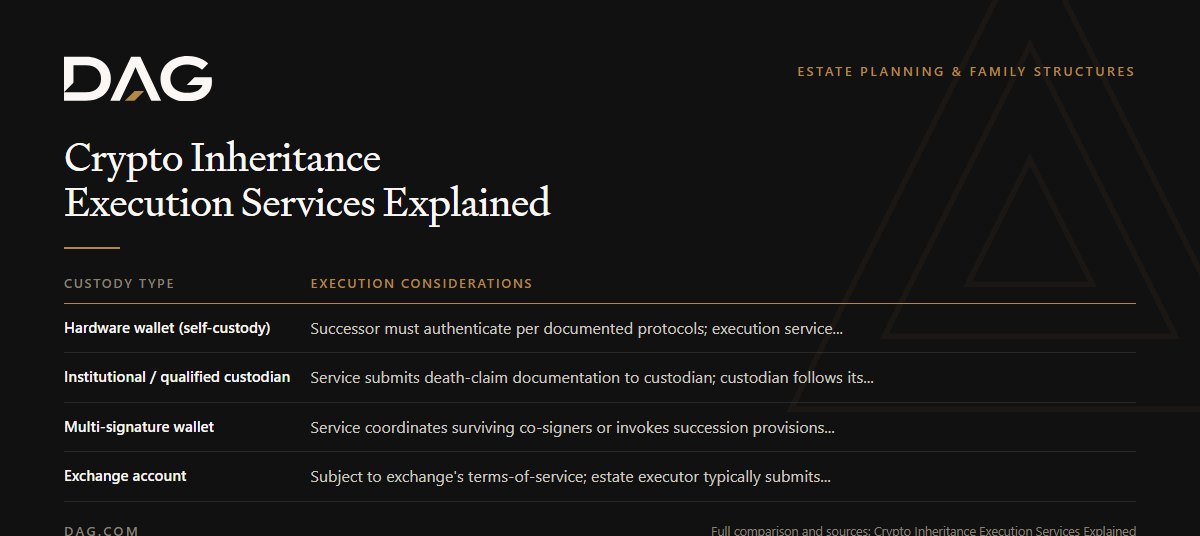
| Custody type | Execution considerations |
|---|---|
| Hardware wallet (self-custody) | Successor must authenticate per documented protocols; execution service coordinates without requiring original seed phrase |
| Institutional / qualified custodian | Service submits death-claim documentation to custodian; custodian follows its own successor-access procedures |
| Multi-signature wallet | Service coordinates surviving co-signers or invokes succession provisions; key policy should specify quorum after a signer death |
| Exchange account | Subject to exchange's terms-of-service; estate executor typically submits probate documents directly; execution service can assist with preparation |
For complex holdings, staking arrangements, liquidity pool positions, tokenized assets, execution services coordinate the unwinding or transfer of each position according to the estate plan. The process differs materially from transferring a single Bitcoin wallet.
Why not just share the seed phrase with heirs in advance?
Pre-sharing a seed phrase eliminates the security that makes self-custody valuable. Anyone with the phrase can move assets at any time, with no legal constraint and no audit trail. If that person dies, divorces, or is compromised, so are the assets.
Private key succession planning addresses this directly: the goal is to give heirs legal authority and technical access at the right moment through documented, verified channels, not to give them unconstrained access years in advance. Execution services make that possible by activating successor rights when legal conditions are met, not before.
The alternative, leaving heirs to figure it out independently, creates a different set of risks. Families unfamiliar with blockchain mechanics make mistakes that can permanently lock assets (too many wrong PIN attempts on a hardware wallet, for example) or expose them to theft during the confusion of estate administration.
What about the tax documentation?
Under current U.S. tax law (as of 2026), inherited property generally receives a step-up in basis at death: heirs typically take a cost basis equal to fair market value on the date of death, which can reduce capital gains on pre-death appreciation when assets are later sold. This is a general description, not advice for your situation, and the rules can change, verify current treatment with tax counsel. Capturing the benefit requires documenting asset values on the date of death with sufficient precision for IRS purposes.
Execution services that include tax coordination generate this documentation as part of the transfer process. Heirs should work with a qualified tax professional to apply the records correctly. DAG coordinates this documentation as part of the execution process but does not provide tax advice; consult a qualified CPA or tax attorney for your specific situation.
For more on the reporting side, see crypto tax reporting for trusts and crypto estate data room checklist.
What role does structure play before execution becomes necessary?
Structure does most of the preparation. A Wyoming LLC or trust holding crypto assets defines who inherits, under what conditions, and through what procedures. The operating agreement or trust instrument spells out succession. Documented custody protocols specify how successors authenticate and gain access.
Without that structure, execution services have less to work with. They can still assist an executor who discovers crypto assets without prior planning, see I am an executor and found crypto for that scenario, but the process is more difficult, slower, and carries higher risk of loss or dispute.
Related Questions
Can an execution service recover crypto if there is no estate plan?
Possibly, but with significant limitations. If no access protocols were documented, the executor may need to work directly with custodians (for exchange-held assets) or attempt hardware wallet recovery procedures. Assets in self-custodied wallets without any documented access path may be permanently inaccessible. Execution services can help document what is known and coordinate with custodians, but they cannot override security mechanisms or reconstruct seed phrases that were never recorded. See can heirs recover Bitcoin without a seed phrase.
Does using an execution service mean the service holds my crypto?
No. Execution services coordinate the handoff process, they do not take custody of assets. They work within your existing custody framework, whether that is a hardware wallet, an institutional custodian, or a multi-signature arrangement. Asset control remains with the custodian or the wallet until legal succession is completed and assets transfer to heir wallets or accounts.
How does an execution service interact with an estate attorney?
Probate and trust administration are legal processes that estate attorneys manage. Execution services handle the technical coordination layer: authenticating successors to custody systems, managing multi-sig transitions, and generating blockchain transaction records. The two roles are complementary. DAG coordinates with the estate attorney and other advisors but does not provide legal services; where legal steps are required (court orders, probate filings, trust administration), the estate attorney leads.
What happens if an heir disputes the distribution?
Distribution disputes are legal matters resolved through the estate attorney, probate court, or trust dispute mechanisms. An execution service should not transfer assets while a legitimate dispute is unresolved; it should pause the process and defer to legal authority. Proper legal-verification steps at the start of the execution process, confirming standing before touching anything, reduce the likelihood of executing a transfer that is later contested.
Sources
- IRS, Publication 559: Survivors, Executors, and Administrators, https://www.irs.gov/publications/p559
- IRS, Frequently Asked Questions on Virtual Currency Transactions, https://www.irs.gov/individuals/international-taxpayers/frequently-asked-questions-on-virtual-currency-transactions
- IRS, Rev. Rul. 2023-14 (staking income), https://www.irs.gov/pub/irs-drop/rr-23-14.pdf
- Uniform Fiduciary Income and Principal Act (UFIPA), §201 (stepped-up basis reference framework), verify enactment status in your state
- Wyoming Statute § 17-31-101 et seq. (Wyoming Digital Asset LLC Act), https://wyoleg.gov
Compliance Note
This page is educational and describes how crypto inheritance execution services generally function. It is not legal, tax, investment, or estate planning advice. Advisory services are provided by DAG Wealth, an SEC-registered investment adviser. Registration does not imply a certain level of skill or training. DAG coordinates execution logistics; it does not provide legal representation, probate services, or tax preparation. Probate and trust administration require a licensed estate attorney in the applicable jurisdiction. Tax treatment of inherited digital assets depends on individual circumstances and current law; consult a qualified CPA or tax attorney. No recovery of assets is guaranteed. Laws and IRS guidance on digital assets are subject to change; verify currency of all cited rules with qualified counsel.