
Offshoring crypto assets means placing holdings in foreign trusts or entities for asset protection, not tax reduction, an advanced option within crypto estate planning for those with cross-border exposure. US persons are taxed on worldwide income wherever assets are held, and offshore structures trigger mandatory reporting: FBAR/FinCEN 114, FATCA Form 8938, and Forms 3520/3520-A. Used with full compliance, they can separate crypto wealth from domestic legal exposure.
What does "offshoring crypto assets" actually mean?
Placing crypto holdings into a foreign trust or foreign-domiciled entity creates a legal barrier between you and the assets. Domestic creditors must pursue claims in the trust's jurisdiction, under that jurisdiction's laws, against a separate legal entity. Offshore structures also allow estate planning across borders, distributions can be structured across decades with protections that may survive changes in your home country's estate laws.
Common motivations include:
- Separating holdings from domestic lawsuit exposure
- Managing family succession across multiple countries
- Holding assets across more than one regulatory environment
Offshore structures do not reduce US income tax. Any advisor or promoter suggesting otherwise is wrong.
What does "substance" require, and why do most offshore plans fail?
Registering a company in the Cayman Islands, Cook Islands, or any other offshore jurisdiction is not enough. Most jurisdictions now require proof of actual business activity to recognize the entity as legitimate. That means physical presence, local employees or directors, and real operational expenses. An entity that exists only on paper will not survive scrutiny from tax authorities or in legal proceedings.
Substance requirements vary by jurisdiction. Some require board meetings held in-country with documented minutes. Others require minimum annual operating expenditures. Some require local banking relationships. The rules are enforced differently in practice than they read in statute, which is why local counsel in the target jurisdiction is required, not optional.
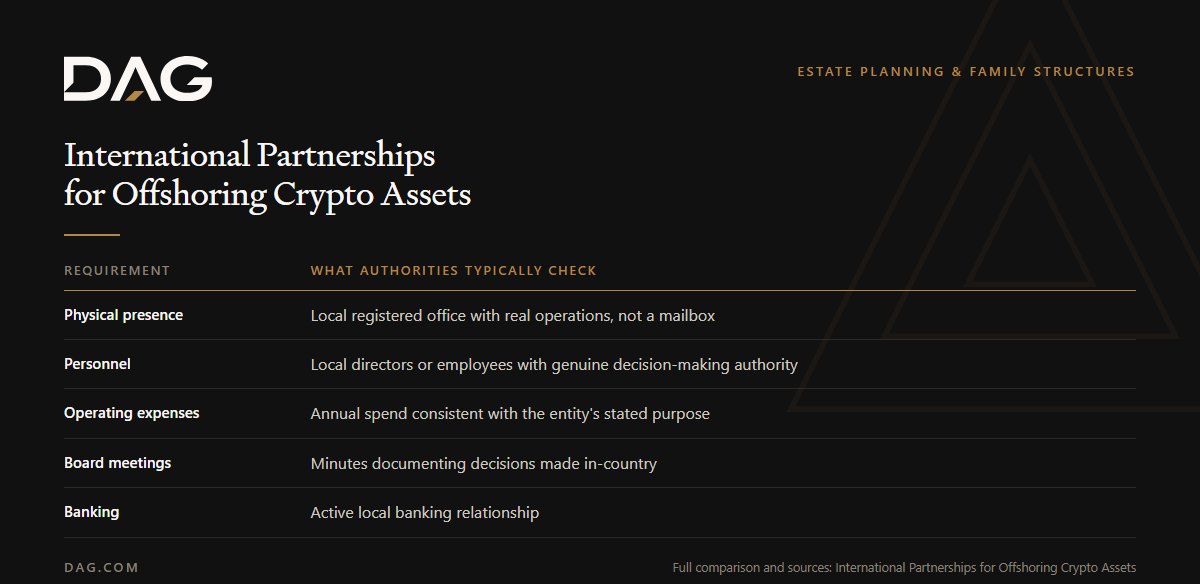
How to evaluate whether a jurisdiction meets substance requirements
| Requirement | What authorities typically check |
|---|---|
| Physical presence | Local registered office with real operations, not a mailbox |
| Personnel | Local directors or employees with genuine decision-making authority |
| Operating expenses | Annual spend consistent with the entity's stated purpose |
| Board meetings | Minutes documenting decisions made in-country |
| Banking | Active local banking relationship |
How do foreign trusts work for crypto asset separation?
A foreign trust places legal title with a trustee governed by foreign law, while you retain beneficial interest. This separation is the mechanism that creates creditor protection, domestic creditors must pursue claims against the trust itself, in its jurisdiction, under its rules.
Foreign trusts also solve succession problems. Distribution schedules can span generations and cross borders, with protections designed to outlast changes to your home country's estate laws.
For crypto specifically, the trust holds the assets but custody, basis tracking, and reporting still require active management. DAG coordinates the administrative infrastructure, custody relationships, reporting workflows, platform integration, while your legal team structures the trust itself.
Reporting obligations for US persons holding foreign trusts
US persons with foreign trusts face mandatory annual reporting. This is not optional and failure to file carries substantial penalties:
- Form 3520: Reports transfers to and distributions from foreign trusts
- Form 3520-A: Annual information return required of the foreign trust (trustee files; US person is responsible if trustee does not)
- FBAR / FinCEN 114: Required if aggregate foreign financial account balances exceed the reporting threshold (commonly cited as $10,000) at any point during the year
- FATCA Form 8938: Required for specified foreign financial assets above applicable thresholds
Reporting thresholds and penalty amounts are general and may change. Verify current requirements at IRS.gov and FinCEN.gov before filing (figures as of 2026-06-02).
How to structure an offshore crypto holding: step-by-step
- Define the protection goal. Identify what you are protecting against, legal liability, estate complexity, regulatory concentration, before choosing a jurisdiction or structure. The goal determines the answer.
- Engage US counsel. A US attorney with international estate planning experience must review the structure before anything is moved. This is not a role for offshore promoters or online services.
- Engage foreign counsel in the target jurisdiction. Local expertise is required to meet substance requirements and understand what authorities actually enforce versus what the law says.
- Coordinate tax advice across both jurisdictions. Your US tax advisor maps the reporting obligations, staking and DeFi income characterization, and treaty treatment before assets transfer.
- Establish custody relationships. Institutional crypto custody for trusts under the foreign entity requires its own custodian due diligence. See crypto custody due diligence checklist.
- Document substance from day one. Board meeting minutes, operating expense records, and banking relationships must be maintained continuously, not reconstructed later.
- Set up ongoing compliance workflows. Annual filings, trustee meetings, regulatory monitoring, and cross-jurisdictional tax reporting run indefinitely. Build the process before the structure is funded.
- Fund the structure. Transfer assets only after legal documentation, custody arrangements, and reporting workflows are operational.
Realistic timeline: six months minimum from initial planning to an operational structure. Jurisdictional approvals, legal documentation, and institutional custody onboarding each take time.
What does DAG Wealth coordinate?
DAG Wealth does not provide legal or tax advice. The coordination role covers:
Administrative infrastructure. After your attorney structures the foreign entity or trust, DAG Wealth establishes custody relationships, sets up reporting workflows, and integrates everything into the platform.
International partner introductions. DAG Wealth can introduce clients to independent law firms, trust companies, and administrators across multiple jurisdictions, depending on the client's planning requirements. DAG Wealth is not licensed to practice law or provide legal services in any foreign jurisdiction; engagement of qualified local counsel in the target jurisdiction is required.
Ongoing compliance coordination. Annual filings, substance documentation, trustee meetings, regulatory monitoring, and deadline tracking across jurisdictions.
Operational management. Custody transfers, wallet management, transaction reporting, and basis tracking across tax jurisdictions.
When do offshore structures not make sense?
- Primary goal is tax reduction. Offshore structures do not reduce US tax on worldwide income. If that is the goal, the structure will not work and will create compliance exposure.
- Smaller holdings. Setup and ongoing substance costs, legal, administrative, and operational, can outweigh the benefits for smaller portfolios. One illustrative figure sometimes cited is roughly $5M, but this is an illustrative example only, not a rule; the appropriate threshold depends on individual circumstances and current costs (verify current figures).
- Insufficient budget for proper legal structuring. A poorly structured offshore entity creates more problems than it solves. If the full cost of setup and ongoing substance cannot be funded, this approach is not appropriate.
Related Questions
Do offshore crypto structures trigger US tax reporting?
Yes, extensively. US persons must file FBAR/FinCEN 114 for foreign financial accounts, Form 8938 under FATCA, and Forms 3520 and 3520-A for foreign trusts. These are separate from income tax reporting. Failure to file carries civil and criminal penalties. See crypto tax reporting for trusts for the domestic trust reporting context; offshore trusts carry additional layers on top.
How is staking income taxed when held in an offshore structure?
Unresolved. Tax treaties were written for traditional assets and do not clearly address staking rewards, liquidity pool income, or whether such income is "earned" in the jurisdiction where the validator runs or where the beneficial owner resides. Your tax advisor must analyze each income type before the structure is funded. See crypto staking tax reporting for the general reporting framework.
What happens if a foreign trust does not meet substance requirements?
Tax authorities, including the IRS, can disregard the entity and treat assets as still owned by the grantor. This eliminates the protection the structure was intended to create and may result in back taxes, interest, and penalties. Legal challenges can also defeat asset-protection claims if a court finds the entity lacks genuine independent existence.
Can a domestic trust structure accomplish similar goals without offshore complexity?
For many clients, yes. Domestic trust structures for crypto wealthy individuals, including directed trusts and trust-owned LLCs, can provide creditor protection and succession planning without foreign substance requirements and offshore reporting obligations. See crypto estate planning for high-net-worth families for a broader comparison of domestic and offshore planning approaches.
Sources
- IRS, Foreign Trusts: https://www.irs.gov/businesses/small-businesses-self-employed/foreign-trusts
- IRS, Form 3520 Instructions: https://www.irs.gov/forms-pubs/about-form-3520
- IRS, Form 3520-A Instructions: https://www.irs.gov/forms-pubs/about-form-3520-a
- FinCEN, FBAR Filing Requirements (FinCEN 114): https://www.fincen.gov/report-foreign-bank-and-financial-accounts
- IRS, FATCA Form 8938 Overview: https://www.irs.gov/businesses/corporations/foreign-account-tax-compliance-act-fatca
- IRS, US Taxation of Worldwide Income: https://www.irs.gov/individuals/international-taxpayers/us-citizens-and-resident-aliens-abroad
Compliance Note
This page is for educational purposes only and does not constitute legal, tax, or investment advice. Offshore structures involve complex multi-jurisdictional legal and tax requirements. US persons considering offshore crypto structures must engage qualified US legal counsel, foreign legal counsel in each relevant jurisdiction, and a tax advisor with international experience before moving any assets.
US persons are taxed on worldwide income regardless of where assets or entities are held. Offshore structures do not reduce US tax obligations. They are asset-protection tools that require full compliance with all applicable US reporting requirements, including FBAR/FinCEN 114, FATCA Form 8938, and Forms 3520/3520-A for foreign trusts.
DAG Wealth (Digital Ascension Group) provides administrative coordination and partner introductions. DAG Wealth does not provide legal or tax advice, does not practice law, and is not licensed to provide legal or tax services in any US or foreign jurisdiction. Entity formation, trust and estate drafting, and operating-agreement work are legal services; DAG coordinates these with qualified counsel and does not perform them. Consult a qualified attorney and tax professional for advice specific to your situation.
Advisory services are provided by DAG Wealth, an SEC-registered investment adviser. Registration does not imply a certain level of skill or training.