
A family trust for digital assets holds crypto, NFTs, and other digital holdings for named beneficiaries, and is one of the core structures covered in crypto estate planning. Standard trust language written for bank and brokerage accounts will not work, it needs provisions for access credentials, key storage, trustee technical competency, and ongoing tax compliance, otherwise assets may be permanently lost at death.
What Is a Family Trust for Digital Assets?
A family trust for digital assets is a legal structure that holds crypto wallets, exchange accounts, NFTs, domain names, or other digitally-held value on behalf of named beneficiaries, with a trustee responsible for managing and eventually distributing those assets.
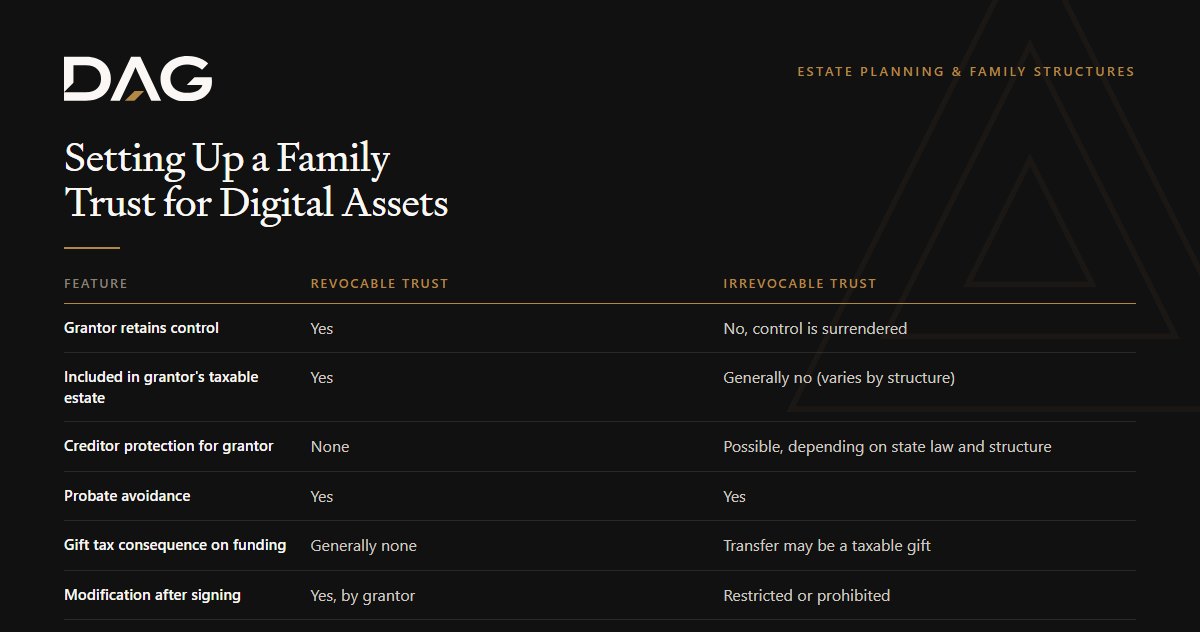
The two main forms differ materially:
| Feature | Revocable Trust | Irrevocable Trust |
|---|---|---|
| Grantor retains control | Yes | No, control is surrendered |
| Included in grantor's taxable estate | Yes | Generally no (varies by structure) |
| Creditor protection for grantor | None | Possible, depending on state law and structure |
| Probate avoidance | Yes | Yes |
| Gift tax consequence on funding | Generally none | Transfer may be a taxable gift |
| Modification after signing | Yes, by grantor | Restricted or prohibited |
A revocable trust's primary benefit for digital assets is probate avoidance and centralized access instructions, not asset protection. Protection requires an irrevocable structure, and that trade-off (surrendering control, potential gift tax) must be evaluated with qualified legal and tax counsel.
Funding a revocable trust with existing crypto holdings is generally not a taxable event; funding an irrevocable trust may trigger gift tax reporting obligations. Consult a tax professional before transferring.
Why Standard Trust Language Fails for Crypto
Traditional trusts assume a third-party institution holds the assets. When someone dies, the trustee contacts the bank or brokerage, presents a death certificate and trust document, and the institution transfers title.
Self-custodied crypto has no institution to call. Access requires:
- The physical hardware wallet and its PIN
- The seed phrase or multi-sig signing keys
- Exchange login credentials and two-factor authentication recovery codes
Without explicit instructions in the trust document, and a functioning, secure process for the trustee to follow, the assets are effectively inaccessible. Families lose crypto this way regularly, not through theft but through planning gaps.
What Trust Provisions Must Cover
Effective digital asset trust provisions address five areas:
Asset definition. Name specific wallets, exchange accounts, NFT platforms, and any other location where digital value is held. "All my cryptocurrency" is too vague when holdings span multiple wallets and custodians.
Access instructions (by reference, not in the document). The trust should direct the trustee to a separately maintained and securely stored access document, never embed seed phrases or private keys in the trust instrument itself. The trust and the access document must be stored separately.
Security architecture. The trustee needs conditional access, available at incapacity or death, not before. Common approaches include encrypted storage with a trusted third party, commercial digital-inheritance services, or a multi-sig custody arrangement where multiple signers are required.
Tax compliance provisions. Digital assets require ongoing attention to capital gains, estate tax inclusion, and income from staking rewards or yield. The trust should authorize the trustee to engage tax professionals and specify how gains and income are reported. See crypto tax reporting for trusts for the mechanics.
Technology flexibility. The platforms and wallet standards that exist today may not exist in 20 years. The trust should give the trustee explicit authority to migrate assets to new platforms, custody arrangements, or protocols.
How to Choose a Trustee
The trustee must either understand digital assets or be willing to hire specialists. Naming someone unfamiliar with private key management as the sole trustee of a significant crypto estate creates real execution risk.
Options families use:
- Tech-capable individual trustee with authority to engage professional help when needed
- Co-trustee structure: institutional trustee for traditional assets, knowledgeable co-trustee for digital assets. Note that many institutional trustees decline crypto co-trustee arrangements due to unfamiliarity with liability exposure, confirm willingness before drafting.
- Directed trust structure: separates the investment direction function from administrative trustee duties, which can work well when the grantor wants an advisor (like DAG Wealth) to handle technical aspects while a corporate trustee handles administration. See directed trusts for digital assets for how this works.
A crypto trustee checklist can help evaluate candidates before the trust is signed.
How to Store Access Information Securely
Never write seed phrases, private keys, or wallet PINs in the trust document itself. The trust is a legal instrument that may be reviewed by attorneys, courts, or notaries. If the trust contains access credentials, they are not secure.
Practical approaches vary by holdings size and complexity:
- Encrypted digital document with a trusted third party (attorney, bank safe deposit) holding the decryption key or passphrase under specific conditions
- Commercial digital-inheritance service designed for this purpose
- Multi-sig setup where no single key holder can move assets unilaterally, this eliminates the single point of failure but requires more setup
For detailed guidance, see seed phrase storage for estate planning.
Whatever approach is chosen, test it. Have the trustee go through the access process while you're alive, not moving assets, just confirming they can reach them, before you rely on the plan.
Exchange Accounts vs. Self-Custody
Exchange-held crypto is more accessible at death than self-custodied assets but introduces its own complications. Exchange policies for deceased account holders vary: some work directly with trustees, others require probate proceedings even when a trust exists, and some freeze accounts pending extensive documentation.
The trust should specifically list exchange accounts and include authorization language for trustee access. Some families keep a portion on exchanges for easier administration and hold larger balances in qualified custody for better control and protection.
Tax Considerations
Step-up in basis at death applies to digital assets held in a revocable trust (and many irrevocable trust structures), just as it does for traditional assets. Beneficiaries inherit at the fair market value on the date of death. Gain accrued before death is generally not subject to capital gains tax if assets are sold promptly.
Estate tax: Digital assets are included in the gross estate for federal estate tax purposes. As an illustrative figure, the federal exemption was reported at roughly $13.61 million per individual for 2024; this threshold is indexed and subject to scheduled legislative change, so verify the current amount with qualified counsel before relying on it.
Staking rewards and yield generated inside the trust are generally taxable income in the year received. The trust instrument should address how these are handled.
Transferring assets to fund an irrevocable trust: This may be a taxable gift. Get tax advice before funding.
For family offices managing trust-held crypto, crypto tax reporting for trusts covers the mechanics of Form 1041 and K-1 issuance.
When a Trust Makes Sense vs. Other Options
Trusts are not the only structure. A simple will with clear instructions may be sufficient for modest crypto holdings. Consider a trust when:
- Holdings are significant enough that probate administration creates meaningful cost, delay, or privacy exposure
- You have minor children who need managed distributions over time rather than immediate lump-sum inheritance
- Privacy matters, wills become public record through probate; trusts do not
- You want ongoing asset management rather than immediate distribution
- Asset protection is a goal (requires irrevocable structure; consult counsel)
For a structured comparison, see crypto will vs. crypto trust and should crypto be held personally, in an LLC, or in a trust.
Five Common Mistakes
Listing assets without explaining access. "All my cryptocurrency holdings" in the trust, with no linked access document and no process for the trustee to find the assets.
Storing seed phrases with the trust document. Anyone who reads the trust can access the crypto. Store them separately, in a secure system with conditional access.
Never telling the trustee about the digital assets. Thorough planning means nothing if the trustee learns about the crypto holdings for the first time after death.
Failing to update the access document. The trust references a hardware wallet you replaced two years ago. Maintain a current digital asset inventory and update it quarterly or whenever holdings change significantly.
No coordination among the people executing the plan. The trustee doesn't know how to use a hardware wallet. The estate attorney has never dealt with multi-sig. The beneficiaries don't know what they're inheriting or what their tax obligations are. The plan exists on paper but has no operational backbone.
Related Questions
Is a revocable trust enough to protect digital assets from creditors?
No. A revocable trust offers no creditor protection for the grantor, the assets remain reachable because the grantor retains control and the assets are still included in the taxable estate. Creditor protection requires an irrevocable structure, which involves surrendering meaningful control and may have gift tax consequences. This distinction matters significantly for anyone holding concentrated crypto positions. Consult an estate attorney before choosing a structure based on protection goals.
Do I need a new trust, or can I add digital assets to my existing one?
Most existing trusts can be amended to include digital assets, provided the trust was drafted with sufficient flexibility in the asset definition clauses. The more important question is whether the trust contains the access and security provisions described above, most older trusts do not, regardless of asset definition language. Review the existing document with an attorney who has handled digital asset estates before assuming an amendment is sufficient.
Does a family trust for digital assets need to be drafted differently in different states?
Yes, meaningfully so. Wyoming, South Dakota, Nevada, and Delaware have enacted statutes that address digital asset trust administration, directed trust structures, and trustee duties with respect to digital property. These states may offer advantageous terms for crypto-heavy estates. The Revised Uniform Fiduciary Access to Digital Assets Act (RUFADAA) has been adopted in most states but implementation varies. State-specific legal counsel is required. DAG coordinates with attorneys in relevant jurisdictions but does not draft legal documents.
What happens to NFTs and domain names in a trust?
NFTs are treated as property held in the trust wallet; the trustee needs wallet access and understanding of the marketplace or protocol where the NFT is held. Domain names registered with major registrars can often be transferred to the trust directly through the registrar's account, but the trustee still needs account credentials. Digital intellectual property requires the trust to specify rights management and licensing authority. All of these should be inventoried and included in the access document.
Sources
- IRS Notice 2014-21, IRS Revenue Ruling 2023-14 (digital asset taxation)
- IRS Publication 559 (Survivors, Executors, and Administrators), step-up in basis
- Revised Uniform Fiduciary Access to Digital Assets Act (RUFADAA). Uniform Law Commission, 2015
- Wyoming Stat. § 34-29-101 et seq. (Wyoming Digital Asset Act)
- Internal Revenue Code § 2001 et seq. (estate tax)
- Internal Revenue Code § 2503 (annual gift tax exclusion), § 2505 (unified credit)
Compliance Note
This page is educational only and does not constitute legal, tax, or investment advice. Trust structures, tax treatment, and creditor protection rules vary by state and individual circumstances and change over time. The federal estate tax exemption and gift tax rules referenced here are subject to legislative change; verify current thresholds with qualified counsel before relying on any figure.
DAG coordinates planning across legal, tax, and investment disciplines but does not draft legal documents or provide legal advice. Trust drafting is a legal service performed by licensed attorneys. Advisory services are provided by DAG Wealth, an SEC-registered investment adviser. Registration does not imply a certain level of skill or training. Asset and creditor protection is never absolute. Consult a licensed estate planning attorney and qualified tax professional for advice specific to your situation.