
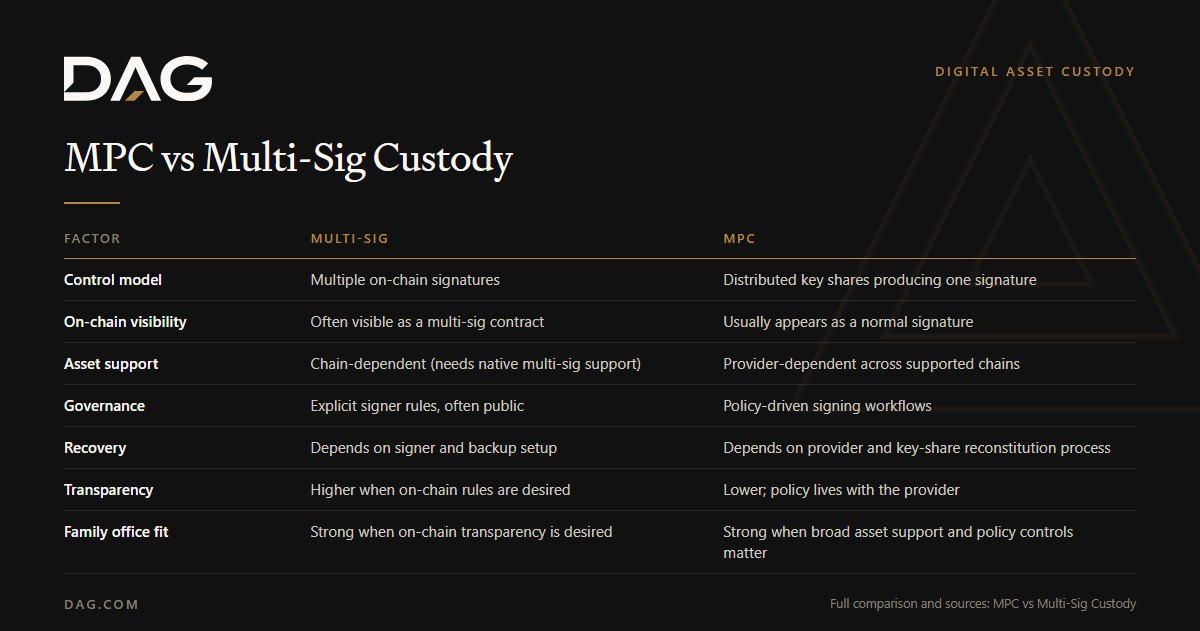
MPC vs multi-sig custody is a comparison of two ways to remove single-key risk from digital assets. Multi-sig requires several signatures under rules that are often visible on-chain. MPC splits a key into cryptographic shares that jointly produce one signature without ever reconstructing a full private key. The better fit depends on assets, governance, recovery, and provider.
Short Answer
MPC custody and multi-sig custody both avoid relying on a single person or a single private key to move digital assets. Multi-sig uses multiple signatures under rules that are often visible on-chain. MPC uses cryptographic key shares to produce a valid signature without reconstructing one full private key. The better choice depends on asset support, governance, recovery, custody provider, compliance, and operational needs.
What These Terms Mean
Multi-signature (multi-sig) custody requires a defined quorum of independent signatures, for example, 2-of-3 or 3-of-5, before a transaction can execute. The signing policy is enforced by a smart contract or wallet script, so on many chains the rule and the signers can be inspected on-chain.
Multi-party computation (MPC) custody splits one private key into several shares held by different parties or devices. Those shares cooperate to compute a single valid signature without any one location ever holding the whole key. On-chain, the result usually looks like an ordinary single-signature transaction.
Both models support shared control, which is why they matter for digital asset custody inside a family office or trust.
Why This Matters
High-net-worth families and family offices need shared control. One person holding one seed phrase is often too fragile. MPC and multi-sig can both create approval workflows, but they differ in how they work and how they are supported across chains, custodians, wallets, and institutions. For households deciding between holding keys themselves and using a regulated provider, the choice also interacts with the broader question of qualified custody versus self-custody.
How They Compare
| Factor | Multi-Sig | MPC |
|---|---|---|
| Control model | Multiple on-chain signatures | Distributed key shares producing one signature |
| On-chain visibility | Often visible as a multi-sig contract | Usually appears as a normal signature |
| Asset support | Chain-dependent (needs native multi-sig support) | Provider-dependent across supported chains |
| Governance | Explicit signer rules, often public | Policy-driven signing workflows |
| Recovery | Depends on signer and backup setup | Depends on provider and key-share reconstitution process |
| Transparency | Higher when on-chain rules are desired | Lower; policy lives with the provider |
| Family office fit | Strong when on-chain transparency is desired | Strong when broad asset support and policy controls matter |
A deeper treatment of the two approaches and their tradeoffs also belongs in any crypto custody due diligence checklist before a provider is selected.
Evidence Standard
This article explains custody models and does not recommend a specific wallet or custodian. It does not state or imply that any named provider, chain, or model is safer, superior, or deficient relative to another.
How to Choose Between Them
- Map the assets you hold. Confirm which chains your holdings sit on and whether each model supports them natively or through a provider.
- Define the governance you need. Decide who must approve a transfer and whether you want those rules enforced on-chain (multi-sig) or by provider policy (MPC).
- Stress-test recovery. Ask what happens if a signer, device, or key share is lost, and document the backup and reconstitution process.
- Review the provider's controls. If a custodian operates the model, examine its SOC 1 or SOC 2 reporting, insurance, and whether it acts as a qualified custodian under the SEC custody rule.
- Write it down. Capture the chosen model, signers, and procedures so an adviser, trustee, or auditor can follow them. Use a crypto custody policy as the home for these decisions.
When It May Help
- The family wants shared transaction control.
- A trust, LLC, or family office requires approval workflows.
- The holder wants to reduce single-key risk.
- Advisors need a custody model they can document.
- Different assets require different custody methods.
When It May Not Be Enough
Neither MPC nor multi-sig removes market risk, custody risk, or tax risk, and neither eliminates human error, phishing, poor policy design, or weak recovery procedures. No technical control guarantees the safety of assets or any particular outcome. Governance matters as much as cryptography.
Related Questions
Is MPC safer than multi-sig?
Not universally. Each model has strengths and tradeoffs, and implementation quality, signer discipline, and recovery design often matter more than the cryptography itself. Evaluate both against your own governance and consult a qualified professional.
Is multi-sig better for transparency?
Often, because multi-sig rules may be visible on-chain depending on the network and wallet design. That visibility can help an auditor or trustee verify controls, though it can also expose the signing structure publicly. Whether that tradeoff suits you depends on the facts.
Which is better for institutions?
It depends on the provider, assets, workflow, and governance. Some institutions favor MPC for broad asset support and policy-based controls; others prefer multi-sig for on-chain transparency. Neither model alone makes a provider a qualified custodian.
Does either model change my tax or reporting obligations?
Generally no. Choosing MPC or multi-sig does not change how digital assets are treated for tax purposes, and transfers between your own wallets are usually not themselves taxable events. Confirm the specifics with a qualified tax professional, and keep records that survive an audit.
Bottom Line
MPC and multi-sig are tools for shared control. The right question is not which acronym wins, but which control model fits the family, entity, trust, custodian, and advisor workflow.
Sources
- MPC Alliance: Introduction to secure multiparty computation for digital asset custody wallets
- CoinGecko: MPC wallets vs multi-sig wallets
Compliance Note
This article is for general educational purposes and is not custody, cybersecurity, legal, tax, or investment advice.