
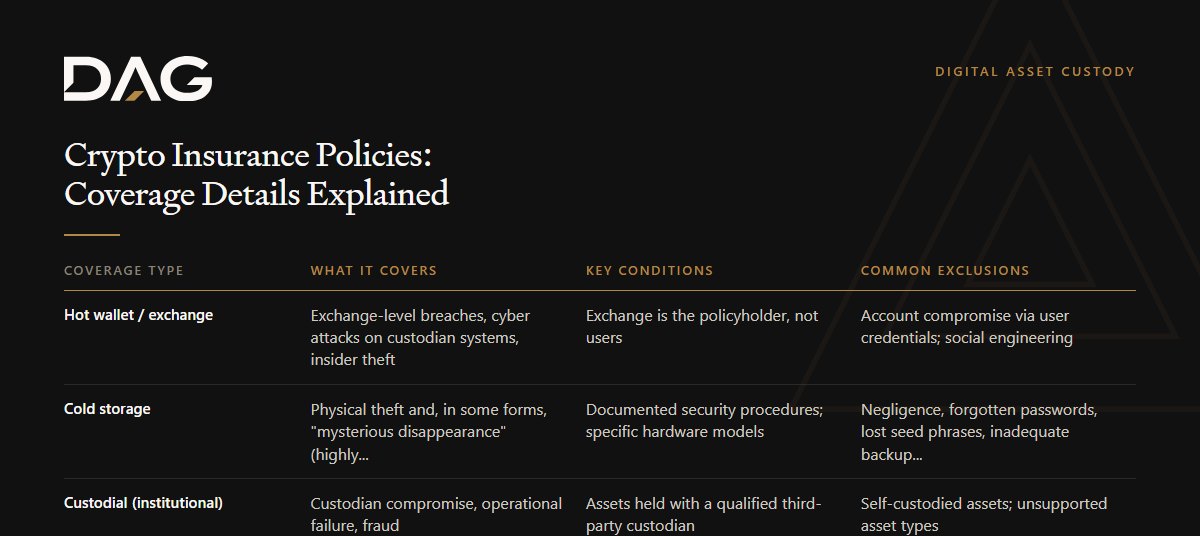
Crypto insurance policies are narrow property and crime coverage for digital assets, not a guarantee that holdings are protected. Exchange crime insurance covers the exchange, not your account; self-custody has essentially no default coverage; and cold storage policies pay only when documented security procedures are met. The exclusions matter as much as the coverage.
Crypto insurance is property and crime coverage written specifically for digital assets. Unlike FDIC deposit insurance or SIPC securities protection, it is discretionary, unregulated at the federal level, and highly variable in scope depending on the insurer and policy structure.
What does crypto insurance actually cover?
Coverage depends entirely on policy type and custody arrangement. The four main categories are:
| Coverage Type | What It Covers | Key Conditions | Common Exclusions |
|---|---|---|---|
| Hot wallet / exchange | Exchange-level breaches, cyber attacks on custodian systems, insider theft | Exchange is the policyholder, not users | Account compromise via user credentials; social engineering |
| Cold storage | Physical theft and, in some forms, "mysterious disappearance" (highly policy-specific) | Documented security procedures; specific hardware models | Negligence, forgotten passwords, lost seed phrases, inadequate backup documentation |
| Custodial (institutional) | Custodian compromise, operational failure, fraud | Assets held with a qualified third-party custodian | Self-custodied assets; unsupported asset types |
| Crime / specie | Insider theft, employee misconduct at custodians, external fraud | Complements storage-based coverage | Market loss, regulatory seizure, voluntary transfers under fraudulent instructions |
These are distinct policy types, not layers of the same policy. A cold storage policy does not cover exchange assets, and vice versa.
Sub-limits and deductibles matter more than headline limits
Headline limits often overstate what is recoverable. As an illustrative example (verify against any actual policy), a policy advertised with a $1 million per-incident limit may carry a lower per-wallet sub-limit, so holdings split across several wallets can leave aggregate exposure and actual recoverable amounts far apart. Crypto policies also commonly carry meaningful deductibles, which are material on a large loss. Read the declarations page against your actual custody structure, not against the policy summary.
Does exchange insurance cover my account?
No. Exchange-held crime insurance is the custodian's policy for the custodian's benefit. A major crypto exchange, for example, may disclose crime insurance covering physical security breaches, cyber attacks on its systems, and employee theft. It does not cover individual account compromise resulting from a user's password being obtained, two-factor authentication being bypassed, or voluntary transfers made under fraudulent instructions (social engineering). The distinction is the exchange's infrastructure versus your account credentials.
Does homeowner's insurance cover crypto?
Rarely in any meaningful amount. Some homeowner's and renter's policies cover only a small amount of physical cash on premises, and most policy language either explicitly excludes digital assets or is ambiguous enough that claims get denied. Business property and commercial crime policies have the same structural problem at larger scale.
What about self-custody, hardware wallets and seed phrases?
Cold storage held personally has no default insurance coverage. Crypto-specific cold storage policies exist but require the insurer to approve your specific custody setup in advance: hardware wallet model, physical storage location, documented seed phrase backup procedures, and access controls. If the actual setup deviates from the approved configuration, claims can be denied regardless of the cause of loss. Loss of a seed phrase, forgotten passwords, and hardware failure are commonly excluded even under dedicated cold storage policies.
Related Questions
Is crypto insured the way bank deposits are?
No. FDIC insurance covers up to $250,000 per depositor per institution at FDIC-member banks for cash deposits. SIPC protects brokerage customers against firm failure up to $500,000 in securities and cash. Neither program covers cryptocurrency. Some exchanges hold cash in FDIC-insured accounts on behalf of users, that cash portion may carry FDIC protection, but the crypto itself does not.
Who actually underwrites crypto insurance?
Lloyd's of London syndicates are the primary underwriters in this market. A small number of specialty insurers, including Marsh, Aon, and Lockton on the broker side, have built dedicated crypto coverage practices. The market has grown since 2018 but remains thin relative to the size of the asset class. For individual self-custody at smaller account sizes, standalone coverage at reasonable premiums is genuinely difficult to source; the underwriting economics do not currently favor that segment.
What documentation do I need to file a claim?
Claim documentation requirements are extensive and must be assembled before a loss occurs. Insurers typically require transaction records establishing assets held, evidence of the security procedures in place at the time of loss, proof of the loss event itself, and documentation of the custody setup as originally disclosed and approved. Investors who did not maintain this documentation before a loss find it nearly impossible to satisfy requirements after the fact.
Does insurance cover DeFi or smart contract losses?
Generally no. Losses from software bugs, smart contract failures, or protocol exploits in DeFi positions are a standard exclusion in most crypto insurance policies. On-chain protocol risk is a distinct risk category that a small number of specialized DeFi coverage providers (such as Nexus Mutual or similar discretionary cover protocols) attempt to address, but this is separate from custodial property and crime coverage.
What to verify before placing a policy
Ask for the specific covered perils in the policy document, not the marketing summary. Confirm that your actual custody setup, specific hardware wallet model, multisig configuration, exchange accounts by name, is covered and approved. Get the claims notification procedure and documentation requirements in writing. Check the insurer's financial strength rating and, where possible, whether they have a track record of paying claims in this asset class.
For institutional holdings and family office structures, coverage is often embedded in the custody arrangement itself rather than sourced as a standalone policy. Understanding what a custodian's insurance actually covers, and whether it extends to your assets or only to the custodian's operations, is part of crypto custody due diligence. The interaction between insurance and custody structure is covered in more detail at crypto insurance and custody.
For high-net-worth families evaluating how insurance fits into a broader protection structure, crypto wealth planning and common crypto mistakes for high-net-worth investors address adjacent decisions around custody selection, concentration risk, and documentation gaps that affect both insurability and estate planning outcomes. Families using institutional crypto custody should confirm directly with their custodian which risks the custody arrangement's insurance covers and which remain the client's exposure.
The crypto custody hub links out to the full custody and coverage topic cluster.
Sources
- FDIC: What's Covered: https://www.fdic.gov/deposit/covered/ (accessed 2026-06-02)
- SIPC: What SIPC Protects: https://www.sipc.org/for-investors/what-sipc-protects (accessed 2026-06-02)
- Lloyd's of London, specialty crypto and digital-asset coverage market; no single stable public factsheet URL, so confirm current market terms directly with a Lloyd's broker.
Any coverage figures, limits, sub-limits, or deductible levels referenced on this page are illustrative only and do not reflect any specific current policy. Confirm all terms with a licensed insurer or broker.
Compliance Note
This page is for educational purposes only and does not constitute legal, tax, investment, or insurance advice. Crypto insurance markets, policy terms, and coverage availability change frequently. Coverage details vary materially by insurer, policy form, and custody arrangement. Do not rely on this page as a substitute for review of actual policy documents. Consult a licensed insurance professional with experience in digital asset coverage before placing any policy. DAG provides wealth management services; it does not sell insurance.