
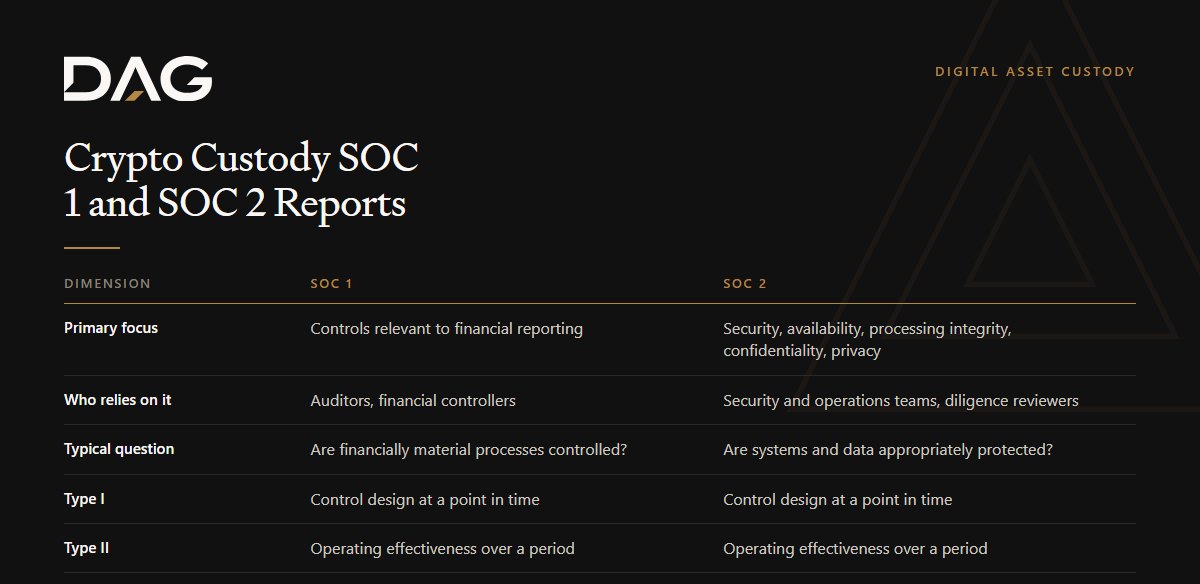
Crypto custody SOC 1 and SOC 2 reports are independent assurance reports that help investors, RIAs, and family offices evaluate aspects of a crypto custodian's control environment during due diligence. SOC 1 covers controls relevant to financial reporting; SOC 2 covers security, availability, processing integrity, confidentiality, and privacy. They support a review but do not guarantee that assets are risk-free.
What a SOC Report Is
A SOC (System and Organization Controls) report is produced by an independent CPA firm that examines a service provider's controls against a defined standard. For a crypto custodian, these reports give a diligence team third-party evidence about how the firm manages private keys, transaction approvals, and access permissions. A report describes the control environment as tested; it does not certify that holdings are safe or insured. SOC reports are one input among many in crypto custody due diligence, not a substitute for it.
SOC 1 vs SOC 2
The two report types answer different questions, and a serious diligence review usually looks at both. This sits inside the broader work of digital asset custody selection and oversight.
| Dimension | SOC 1 | SOC 2 |
|---|---|---|
| Primary focus | Controls relevant to financial reporting | Security, availability, processing integrity, confidentiality, privacy |
| Who relies on it | Auditors, financial controllers | Security and operations teams, diligence reviewers |
| Typical question | Are financially material processes controlled? | Are systems and data appropriately protected? |
| Type I | Control design at a point in time | Control design at a point in time |
| Type II | Operating effectiveness over a period | Operating effectiveness over a period |
Type II reports generally carry more weight than Type I because they test whether controls actually operated over a stated window, not just whether they were designed on a single date.
Questions to Ask
Use a specific checklist when you request and read a report:
- Does the custodian have current SOC 1 and SOC 2 reports?
- Are the reports Type I or Type II?
- What period do the reports cover, and how recent is the period end?
- Which legal entity is covered, and does it match the entity that will hold your assets?
- Which services and systems are in scope, and are key-management and withdrawal controls included?
- Were there exceptions or qualified opinions, and how were they remediated?
- Can the reports be shared under NDA for your records?
Reading the report itself matters more than confirming one exists. The scope section and the auditor's exceptions often tell you more than the cover opinion. For an entity-fit angle, see how this connects to opening accounts in a crypto account opening checklist for trusts and LLCs.
Why This Matters
Crypto custody depends on private key controls, transaction approvals, account permissions, and operational procedures. A SOC report lets a diligence team see how an independent examiner assessed those controls rather than relying on the custodian's own description. That evidence supports a fair comparison across providers. It does not remove market, custody, or technology risk, and it says nothing about whether a yield, peg, or balance is protected. SOC assurance is also distinct from a qualified custodian's role under the SEC custody framework, a firm can hold one without the other, so confirm both where they apply.
Related Questions
Does a SOC 2 report mean a crypto custodian is safe?
No. A SOC 2 report describes how an independent examiner assessed specified controls over a defined period. It generally does not guarantee against loss, theft, or insolvency, and it does not imply FDIC or SIPC coverage. Read the scope and exceptions, and treat it as one input among several.
Is a SOC 1 or SOC 2 report better for crypto custody diligence?
Neither is strictly better; they answer different questions. SOC 1 generally addresses financial-reporting controls, while SOC 2 addresses security and related criteria. Many diligence teams review both, and a qualified professional can advise which is most relevant to your facts.
What is the difference between a Type I and Type II SOC report?
A Type I report generally assesses whether controls are suitably designed at a single point in time. A Type II report tests whether those controls operated effectively over a stated period, which usually provides stronger evidence for ongoing custody arrangements.
Sources
Compliance Note
This article is educational and does not provide legal, audit, compliance, investment, fiduciary, or custody advice. SOC reports should be reviewed by qualified diligence professionals. Registration does not imply a certain level of skill or training.