
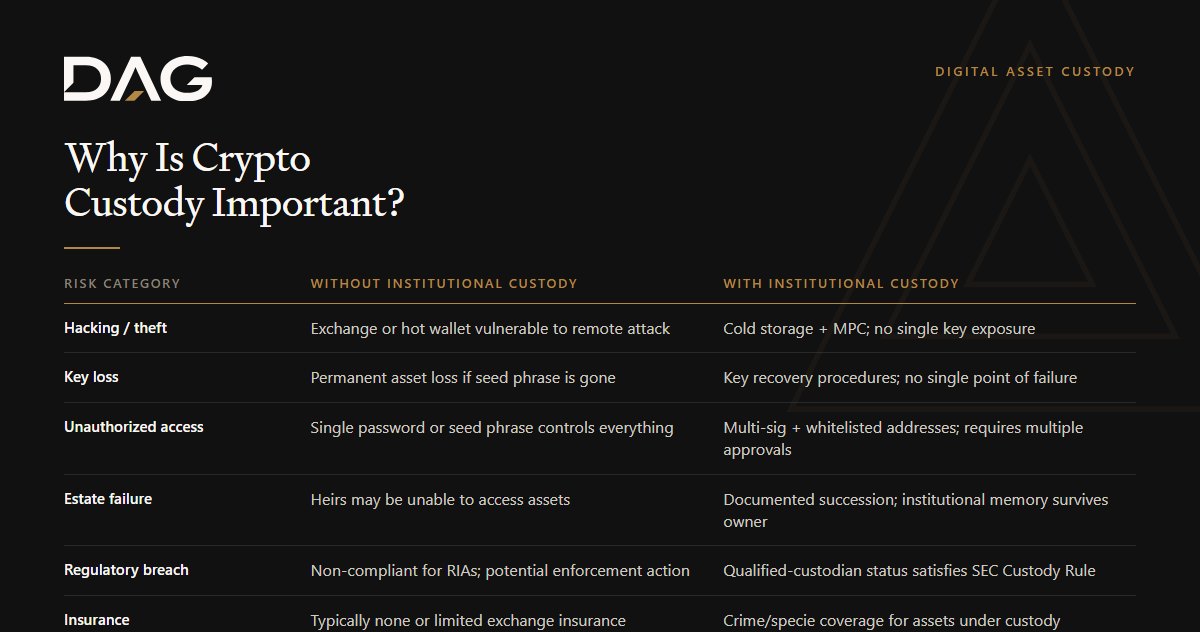
Crypto custody is important because digital assets have no central recovery mechanism: a lost private key or a successful hack generally results in permanent loss with no way to reverse it. Institutional custody is designed to reduce exposure to hacking, unauthorized access, operational error, and estate failure through segregated storage, regulatory oversight, and defined recovery processes.
What Is Crypto Custody?
Crypto custody is the professional safeguarding of private keys, the cryptographic credentials that control access to digital assets. Unlike a bank account, there is no "forgot password" reset for a blockchain wallet. Whoever controls the private key controls the assets. Custody services hold those keys under controlled access policies, insurance, and regulatory frameworks so that the owner does not bear the entire operational and security burden alone. For the full range of custody approaches, see the crypto custody hub.
Why Does Custody Matter for High-Net-Worth Holders?
For individuals holding significant digital asset wealth, the stakes of poor custody scale directly with portfolio size. A $50,000 self-custody error is painful; the same error on a $5 million position can be catastrophic and permanent.
Institutional custody addresses three categories of exposure:
Security exposure. Exchange hacks, phishing attacks, SIM-swap fraud, and physical theft all target private keys. Qualified custodians use cold storage, multi-party computation (MPC), hardware security modules (HSMs), and multi-signature approval policies designed to avoid a single point of failure. Self-custody wallets and exchange accounts lack most of these controls.
Operational exposure. Key mismanagement is more common than external attacks. Hardware wallets are lost in fires or floods; seed phrases are stored incorrectly; estate plans fail to convey access to heirs. Institutional custodians maintain documented procedures, geographic redundancy, and succession protocols that survive the loss of any individual.
Regulatory exposure. For entities subject to SEC oversight, including registered investment advisers, holding client crypto in a non-qualified custodian violates the Custody Rule. Institutional custody provides the qualified-custodian status, SOC 1/SOC 2 audit reports, and segregated account structure that compliance requires.
What Are the Specific Risks of Holding Without Institutional Custody?
| Risk Category | Without Institutional Custody | With Institutional Custody |
|---|---|---|
| Hacking / theft | Exchange or hot wallet vulnerable to remote attack | Cold storage + MPC; no single key exposure |
| Key loss | Permanent asset loss if seed phrase is gone | Key recovery procedures; no single point of failure |
| Unauthorized access | Single password or seed phrase controls everything | Multi-sig + whitelisted addresses; requires multiple approvals |
| Estate failure | Heirs may be unable to access assets | Documented succession; institutional memory survives owner |
| Regulatory breach | Non-compliant for RIAs; potential enforcement action | Qualified-custodian status satisfies SEC Custody Rule |
| Insurance | Typically none or limited exchange insurance | Crime/specie coverage for assets under custody |
How Does Institutional Custody Reduce Risk?
Institutional custodians address each exposure category through layered controls:
- Cold storage keeps private keys air-gapped from internet-connected systems, which sharply reduces remote-attack vectors.
- Multi-signature (multi-sig) or MPC requires multiple independent approvals for any transfer, so a single compromised credential is generally not enough to move funds.
- Whitelisted withdrawal addresses restrict where assets can go, blocking unauthorized transfers even if credentials are partially compromised.
- Segregated accounts hold each client's assets separately from the custodian's own balance sheet, providing bankruptcy-remote protection if the custodian fails.
- Crime and specie insurance covers losses from theft, internal fraud, and certain hacking events, coverage self-custody users cannot replicate.
- SOC 1 / SOC 2 audit reports provide independent verification that controls are operating as described.
Is Self-Custody Ever Appropriate?
Self-custody, holding your own private keys via a hardware wallet, can be appropriate for smaller positions where the holder has technical competence, a documented seed-phrase backup and recovery plan, and no compliance obligations requiring a qualified custodian. It is generally not appropriate for:
- Portfolios above the threshold where loss would be financially material
- Assets held through an entity (trust, LLC, family office) where governance documentation is required
- Advisers managing client assets subject to the SEC Custody Rule
The relevant comparison is not "self-custody vs. institutional custody" but "which risks am I prepared to own?" Self-custody transfers all operational and security risk to the individual; institutional custody distributes those risks across professional infrastructure and insurance. See Qualified Custody vs Self-Custody for Crypto Wealth for a full comparison.
Related Questions
What happens if I lose my private key?
Without a backup seed phrase and without an institutional custodian, loss of a private key means permanent loss of access to any assets it controls. There is no account recovery, no customer support escalation, and no legal mechanism to compel the blockchain to return funds. This is the single most common cause of permanent digital asset loss.
Does a hardware wallet count as institutional custody?
No. A hardware wallet is a self-custody device. It improves security over a software wallet by keeping the private key offline, but the owner still bears full responsibility for the seed phrase backup, physical security of the device, and estate accessibility. It does not provide crime insurance, segregated account status, or SOC audit reports. It does not satisfy the SEC Custody Rule for advisers.
Do crypto custodians carry insurance?
Qualified institutional custodians generally maintain crime and/or specie insurance covering assets under custody against theft, internal fraud, and certain hacking events. Coverage limits, exclusions, and deductibles vary by custodian. Confirm coverage details during custodian due diligence. See Crypto Insurance and Custody for more detail.
What is the difference between custody and exchange custody?
A regulated qualified custodian holds assets in segregated accounts, under a trust charter or state charter, with insurance and SOC audit coverage. An exchange holds assets on an omnibus basis, commingled with other users' assets, and exchange insolvency has historically left users as unsecured creditors. Exchange custody is generally not equivalent to qualified custody for regulatory or estate-planning purposes.
At what portfolio size does institutional custody become necessary?
There is no universal threshold. DAG Wealth generally recommends evaluating institutional custody when total digital asset holdings exceed $500,000, or earlier when assets are held through an entity, when there are compliance obligations, or when the holder lacks confidence in their own key-management procedures. When Do You Need a Crypto Wealth Manager? covers the broader trigger criteria.
Sources
- SEC Investment Advisers Act of 1940, Rule 206(4)-2 (Custody Rule), https://www.sec.gov/rules/final/2009/ia-2968.pdf
- SEC Staff Bulletin on Digital Asset Custody (March 2023), https://www.sec.gov/corpfin/staff-bulletin-custody-digital-asset-securities
- Chainalysis Crypto Crime Report 2024 (lost/stolen asset data), https://www.chainalysis.com/blog/crypto-crime-report-2024/
Compliance Note
This page is educational and does not constitute investment, legal, tax, or custody advice. Digital asset custody decisions depend on individual circumstances, portfolio size, entity structure, and applicable regulatory obligations. Consult a qualified professional before selecting a custodian or modifying existing custody arrangements. DAG Wealth works with institutional-grade custodians; arrangements are tailored to each client's needs and risk profile. Registration does not imply a certain level of skill or training.