
Crypto insurance custody refers to the commercial crime or specie policy a custodian holds, which may cover theft of private keys or physical loss under specific terms. This protection generally exists only at the institutional tier; exchanges cover their own systems, and self-custody has none. It does not replace custody due diligence and is not FDIC or SIPC protection.
What Institutional Custody Insurance Covers
Institutional crypto custody insurance is a commercial policy a custodian maintains to cover defined loss scenarios. Coverage typically applies to:
- External theft, hacking that compromises cold-storage private keys
- Physical loss, destruction or loss of hardware holding keys
- Employee dishonesty/internal fraud, misconduct by the custodian's own personnel (where included in the policy)
Policies attach to specific wallet types, named legal entities, and stated dollar limits. Major institutional custodians source coverage from established carriers and Lloyd's of London syndicates, with limits ranging from tens of millions to several hundred million dollars depending on the custodian and client relationship. The existence of a policy says little about your protection until you read what scenarios it actually covers.
For the broader custody framework, see What Is Institutional Crypto Custody?.
What Institutional Custody Insurance Does Not Cover
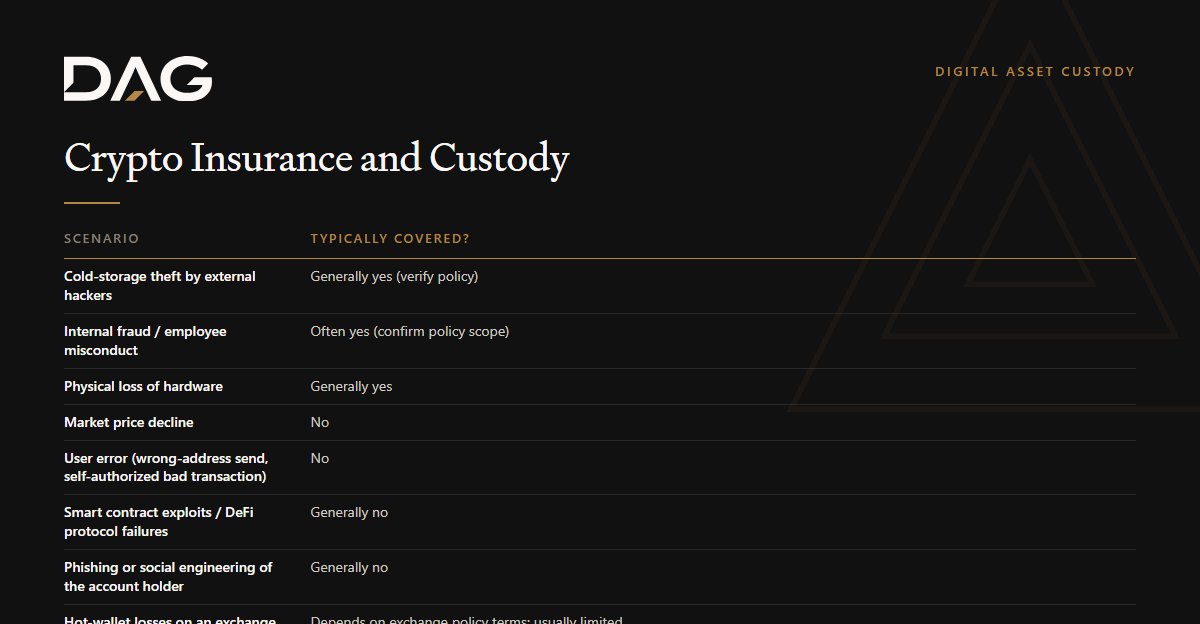
Even qualified custodian policies have material exclusions. Confirm each with the custodian before relying on a published figure.
| Scenario | Typically covered? |
|---|---|
| Cold-storage theft by external hackers | Generally yes (verify policy) |
| Internal fraud / employee misconduct | Often yes (confirm policy scope) |
| Physical loss of hardware | Generally yes |
| Market price decline | No |
| User error (wrong-address send, self-authorized bad transaction) | No |
| Smart contract exploits / DeFi protocol failures | Generally no |
| Phishing or social engineering of the account holder | Generally no |
| Hot-wallet losses on an exchange | Depends on exchange policy terms; usually limited |
| Self-custody (hardware wallet in personal possession) | No |
Why Insurance Exists Only at the Institutional Level
Insurance carriers can underwrite institutional custody because the risk model is assessable. Qualified custodians operate under regulatory oversight. OCC federal bank charters, state trust company licenses, or equivalent status, with documented security procedures, segregated accounts, professional key management, and audit trails. When a loss occurs there is a clear record: controls were followed or they failed, assets were segregated or they weren't.
That auditability makes the risk priceable. Exchanges and self-custody lack the same control structure, which is why comparable coverage is unavailable at those tiers. For a side-by-side of the custody tiers, see Qualified Custody vs Self-Custody for Crypto Wealth.
The Coverage Gap at Exchanges
Exchange insurance typically protects the exchange's own hot-wallet systems, not individual account balances. A platform may advertise crime insurance while your holdings in their cold-storage system fall outside that policy's scope. If the exchange fails financially, account holders generally become unsecured creditors in a bankruptcy proceeding because holdings sit in omnibus wallets commingled with other clients' funds, not in bankruptcy-remote segregated accounts.
This differs fundamentally from institutional custody, where your assets are held in segregated accounts legally separate from the custodian's own balance sheet and other clients' positions. See Qualified Custodian vs Crypto Exchange for a detailed comparison.
Self-Custody Has No Insurance Coverage
When crypto is held personally via a hardware wallet, no insurance exists. Loss through theft of the device, disclosure of the seed phrase, or a compromised recovery method has no insurance remedy. Some companies market individual "crypto insurance," but these products generally cover narrow scenarios at high premiums or are recovery services rather than indemnity policies.
The Aggregate Limit Problem
A custodian's headline coverage figure often applies across all clients on an aggregate basis, not per account. For example, a custodian advertising a $300 million limit may pay only a fraction of that to any single client if multiple accounts sustain losses in the same event. Ask specifically:
- Is the limit per client or aggregate across the entire book?
- What is the sub-limit that applies to accounts of my size or entity type?
- Are there per-occurrence caps or deductibles?
Insurance Questions to Ask Any Custodian
- Does the custodian maintain insurance, and through which carrier or Lloyd's syndicate?
- What loss scenarios are covered and which are explicitly excluded?
- Is the limit per client or aggregate across all clients?
- Which legal entity is the named insured, and does that match the entity holding your assets?
- Are self-custody, hot wallets, smart-contract events, or insider events within scope?
- Are certificates of insurance or policy summaries available for institutional clients?
- How has the custodian responded to past loss events, and were claims paid?
Custody Due Diligence Beyond Insurance
Insurance should be read alongside the rest of a custodian's control environment, not as a standalone guarantee. Review it together with:
- SOC 1 and SOC 2 reports, independent assurance over financial and security controls. See Crypto Custody SOC 1 and SOC 2 Reports.
- Legal entity and qualified custodian status, confirm which entity holds assets and whether it meets the SEC custody rule's definition of a qualified custodian.
- Private key controls, cold storage, multi-sig, or MPC configuration and how signing authority is divided.
- Client asset segregation, whether client assets are bankruptcy-remote from the custodian's own balance sheet.
- Transfer approval workflows, withdrawal allowlists and multi-party authorization requirements.
A structured walk-through of these items is in the Crypto Custody Due Diligence Checklist. The full custody topic map is at the Crypto Custody Hub.
When Institutional Insurance Justifies Custody Costs
At lower holding levels, the operational overhead of institutional custody may outweigh the benefit. As holdings grow, commonly referenced thresholds are $500,000 to $1 million or more in digital assets, the insurance and segregation protections of institutional custody become harder to replicate through self-custody security practices alone. A single theft or operational failure at that scale can cause permanent financial damage with no recovery path.
Accessing institutional custodians typically requires an entity structure (LLC or trust) that can hold assets in a properly titled account, along with meeting the custodian's minimum thresholds. DAG Wealth coordinates custody arrangement oversight, entity structuring, estate planning integration, and multi-custodian strategy for families and advisors with significant digital asset holdings.
Related Questions
Does institutional crypto custody insurance work like FDIC or SIPC protection?
No. FDIC and SIPC are statutory government-backed programs covering bank deposits and brokerage accounts. A custodian's crime or specie policy is a private commercial contract with its own limits, exclusions, and claims process. There is no government guarantee behind it. Confirm specifics with the custodian and qualified legal or insurance counsel.
Is the coverage limit a custodian advertises the amount my account is actually protected for?
Not necessarily. Coverage is frequently written on an aggregate basis across all clients. The per-account figure at any given custodian can be substantially lower than the headline number, especially in a large-scale loss event affecting many accounts simultaneously. Always ask whether limits are per client or aggregate, and request any applicable sub-limits.
Does exchange insurance protect individual account holders the way institutional custody does?
Generally no. Exchange insurance typically protects the exchange's hot-wallet systems. Individual account balances, particularly in cold storage, may fall outside that policy's scope. If the exchange enters bankruptcy, account holders generally hold an unsecured claim rather than direct ownership of segregated assets.
Does insurance replace the need for custody due diligence?
No. Insurance is one control among many. A well-insured custodian with weak segregation, inadequate key management, or thin SOC controls still presents meaningful custody risk. Comprehensive due diligence covers the full control environment, with insurance as one input among several. See the Crypto Custody Due Diligence Checklist for the full review framework.
Can individual self-custody holders get insurance coverage?
Not through conventional institutional channels. Some niche products exist for individuals, but they typically cover narrow scenarios at high cost or function as recovery services rather than indemnity policies. Self-custody carries no meaningful insurance backstop for most holders.
Sources
Compliance Note
This article is educational and does not provide legal, insurance, investment, fiduciary, compliance, or custody advice. Coverage terms, limits, and exclusions vary by custodian and policy. Insurance arrangements should be reviewed with qualified insurance and legal professionals. Digital Ascension Group does not provide insurance products or guarantee any custody outcomes.