
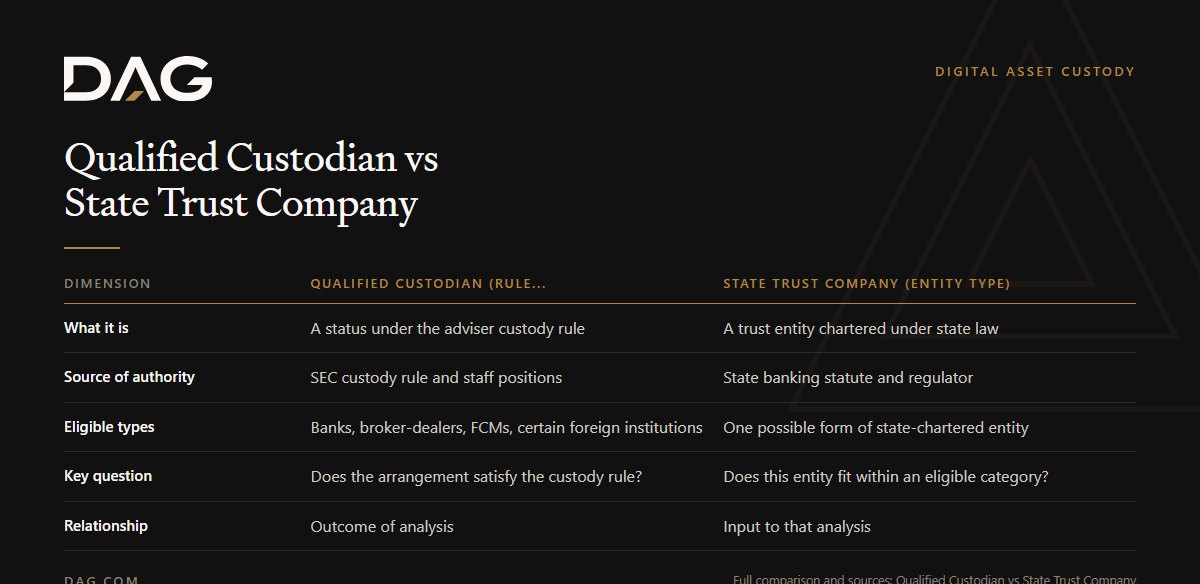
A qualified custodian is a category defined by investment adviser custody rules, while a state trust company is a regulated entity chartered under state law. The two overlap but are not the same: some state trust companies may serve as crypto custodians, but whether a given entity counts as a qualified custodian depends on the law, SEC staff positions, charter status, and the facts of the arrangement.
Short Answer
A state trust company is a type of regulated entity formed under state law. A qualified custodian is a category under investment adviser custody rules. Some state trust companies may be relevant for crypto custody, but whether a specific entity can be treated as a qualified custodian depends on law, SEC staff positions, regulatory status, and the facts of the custody arrangement.
Definitions
- Qualified custodian: Under the SEC custody rule (Rule 206(4)-2), this generally includes banks and savings associations, registered broker-dealers, registered futures commission merchants, and certain foreign financial institutions that hold client assets in segregated accounts. The label is a regulatory function, not a brand.
- State trust company: A trust entity chartered and supervised by a state banking regulator. Whether a state trust company falls within the "bank" prong of the custody rule for a given arrangement is a legal question, not a given.
For the broader framework, see the Digital Asset Custody Hub and the related explainer on what a qualified crypto custodian is.
Why This Matters
Digital asset custody has raised hard questions for RIAs and regulated funds. Some crypto custodians are state-chartered trust companies; others are federally chartered banks or different entity types. Each charter carries its own supervision and its own analysis under the custody rule. Advisers need to verify the legal basis for custody rather than rely on marketing language, a point reinforced in the guidance on qualified custodian vs crypto exchange.
Qualified Custodian vs State Trust Company at a Glance
| Dimension | Qualified Custodian (rule category) | State Trust Company (entity type) |
|---|---|---|
| What it is | A status under the adviser custody rule | A trust entity chartered under state law |
| Source of authority | SEC custody rule and staff positions | State banking statute and regulator |
| Eligible types | Banks, broker-dealers, FCMs, certain foreign institutions | One possible form of state-chartered entity |
| Key question | Does the arrangement satisfy the custody rule? | Does this entity fit within an eligible category? |
| Relationship | Outcome of analysis | Input to that analysis |
A state trust company can be one input to a qualified custody conclusion, but the two terms answer different questions.
How It Works
Work through the arrangement in order:
- Identify whether the entity is a bank, trust company, broker-dealer, FCM, or other potentially eligible custodian.
- Confirm state or federal charter status and the supervising regulator.
- Check applicable SEC guidance or no-action positions and their stated conditions.
- Read the account agreements and confirm how assets are titled and segregated.
- Review custody of both the crypto assets and any related cash.
- Examine account statements, third-party audit, and SOC 1 / SOC 2 reports, see crypto custody SOC 1 and SOC 2 reports.
- Map the adviser's own obligations under the custody rule.
For a related comparison of charter and oversight choices, see how to choose a crypto custodian.
Evidence Standard
This article discusses categories and does not determine whether any specific custodian qualifies, nor does it state that any named entity is deficient or superior. Each conclusion depends on the entity, the charter, and the documented facts.
When It May Help
- An RIA is evaluating a crypto custodian.
- A family office needs institutional custody.
- A trust company is proposed as custodian.
- Compliance needs a custody memo.
When It May Not Be Enough
Qualified custodian analysis is legal and facts-specific. The right charter on paper does not, by itself, resolve how a particular arrangement is treated. Counsel should review the arrangement before an adviser relies on it.
Related Questions
Did SEC staff address state trust companies for crypto custody?
In 2025, SEC materials discussed no-action relief relating to custody of crypto assets with certain state trust companies. The analysis generally remains nuanced and fact-dependent, and a no-action position carries conditions rather than blanket approval. Confirm the current text and its conditions before relying on it.
Is a federally chartered bank treated differently from a state trust company?
Potentially. Entity type, charter, and the supervising regulator all factor into custody analysis, and outcomes can differ even when two entities offer similar services. The label alone does not settle the question, the specific facts and applicable guidance do.
Can advisers rely on a custodian's own claims that it is a qualified custodian?
Generally not without independent verification. Advisers should confirm such claims through legal and compliance review, supporting documents, and the relevant SEC guidance. Note that an entity being registered or chartered does not by itself guarantee skill, safety, or a particular regulatory outcome.
Bottom Line
A state trust company may be part of a qualified custody analysis, but it is not a shortcut. RIAs need a documented legal and operational review, and choosing a custodian does not remove market, custody, or tax risk from holding digital assets.
Sources
- SEC statement on custody of crypto assets with state trust companies
- SEC response statement on no-action relief for state trust companies
- SEC custody rule compliance guide
Compliance Note
This article is for general educational purposes and is not legal, compliance, custody, tax, or investment advice.