
Institutional crypto custody is professional custody infrastructure for digital assets, built for entities rather than a single keyholder. It typically combines account controls, approved transfer workflows, statements and reporting, security procedures, and trust, LLC, or entity account support. It gives family offices, trusts, and RIAs auditability and role-based permissions that personal wallets generally cannot match.
Short Answer
Institutional crypto custody is professional custody infrastructure for digital assets. It typically includes account controls, approved transfer workflows, reporting, security procedures, entity or trust account support, and sometimes staking, trading, or settlement functionality.
What Institutional Crypto Custody Means
The core term describes a custody model where digital assets are held and administered under documented controls instead of one individual holding a seed phrase. A provider operating this model often supplies segregated or omnibus account structures, multi-party approval over transfers (multi-sig or MPC), audited security controls evidenced by SOC 1 and SOC 2 reports, and statements suitable for trustees, accountants, and auditors. Whether a given provider also qualifies as a "qualified custodian" under the SEC custody rule depends on the facts and the entity type.
Why This Matters
Personal wallets can work for some holders, but institutional investors, family offices, trusts, LLCs, and RIAs often need more than one person holding keys. They need auditability, role-based permissions, statements, transfer controls, and operational continuity. For RIAs in particular, the SEC custody framework and qualified-custodian expectations make documented controls a practical necessity, which is why many firms compare qualified custody against self-custody before holding client assets.
How It Works
Institutional custody may include:
- Account onboarding and KYC.
- Trust, LLC, or entity account support.
- Segregated accounts or custody arrangements.
- Multi-approver transaction workflows.
- Reporting and statements.
- Asset support lists.
- Staking or governance support.
- Transfer and withdrawal controls.
- Disaster recovery and security procedures.
Institutional Custody vs Self-Custody
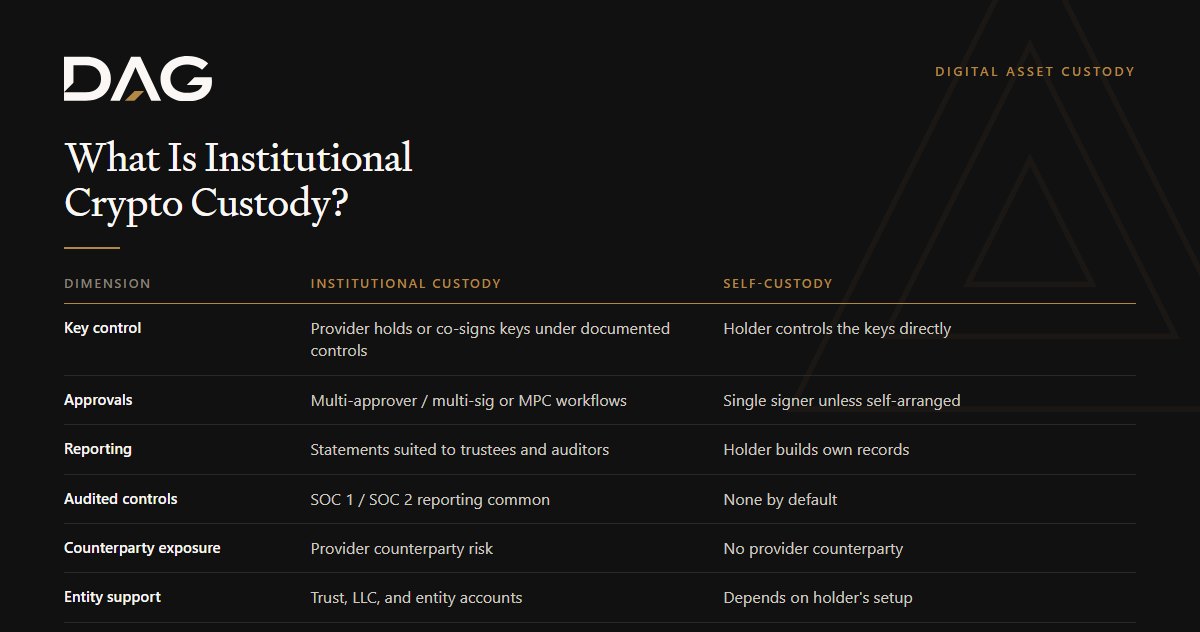
The two models trade off control against operational structure. Neither removes market, custody, or tax risk.
| Dimension | Institutional custody | Self-custody |
|---|---|---|
| Key control | Provider holds or co-signs keys under documented controls | Holder controls the keys directly |
| Approvals | Multi-approver / multi-sig or MPC workflows | Single signer unless self-arranged |
| Reporting | Statements suited to trustees and auditors | Holder builds own records |
| Audited controls | SOC 1 / SOC 2 reporting common | None by default |
| Counterparty exposure | Provider counterparty risk | No provider counterparty |
| Entity support | Trust, LLC, and entity accounts | Depends on holder's setup |
For a deeper treatment, see cold storage versus qualified custody and the broader Digital Asset Custody Hub.
Evidence Standard
This article explains a custody category and does not endorse any provider. Named providers are illustrative; selection should rest on independent diligence, not on any claim of superiority here.
When It May Help
- Crypto is material to family wealth.
- Assets need trustee, LLC, or advisor oversight.
- A family office needs institutional process.
- An RIA is evaluating custody.
- The holder wants reporting and controls beyond self-custody.
When It May Not Be Enough
Institutional custody does not eliminate counterparty, cyber, market, or operational risk, and it does not carry FDIC or SIPC coverage for crypto. Provider diligence still matters; working through a custody due diligence checklist helps surface gaps before assets move.
Related Questions
Is institutional custody the same as qualified custody?
Not always. Institutional custody describes the service model, while qualified custody is a legal and regulatory concept under the SEC custody rule. A provider can offer institutional-grade process without meeting the qualified-custodian definition for a given client; whether it does generally depends on the facts and entity type.
Is institutional custody safer than self-custody?
It changes the risk profile rather than removing risk. Professional controls and multi-approver workflows can reduce single-point-of-failure exposure, but provider counterparty risk and process risk remain, and no model guarantees against loss.
Can trusts and LLCs use institutional custody?
Often, but account support and documentation requirements vary by provider. A trust or LLC generally needs formation documents, authorized-signer records, and beneficial-ownership detail; the account opening checklist for trusts and LLCs outlines what most providers request.
Does using a custodian remove tax reporting obligations?
No. Custodians may issue statements or forms such as Form 1099-DA, but the IRS generally treats digital assets as property, and the holder remains responsible for accurate reporting. Consult a qualified tax professional on your situation.
Bottom Line
Institutional crypto custody turns wallet control into a professional custody workflow. It is often essential for family offices, RIAs, trusts, and LLC-owned digital assets, though the right provider still depends on independent diligence and your own facts.
Sources
Compliance Note
This article is for general educational purposes and is not legal, compliance, custody, security, or investment advice.