
Institutional crypto custody is a professional model for securing large digital asset holdings, where a licensed third party controls private keys under documented security controls. It differs from exchange accounts and personal cold wallets by five defining characteristics: crime insurance, bankruptcy-remote structure, segregated accounts, proper regulatory licensing, and hardware security module (HSM) standards.
What Institutional Custody Means
At its core, institutional custody means a qualified third party holds your crypto under contractual and regulatory obligations, you retain ownership, but the custodian controls the private keys and bears responsibility for security infrastructure. This is distinct from exchange custody, where your assets are co-mingled with other users and the exchange holds them on your behalf as a counterparty, and from self-custody, where you hold the keys directly.
The institutional model emerged because the security infrastructure required for large holdings, geographically distributed HSMs, multi-party authorization workflows, SOC-audited controls, dedicated security staff, is prohibitively expensive to build and operate independently. A qualified institutional custodian amortizes that cost across many clients.
The Five Defining Characteristics
1. Crime Insurance
Institutional custodians carry commercial crime and specie insurance policies covering theft, hacking, and certain operational failures. Coverage limits, excluded events, and deductible terms vary materially between providers; reviewing the policy terms directly is necessary before relying on any stated coverage. Personal hardware wallets and exchange accounts generally carry no equivalent protection.
2. Bankruptcy-Remote Structure
Client assets are held in segregated legal structures that keep them off the custodian's balance sheet. If the custodian becomes insolvent, client holdings are not available to satisfy the custodian's creditors. Exchange accounts typically offer no equivalent protection, when an exchange fails, customers often become unsecured creditors. Verifying the specific legal structure (e.g., state trust company charter, bankruptcy-remote trust account) matters; marketing claims about "segregation" do not automatically create legal bankruptcy remoteness.
3. Segregated Accounts
Client assets are held separately from the custodian's proprietary assets and, depending on the account structure, from other clients' assets. Segregation enables clean audit trails, accurate reporting to trustees and accountants, and clear identification of ownership. Omnibus versus individually segregated accounts have different risk and reporting implications, understand which structure applies.
4. Proper Regulatory Licensing
Institutional custodians hold licenses appropriate to their jurisdiction and client type: state trust company charters, BitLicense, money transmitter licenses, or, in some cases, SEC registration. Licensing establishes regulatory oversight, examination rights, and consumer-protection obligations. Whether a given licensed custodian qualifies as a "qualified custodian" under the SEC's custody rule for a specific RIA's client assets depends on the facts and entity type, the legal analysis is not automatic from licensing alone.
5. HSM Hardware Security Standards
Hardware security modules are tamper-resistant physical devices that generate and store cryptographic keys in an environment isolated from internet-connected systems. Institutional custodians use HSMs in conjunction with multi-party computation (MPC) or multi-signature (multi-sig) schemes, requiring approval from multiple keyholders across geographically distributed secure facilities before any transaction executes. This eliminates the single-point-of-failure risk inherent in a personal hardware wallet or a single seed phrase.
How the Security Infrastructure Works
Multi-approver authorization. A typical institutional setup requires multiple designated signers, often a 3-of-5 or similar threshold, to approve any outgoing transaction. No single person can unilaterally move assets. Compromising one key does not yield access; an attacker would need to compromise multiple keys stored in separate secure locations simultaneously.
Geographic distribution. Keys and signing hardware sit in physically separated secure facilities, sometimes across jurisdictions. A failure, disaster, or breach at one location does not expose the full key set or halt recovery.
Audit trails and reporting. Every transaction is logged with timestamps, signer identities, and authorization details, a level of accountability essential for trustees, family office CFOs, auditors, and RIAs managing client assets. Personal wallets produce no comparable record.
For a structured comparison of custody approaches, see cold storage versus qualified custody and the crypto custody hub.
Institutional Custody vs. Self-Custody vs. Exchange Accounts
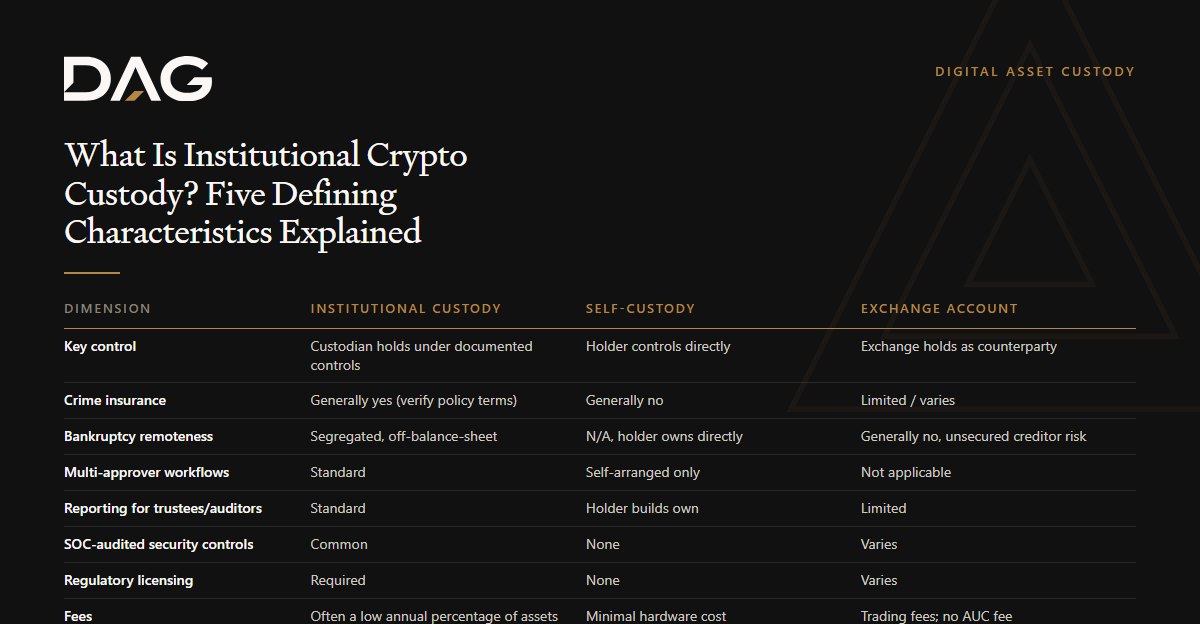
| Dimension | Institutional custody | Self-custody | Exchange account |
|---|---|---|---|
| Key control | Custodian holds under documented controls | Holder controls directly | Exchange holds as counterparty |
| Crime insurance | Generally yes (verify policy terms) | Generally no | Limited / varies |
| Bankruptcy remoteness | Segregated, off-balance-sheet | N/A, holder owns directly | Generally no, unsecured creditor risk |
| Multi-approver workflows | Standard | Self-arranged only | Not applicable |
| Reporting for trustees/auditors | Standard | Holder builds own | Limited |
| SOC-audited security controls | Common | None | Varies |
| Regulatory licensing | Required | None | Varies |
| Fees | Often a low annual percentage of assets under custody, frequently with an annual minimum | Minimal hardware cost | Trading fees; no AUC fee |
Fee structures vary by provider and are not standardized. Custodians commonly publish rates as a fraction of a percent of assets under custody per year, often with an annual minimum; published examples have ranged roughly from 0.10% to 0.50% with minimums in the $10,000–$25,000 range, but actual terms depend on the provider, asset volume, asset types, and service scope. Confirm current pricing directly with each custodian.
Who Typically Needs Institutional Custody
Family offices and trusts. Entities managing crypto across multiple generations or legal structures need account controls, transfer policies, role-based permissions, and reporting that personal wallets cannot provide. Crypto custody for family offices and crypto custody for trusts cover entity-specific requirements.
RIAs managing client digital assets. The SEC's custody framework and qualified-custodian requirements generally make documented, licensed custody a practical necessity. See qualified custody for RIAs managing digital assets.
Corporations with material crypto on the balance sheet. Audit, governance, and financial-reporting obligations drive the need for third-party custody with documented controls.
High-net-worth individuals with large positions. For seven- or eight-figure holdings, the annual custody fee is generally modest relative to the risk reduction institutional infrastructure can provide, though that trade-off depends on the specific fees, coverage terms, and an individual's risk tolerance.
When Self-Custody May Still Be Appropriate
Self-custody can be reasonable for holders who are technically proficient, who hold amounts that would not be catastrophic to lose, and who have established their own key-backup and estate-planning procedures. For holdings under $100,000, annual custody minimums can represent a disproportionate cost. Frequent traders who need quick access to move assets may also find that custodial approval workflows add friction incompatible with their strategy.
That said, self-custody does not eliminate risk, it transfers it entirely to the individual. Lost seed phrases and hardware failures are permanent and irreversible.
What to Evaluate When Selecting a Custodian
A structured due diligence process matters. Key areas include security architecture (HSM usage, multi-sig or MPC scheme, geographic distribution), insurance terms (covered events, limits, exclusions), regulatory standing (licenses held, examination history), audit reports (SOC 1 / SOC 2 availability), access and withdrawal procedures, entity account support, and fee structure.
The crypto custody due diligence checklist provides a structured framework. For custodian-specific questions, see questions to ask a crypto custodian.
DAG Wealth coordinates custody evaluation and administrative setup for clients navigating this process, assessing security procedures, reviewing documentation, and structuring the custody arrangement. Investment advice on portfolio allocation or asset selection is provided through DAG Wealth, the affiliated SEC-registered investment adviser.
Related Questions
Is institutional custody the same as qualified custody under SEC rules?
Not automatically. Institutional custody describes a service model; qualified custody is a legal and regulatory category under the SEC's custody rule (Rule 206(4)-2). A provider can operate institutional-grade infrastructure without meeting the qualified-custodian definition for a given RIA's client assets. Whether a specific provider qualifies depends on the entity type, state of organization, and facts of the advisory relationship. Consult qualified legal counsel.
What happens to client assets if an institutional custodian fails?
Bankruptcy-remote structures are designed to keep client assets off the custodian's balance sheet, meaning they should not be available to satisfy creditors. The legal protection, however, depends on the specific structure (trust company charter, segregated account type, jurisdiction) rather than on marketing representations. Independent legal review of the custody agreement and account structure is advisable for material holdings.
Does institutional custody eliminate custody risk?
No. Institutional custody reduces certain risks, theft, single-point-of-failure, loss of seed phrases, but it introduces counterparty risk (dependence on the provider's operational and financial stability), and it does not eliminate cyber, market, or operational risk. No custody model carries FDIC or SIPC protection for crypto. Crime insurance covers some theft scenarios but typically has limits, exclusions, and deductibles.
Can trusts and LLCs open institutional custody accounts?
Generally yes, though documentation requirements vary. Trust and LLC accounts typically require formation documents, authorized-signer designations, beneficial-ownership records, and entity tax identification. The crypto account opening checklist for trusts and LLCs outlines what most providers request.
What are typical institutional custody fees?
Fees are not standardized, but published custodian rates have commonly run as a fraction of a percent of assets under custody per year, roughly in the 0.10%–0.50% range, typically with an annual minimum in the area of $10,000–$25,000. As a hypothetical illustration, a 0.25% rate on a $10 million holding would be about $25,000 a year, while a $500,000 holding subject to the same minimum would face a much higher effective rate. The economics generally favor larger positions, but confirm current pricing with each provider.
How is MPC different from multi-sig for institutional custody?
Multi-signature (multi-sig) requires multiple complete private keys, each held by a separate party, to co-sign a transaction. Multi-party computation (MPC) splits key material so no complete key ever exists in one place, signing requires parties to compute together without any single party holding a full key. Both achieve multi-approver security; MPC can offer operational advantages for certain asset types and workflows. See MPC vs multi-sig custody for a detailed comparison.
Sources
- SEC: Custody of Funds or Securities of Clients by Investment Advisers (Rule 206(4)-2)
- NYDFS: Virtual Currency Business Licensing (BitLicense)
Compliance Note
This article is for general educational purposes and does not constitute legal, tax, investment, custody, or security advice. Custody arrangements involve legal, regulatory, and operational considerations that vary by client type, jurisdiction, and asset volume. Consult qualified legal and financial professionals before selecting any custody solution or transferring assets. Registration does not imply a certain level of skill or training.