
Institutional-grade crypto custody is a class of regulated, insured, and segregated digital asset storage that private clients with significant holdings can access through a registered investment adviser, see the crypto custody hub for a full overview of this landscape. It is defined by verifiable features. OCC or state trust-company licensing, crime insurance on the assets themselves, bankruptcy-remote segregation, and HSM-grade key management, not by who the client is.
What Makes Custody "Institutional Grade"?
The term describes a measurable set of features, not a marketing tier. Each element addresses a distinct failure mode that exchange storage and personal wallets cannot cover.
Regulated storage under proper licensing. Qualified custodians operate under an OCC federal bank charter, a state trust company license, or equivalent regulatory oversight. They are regulated financial institutions subject to examination and operational standards, not technology companies offering incidental storage services.
Crime insurance covering the assets themselves. This is asset-level coverage: policies that pay out if Bitcoin, Ethereum, or other holdings are stolen through hacking, fraud, or employee misconduct. It is distinct from infrastructure insurance or policies that cover only the custodian's systems. Coverage limits, sublimits, and exclusions vary by custodian and policy, and asset-level coverage is not universal; confirm the scope and current limits in the custodian's policy documents before relying on it.
Bankruptcy-remote segregation. Client assets remain legally separate from the custodian's own holdings. If the custodian fails financially, client cryptocurrency is not swept into bankruptcy proceedings. Clients retain ownership claims through potential custodian insolvency, this is materially different from exchange omnibus custody.
HSM-grade key management. Hardware security modules meeting FIPS 140-2 Level 3 or 4 standards store cryptographic keys in tamper-resistant physical devices. Private keys do not leave the HSM even during transaction signing.
Governed access and audit trails. Documented authorization procedures, multi-party approval requirements, and complete audit logs prevent unauthorized transactions. No single individual can move funds unilaterally.
These features address security, insurance, legal ownership, and operational risk simultaneously, protections that hardware wallets and exchange accounts do not combine.
How Institutional Custody Differs from Exchange Storage
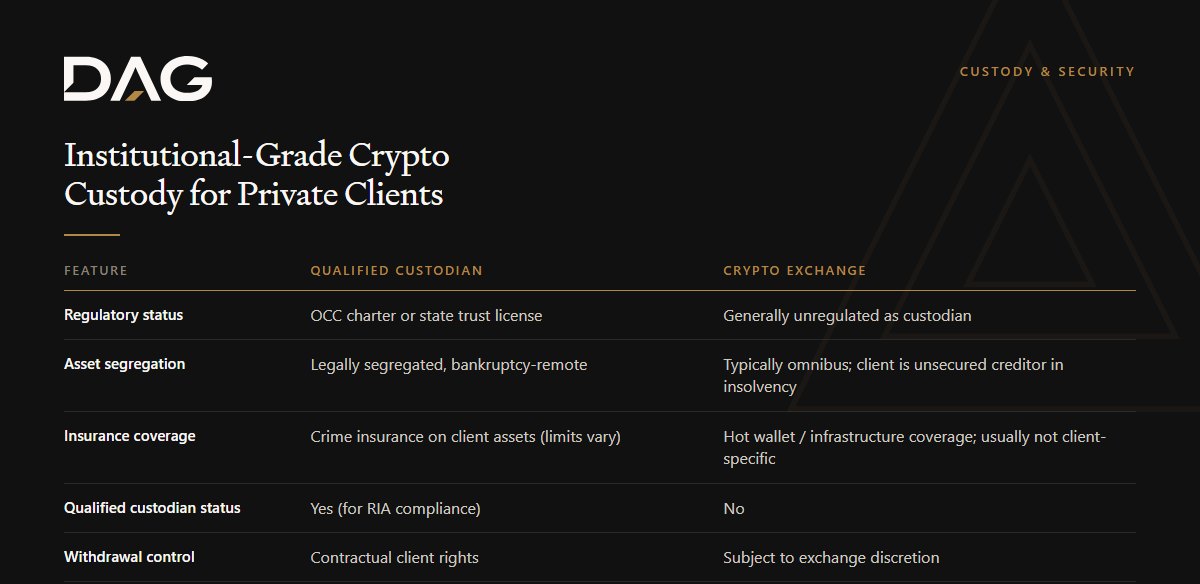
Exchange accounts are often mistaken for qualified custody. The structures are different in material ways.
| Feature | Qualified Custodian | Crypto Exchange |
|---|---|---|
| Regulatory status | OCC charter or state trust license | Generally unregulated as custodian |
| Asset segregation | Legally segregated, bankruptcy-remote | Typically omnibus; client is unsecured creditor in insolvency |
| Insurance coverage | Crime insurance on client assets (limits vary) | Hot wallet / infrastructure coverage; usually not client-specific |
| Qualified custodian status | Yes (for RIA compliance) | No |
| Withdrawal control | Contractual client rights | Subject to exchange discretion |
The qualified custodian distinction matters specifically for registered investment advisers. Under SEC rules, RIAs managing client assets must use qualified custodians. Exchanges do not qualify, which means an RIA that uses exchange custody for client assets faces compliance exposure.
How Institutional Custody Differs from Self-Custody
Self-custody through hardware wallets gives complete control with no counterparty. The tradeoffs are operational responsibility and zero insurance.
Self-custody makes sense for operational balances, amounts actively used for trading, DeFi participation, or frequent transactions where approval delays are impractical. It does not scale well to long-term holdings representing serious wealth because:
- One key-management error means permanent loss with no recovery process
- No crime insurance exists; theft is a total loss
- Succession planning is manual; heirs who cannot locate or access keys lose the assets permanently
For holdings where security and insurance outweigh access speed, qualified custody vs self-custody for crypto wealth examines the trade-off structure in detail.
Why Entity Structure Comes First
Most institutional custodians do not onboard personal accounts. They require an entity, an LLC or trust, with formation documents, a tax identification number, and governance structure before opening a custody account.
This is not arbitrary. Entity structure provides liability separation, clear succession planning, and the governance framework that institutional custody requires. Authorization matrices and approval procedures flow from proper entity documentation.
The LLC or trust holds the custody account; the individual controls the entity through ownership or trustee designation. Assets remain separate from personal holdings with defined beneficiary designations. See should crypto be held personally, in an LLC, or in a trust? for the structural decision framework.
How Private Clients Access Institutional Custody
Private clients typically access institutional custodians through a registered investment adviser that maintains an existing custodian relationship. Institutional custodians generally require institutional counterparties. RIAs, family offices, or funds, rather than onboarding individuals directly.
DAG provides this access through its relationship with a qualified institutional custodian. Advisory services are provided by DAG Wealth, an SEC-registered investment adviser. Registration does not imply a certain level of skill or training.
The adviser relationship structures custody so that client assets sit with the qualified custodian under the full institutional infrastructure: crime insurance, segregated wallets, OCC charter protections, and HSM-grade key management.
On minimum thresholds: Custodians and advisers set minimums, and figures circulated in older write-ups (for example, on the order of 50,000 XRP or $500,000 in total digital assets) are illustrative only and likely outdated; verify current minimums directly with the custodian or adviser.
Checklist: Evaluating an Institutional Custodian
Before placing assets with any custodian, confirm the following:
- Holds an OCC federal bank charter or state trust company license (verify via regulator, not custodian marketing)
- Crime insurance policy explicitly covers client asset losses, not only custodian infrastructure (request policy summary)
- Assets held in segregated accounts, not commingled omnibus wallets
- Qualified custodian status confirmed for RIA-compliance purposes
- HSM or MPC key management with FIPS 140-2 Level 3+ certification documented
- SOC 1 or SOC 2 report available upon request
- Bankruptcy-remote account structure confirmed in custody agreement
- Withdrawal procedures, approval thresholds, and audit trail practices documented
For a deeper due diligence framework, see crypto custody due diligence checklist and questions to ask a crypto custodian.
How This Fits a Complete Wealth Structure
Institutional custody addresses security and legal ownership of digital assets. It does not address tax coordination, estate planning, multi-entity governance, or investment strategy.
For families managing crypto alongside traditional investments, real estate, and operating businesses, custody is one component of a broader wealth architecture. Crypto estate planning for high-net-worth families covers how custody integrates with succession and beneficiary planning. Digital asset wealth management for high-net-worth families addresses the coordination layer across asset classes.
Related Questions
Does institutional custody eliminate the risk of loss?
No. Institutional custody reduces specific risks, theft by third parties, custodian insolvency, and unauthorized transactions, through insurance, segregation, and access controls. It does not eliminate market risk, protocol risk, or coverage gaps. Crime insurance policies carry limits and exclusions; verify current terms with the custodian. No custody structure eliminates the possibility of loss.
Can a revocable living trust open an institutional custody account?
Many qualified custodians accept revocable trusts as account holders, provided the trust documentation meets their onboarding requirements (trust agreement, trustee identification, tax ID). The custodian's specific requirements govern; confirm before forming the entity. See crypto custody for trusts for the structural considerations.
What happens to custody accounts if the custodian goes out of business?
Bankruptcy-remote segregation means client assets should not become part of the custodian's bankruptcy estate. However, the practical recovery process, who administers the estate, how quickly assets transfer, and what documentation clients need, depends on the bankruptcy proceedings and jurisdiction. This risk is material and should factor into custodian selection and concentration decisions. See what happens if a crypto custodian fails? for a fuller treatment.
Is institutional custody available for all cryptocurrencies?
Qualified custodians support a defined list of assets, which varies by custodian and may change over time. Verify supported assets directly; do not assume coverage for newer or lower-liquidity tokens.
Sources
- OCC: Federal Bank Charter. National Bank Act
- NIST FIPS 140-2: Security Requirements for Cryptographic Modules
- SEC: Investment Advisers Act of 1940, Rule 206(4)-2 (Custody Rule)
Compliance Note
This page is for educational purposes only and does not constitute legal, tax, investment, or financial advice. Digital asset custody involves material risks including but not limited to theft, custodian insolvency, coverage gaps in insurance policies, and permanent loss in the event of key-management failure. Insurance coverage limits and terms vary by custodian and policy; verify current terms before relying on them. Custody structures described here may not be suitable for all investors. Consult a qualified legal, tax, and financial professional before making custody decisions. DAG Wealth and its affiliated entities do not guarantee the security, availability, or continued operation of any third-party custodian referenced herein.