
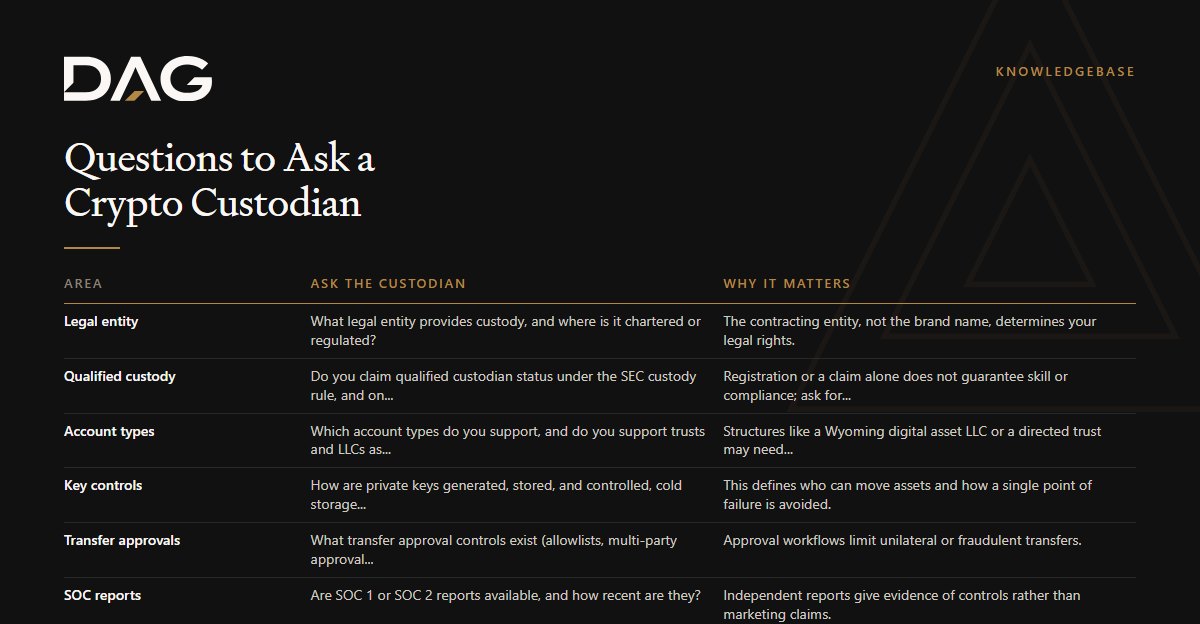
The core questions to ask a crypto custodian cover eight areas: legal entity status, qualified custody, private key controls, transfer approvals, account support, reporting, insurance, and SOC reports. Asking these before you commit assets helps you confirm who actually holds the keys, what protections exist, and whether the arrangement fits your tax and fiduciary needs.
A crypto custodian is the party that holds and safeguards the private keys controlling your digital assets, typically through cold storage, multi-signature approvals, or other key-management controls. A "qualified custodian" is a narrower legal term under the SEC custody rule (Rule 206(4)-2); not every firm that markets custody meets it, so the label is worth verifying directly rather than assuming. The questions below work for any holder, family office, or registered investment adviser doing diligence; they sit alongside the broader topics covered in our Digital Asset Custody Hub.
Questions
Group your diligence by the area each question protects. Answers should generally be backed by documents (a SOC report, an insurance certificate, a Form ADV reference) rather than verbal assurances.
| Area | Ask the custodian | Why it matters |
|---|---|---|
| Legal entity | What legal entity provides custody, and where is it chartered or regulated? | The contracting entity, not the brand name, determines your legal rights. |
| Qualified custody | Do you claim qualified custodian status under the SEC custody rule, and on what basis? | Registration or a claim alone does not guarantee skill or compliance; ask for the basis. See What Is a Qualified Crypto Custodian?. |
| Account types | Which account types do you support, and do you support trusts and LLCs as account holders? | Structures like a Wyoming digital asset LLC or a directed trust may need specific titling. |
| Key controls | How are private keys generated, stored, and controlled, cold storage, multi-sig, HSMs? | This defines who can move assets and how a single point of failure is avoided. |
| Transfer approvals | What transfer approval controls exist (allowlists, multi-party approval, withdrawal delays)? | Approval workflows limit unilateral or fraudulent transfers. |
| SOC reports | Are SOC 1 or SOC 2 reports available, and how recent are they? | Independent reports give evidence of controls rather than marketing claims. |
| Insurance | What insurance is described, what does it actually cover, and what are its limits? | Crypto custody insurance is not FDIC or SIPC coverage and rarely covers market loss. |
| Reporting | What statements and tax exports are available (cost basis, Form 1099-DA support)? | Clean records support cost basis reconstruction and accurate tax filing. |
| Signer changes | How are signer and authorized-user changes handled, and how is succession supported? | Key-holder succession is central to estate and continuity planning. |
Use-case callouts: a family office often weighs trust and LLC titling and signer governance most heavily; an individual holder usually focuses on key controls and recovery. RIAs carry added regulatory duties under the custody rule and Form ADV, for that angle, work through the RIA-specific crypto custody due diligence checklist.
Related Questions
What makes a crypto custodian a "qualified custodian"?
A qualified custodian is generally a bank, trust company, or similar regulated entity that meets the conditions of the SEC custody rule. Whether a particular crypto firm qualifies depends on the facts and its regulatory status, so confirm the basis directly and consult a qualified professional.
Is crypto custody insurance the same as FDIC or SIPC protection?
No. Custody insurance is private coverage with its own limits and exclusions, and it generally does not protect against market losses, depegging, or every form of theft. It is not FDIC or SIPC insurance. Read the policy terms and limits rather than relying on a summary.
Should a trust or LLC hold crypto with a custodian?
It can, but titling, authorized signers, and the custodian's support for entity accounts all matter. Whether a trust or LLC is appropriate depends on your goals and state law, so review the structure with qualified legal and tax advisers. See Should I Put My Crypto in a Wyoming LLC?.
Sources
Compliance Note
This article is educational and does not provide legal, tax, investment, fiduciary, compliance, or custody advice. No custody arrangement removes market, custody, or tax risk, and registration or a qualified-custodian claim alone does not guarantee skill or outcomes. Custodian diligence should be reviewed with qualified professionals. Registration does not imply a certain level of skill or training.