
Whether you should put your crypto in a Wyoming LLC depends on your facts. For meaningful digital asset wealth, a Wyoming LLC can create clearer ownership, custody authority, tax records, and succession structure, but only when it is coordinated with a custody plan, estate documents, tax reporting, and written private-key procedures. It is not a universal answer, and it removes no market, custody, or tax risk.
What a Wyoming LLC Is in This Context
A Wyoming LLC is a limited liability company formed under Wyoming's LLC statute and used as a holding container for digital assets. Wyoming is often discussed for crypto because its statute includes charging-order language and the state has digital asset statutes that classify and recognize digital assets as property. Those features can make it attractive for entity planning, but outcomes still depend on facts, jurisdiction, documents, creditor issues, and tax treatment. The LLC is the container; the operating agreement, custody workflow, tax records, and succession plan decide whether the container works.
Why This Matters
Holding crypto personally can feel simple until something changes: a custody provider asks who owns the account, a family member needs access after incapacity, a CPA asks for clean transaction records, or an estate plan needs to explain who can control wallets. The issue is rarely just ownership. It is whether the structure around the assets can survive real events. A clearer way to think about the trade-offs sits within the broader Crypto Wealth Management Hub.
How It Works
- A Wyoming LLC is formed and registered with the state.
- The operating agreement defines how digital assets are owned, controlled, transferred, and documented, see the operating agreement checklist for the clauses that matter.
- Wallets, custody accounts, or exchange accounts are titled or administered in the LLC's name where supported, and assets are transferred into the LLC with documented contributions.
- The operating agreement addresses private-key control, multi-signature authority, staking, forks, airdrops, successor managers, and member transfers.
- The LLC is coordinated with a trust so the ownership interest has a succession path.
When It May Help vs When It May Not Be Enough
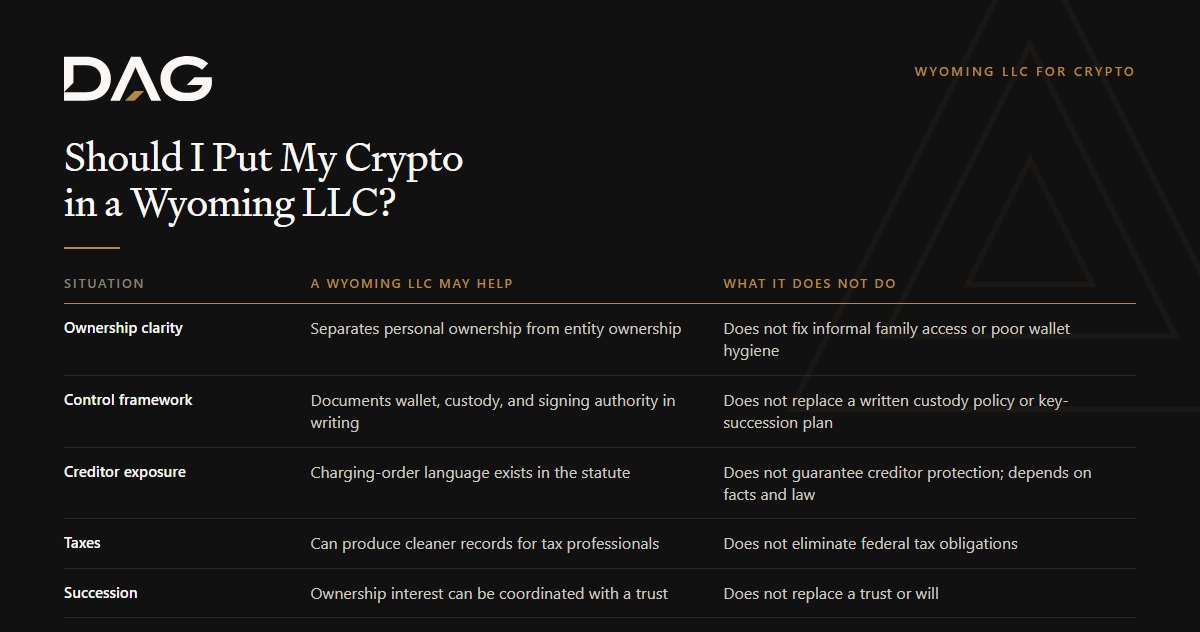
| Situation | A Wyoming LLC may help | What it does not do |
|---|---|---|
| Ownership clarity | Separates personal ownership from entity ownership | Does not fix informal family access or poor wallet hygiene |
| Control framework | Documents wallet, custody, and signing authority in writing | Does not replace a written custody policy or key-succession plan |
| Creditor exposure | Charging-order language exists in the statute | Does not guarantee creditor protection; depends on facts and law |
| Taxes | Can produce cleaner records for tax professionals | Does not eliminate federal tax obligations |
| Succession | Ownership interest can be coordinated with a trust | Does not replace a trust or will |
| Institutional review | Gives custodians, banks, and advisers a structure to evaluate | Registration or formation alone does not guarantee any outcome |
If creditor exposure is your main concern, the limits are covered in more depth in does a Wyoming LLC protect crypto from lawsuits, and the structural choice between entities is examined in crypto LLC vs trust.
Related Questions
Can a Wyoming LLC hold Bitcoin?
In many structures an LLC can own digital assets, or own accounts that hold them. The practical answer depends on the custodian, exchange, wallet setup, operating agreement, banking requirements, and tax classification. Confirm the specifics with a qualified professional before titling assets.
Does a Wyoming LLC protect crypto from creditors?
Wyoming's LLC statute includes charging-order language, but asset protection depends on the facts and applicable law. No LLC eliminates all creditor risk or prevents all claims, and outcomes vary by jurisdiction.
Should a trust own the LLC?
For some crypto-holding families, a trust-owned LLC can divide labor: the LLC handles the operational layer while the trust handles succession and continuity. Whether that fits depends on your goals and requires qualified legal advice.
Bottom Line
A Wyoming LLC can be useful when crypto wealth needs more than a personal wallet and a spreadsheet. Treat it as one piece of a broader structure, custody, tax, trust planning, and private-key procedures all need to work together. No single entity removes market volatility, custody failure, or tax exposure on its own.
Sources
- Wyoming Limited Liability Company Act, Wyo. Stat. 17-29-503
- Wyoming digital asset statutes, Title 34 Chapter 29
- IRS digital assets guidance
Compliance Note
This article is for general educational purposes and is not legal, tax, or investment advice. Outcomes depend on facts, jurisdiction, documents, and applicable law. Consult qualified legal and tax professionals for advice on your situation.