
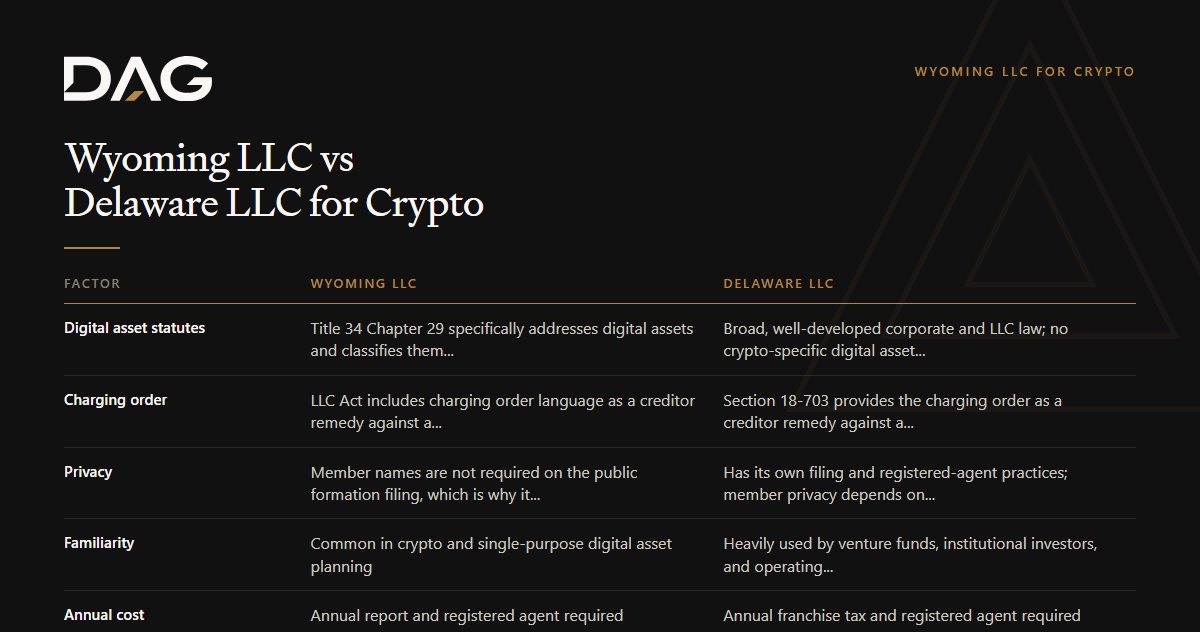
When comparing a Wyoming LLC vs Delaware LLC for crypto, the choice usually turns on digital asset statutes, charging order protection, privacy, and cost. Wyoming is often cited for crypto-specific statutes and member privacy; Delaware is known for mature business law and venture familiarity. The right fit depends on your goals, home-state tax, custody needs, and operating agreement.
What a Wyoming vs Delaware LLC Comparison Means for Crypto
An LLC is a limited liability company: a state-law entity that can own property, open accounts, and hold digital assets separately from its members. Choosing between Wyoming and Delaware means comparing two state LLC statutes that each govern how the entity holds crypto, how members are shielded from entity creditors, and how creditors of a member can reach (or not reach) an interest in the company. The jurisdiction sets the legal foundation, but the operating agreement typically does more day-to-day work in a digital asset structure.
Why This Matters
For crypto holders, choosing an LLC state is not only about filing fees. The entity may need to own digital assets, open a custody account with a qualified custodian, coordinate with a trust, support tax reporting, and define who holds wallet and signing authority. Jurisdiction affects the legal baseline; the documents decide how it works in practice.
Wyoming LLC vs Delaware LLC: Side-by-Side
| Factor | Wyoming LLC | Delaware LLC |
|---|---|---|
| Digital asset statutes | Title 34 Chapter 29 specifically addresses digital assets and classifies them under commercial law | Broad, well-developed corporate and LLC law; no crypto-specific digital asset article of the same kind |
| Charging order | LLC Act includes charging order language as a creditor remedy against a member's interest | Section 18-703 provides the charging order as a creditor remedy against a member's interest |
| Privacy | Member names are not required on the public formation filing, which is why it is often cited for privacy | Has its own filing and registered-agent practices; member privacy depends on how the entity is structured |
| Familiarity | Common in crypto and single-purpose digital asset planning | Heavily used by venture funds, institutional investors, and operating companies |
| Annual cost | Annual report and registered agent required | Annual franchise tax and registered agent required |
| Typical fit | Digital asset-focused holding structures | Institutional, venture, or multi-investor contexts |
A charging order generally limits a member's personal creditor to a lien on distributions rather than seizure of the entity's assets, but how strong that protection is depends on the facts, the documents, and court outcomes. Whether the charging order is the exclusive remedy varies, so confirm the current statute and case law with counsel. For more on creditor exposure, see does a Wyoming LLC protect crypto from lawsuits.
Evidence Standard
This article provides a general comparison and does not recommend a jurisdiction for any specific person. Neither Wyoming nor Delaware is described here as superior; each statute simply weights different factors.
When It May Help
- You are forming an LLC to hold or administer digital assets.
- A trust may own the LLC, and you are weighing how a crypto LLC compares with a trust.
- You need custody account documentation for a qualified custodian.
- You are comparing privacy, asset protection, and statutory recognition of digital assets.
- Your advisors are deciding between two familiar jurisdictions.
When It May Not Be Enough
State choice does not, by itself, solve tax, custody, estate, or operating agreement problems. Your home state's law and tax rules may still apply if you live and operate there. No jurisdiction removes market, custody, or tax risk, and the entity must still keep clean records of its crypto holdings. Qualified legal advice is required.
Related Questions
Is Wyoming always better for crypto?
No. Wyoming is often cited for digital asset statutes and member privacy, but the better jurisdiction depends on your facts, your home state, and legal advice. "Better" is not automatic.
Is Delaware better for institutional investors?
Delaware is widely used in institutional and venture contexts because of its developed business law, but that does not automatically make it the right choice for personal crypto wealth.
Does either state eliminate creditor risk?
No. LLC protections, including the charging order, depend on facts, documents, timing, statute, and how a court rules. Neither state guarantees a particular outcome.
Does the LLC state affect crypto taxes?
Generally, federal tax treatment follows the IRS view of digital assets as property regardless of formation state, and your home state may still tax you. Confirm specifics with a qualified tax professional.
Bottom Line
Wyoming may suit crypto-specific LLC planning, while Delaware may be familiar for broader business and venture contexts. Choose based on the full structure, custody, tax, trust coordination, and documents, rather than brand recognition. The Crypto Wealth Management Hub covers how this entity decision fits the wider plan.
Sources
- Wyoming Limited Liability Company Act
- Wyoming digital asset statutes, Title 34 Chapter 29
- Delaware Limited Liability Company Act, Section 18-703
Compliance Note
This article is for general educational purposes and is not legal, tax, or asset-protection advice. Jurisdiction decisions should be made with qualified counsel.