
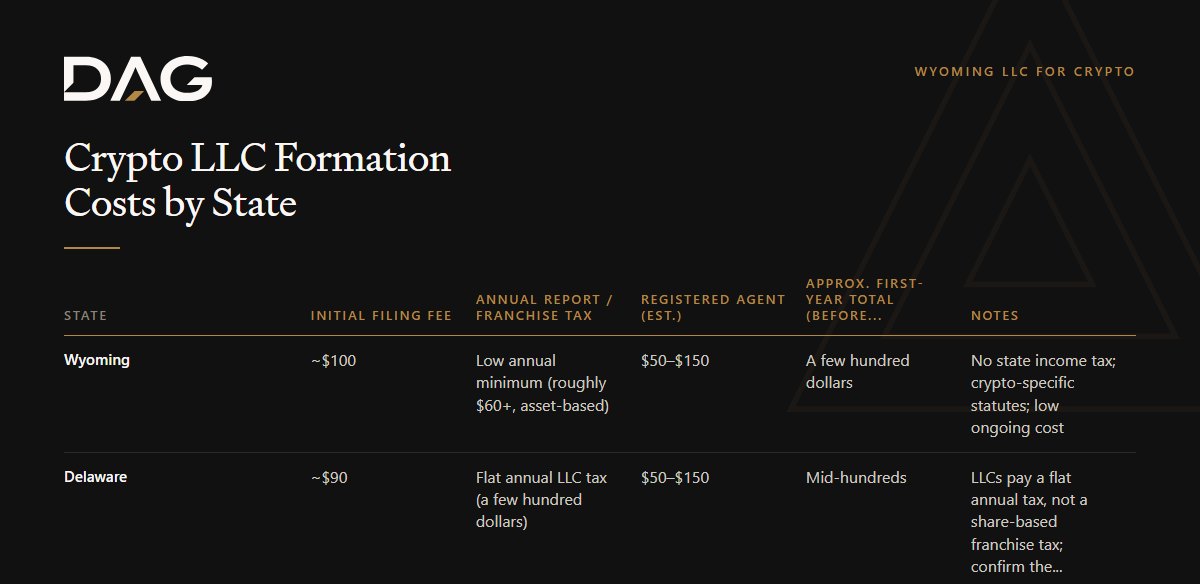
Crypto LLC formation costs by state add up well beyond the initial filing fee. Across Wyoming, Delaware, Nevada, California, and Texas, first-year totals, filing fee, annual maintenance, and registered agent, generally run from a few hundred dollars to roughly $800 or more before professional fees. Figures change often, and where you live and operate can override your formation state entirely. For a broader overview, see crypto LLC formation.
What Is a Crypto LLC Formation Cost?
A crypto LLC formation cost is the sum of every recurring state and administrative expense required to create and maintain a limited liability company holding digital assets: the initial filing fee paid to the state's Secretary of State, any annual report or franchise tax to keep the entity active, and the registered agent fee required in each state where the LLC is registered.
Professional costs, legal, accounting, compliance software, and custody infrastructure, typically exceed state fees in most operating years and are not reflected in the state fee schedules below.
Why the Filing Fee Is the Wrong Number to Watch
What recurring expenses apply after formation?
After the initial filing, an LLC holding crypto typically incurs:
- Annual report or franchise tax, varies widely by state (see table below); verify current amounts with each state's Secretary of State, as schedules change
- Registered agent, typically $50–$150/year in any state where the LLC is registered
- Crypto accounting software, dedicated cost-basis tools start at a few hundred dollars per year for active portfolios
- CPA or tax counsel, a CPA with genuine crypto expertise charges more than a generalist; for crypto tax reporting for LLCs, this is not optional
- Custody infrastructure, proper multi-sig or cold-storage setup for a serious holding entity carries setup and ongoing costs
A properly maintained crypto LLC commonly runs $1,500–$3,000 or more per year in total costs once professional services are included.
State Filing and Annual Fee Comparison
Important: All figures below reflect publicly available state fee schedules as of early 2026 and are approximate. State filing fees, franchise taxes, and annual report requirements change. Verify every figure against the current Secretary of State fee schedule for each state, fees change, before filing or budgeting.
Figures are approximate, as of early 2026. Verify each with the state's Secretary of State, fees change.
| State | Initial Filing Fee | Annual Report / Franchise Tax | Registered Agent (est.) | Approx. First-Year Total (before professional fees) | Notes |
|---|---|---|---|---|---|
| Wyoming | ~$100 | Low annual minimum (roughly $60+, asset-based) | $50–$150 | A few hundred dollars | No state income tax; crypto-specific statutes; low ongoing cost |
| Delaware | ~$90 | Flat annual LLC tax (a few hundred dollars) | $50–$150 | Mid-hundreds | LLCs pay a flat annual tax, not a share-based franchise tax; confirm the current amount |
| Nevada | ~$75 | Combined annual list + business license fees (several hundred dollars) | $50–$150 | Mid-hundreds | Higher annual costs than Wyoming; privacy protections still strong |
| Texas | ~$300 | Franchise tax is revenue-based; many small entities owe $0 below the state's "no-tax-due" threshold | $50–$150 | Varies | No state income tax; higher initial fee; confirm the current revenue threshold |
| California | ~$70 | $800 minimum franchise tax (verify current amount) | Not required if owner is agent | Highest of the five (driven by the franchise tax) | Minimum franchise tax applies even to out-of-state LLCs doing business in CA |
Sources: Wyoming Secretary of State; Delaware Division of Corporations; Nevada Secretary of State; Texas Comptroller / Secretary of State; California Secretary of State / Franchise Tax Board, see Sources below. Verify current schedules before filing.
The Home-State Problem
Does forming in Wyoming protect a California resident from California taxes?
No. California applies its $800 minimum franchise tax to any LLC, regardless of formation state, that is "doing business" in California. If you manage a Wyoming LLC from California, California will generally treat it as a California-doing-business entity. You would then owe California's franchise tax in addition to Wyoming's annual fee, and you would need to register the Wyoming LLC as a foreign entity in California, adding another filing fee and a second registered agent.
The result is often a higher total cost than simply forming in California in the first place. Should I Put My Crypto in a Wyoming LLC? addresses when this calculus changes.
What are nexus rules and why do they matter for crypto LLCs?
Each state defines "doing business" differently, but relevant factors typically include where the LLC's manager resides, where decisions are made, where employees or contractors work, and where customers are located. Digital asset activity does not automatically create multi-state nexus, but an LLC whose sole manager lives and operates in a high-tax state will usually be subject to that state's rules regardless of formation state. Consult a tax professional familiar with state nexus rules before selecting a formation state.
The Costs That Surprise People Later
What is foreign qualification and when does it apply?
Foreign qualification is the process of registering an out-of-state LLC to do business in another state. Each qualified state adds: a filing fee, an annual report requirement, and a registered agent. If your crypto LLC expands operations across state lines or you relocate, these costs accumulate. For crypto custody for LLCs where the entity opens accounts with custodians in multiple jurisdictions, verify whether that triggers qualification requirements.
Do multi-member crypto LLCs cost more to form?
The formation filing fee is the same, but legal costs are higher. A single-member LLC holding crypto can use a relatively simple operating agreement. A multi-member LLC requires a real operating agreement addressing capital contributions, distribution waterfalls, exit provisions, and, specific to crypto, how wallet access, signing authority, and key management are handled. Skipping this work to save on legal fees creates risk that typically costs more to resolve than it saved. See crypto LLC operating agreement checklist for what that document should cover.
How does tax election choice affect total cost?
An LLC's default federal tax classification depends on member count (single-member = disregarded entity; multi-member = partnership). Elections to be taxed as an S-corp or C-corp each carry different compliance costs, self-employment tax implications, and payroll requirements. The right election depends on income level, trading activity, and entity purpose. Choosing incorrectly can cost more in taxes and professional fees than the formation itself.
Related Questions
Is Wyoming a good fit for a crypto LLC in 2026?
Wyoming is a common starting point for many individual crypto investors: relatively low filing costs (around $100), low annual minimums, no state income tax, and a body of crypto-specific statutes that some other states have not matched. There is no single "best" state, though, the right choice depends on where you live, how you operate, and what you're trying to accomplish. A resident of a no-income-tax state like Texas or Florida may find home-state formation simpler and lower-cost overall. The trade-offs, not a ranking, should drive the decision.
Should a trust own the LLC rather than an individual?
Using a trust as the LLC member is a common structure for estate planning and asset protection. The trust-over-LLC approach can provide both the operating flexibility of an LLC and the succession and creditor-protection features of a trust. It adds cost, trust drafting, trustee fees, and additional accounting complexity. Should a trust own a Wyoming LLC for crypto assets? and trust-owned LLC for crypto assets cover the structure in detail.
What custody setup does a crypto LLC actually need?
An LLC holding digital assets should have documented key management procedures, a defined signing policy, and, for significant holdings, multi-signature or institutional custody rather than a single-point software wallet. Crypto custody for LLCs covers what a proper setup looks like and what questions to ask a custodian.
How does an LLC affect crypto tax reporting?
A single-member LLC taxed as a disregarded entity reports crypto activity on Schedule C or Schedule D (depending on the activity). A multi-member LLC taxed as a partnership files Form 1065 and issues K-1s. Either way, cost-basis tracking, wash-sale-adjacent considerations for crypto, and exchange reporting via Form 1099-DA all apply. See crypto tax reporting for LLCs for specifics.
Sources
- Wyoming Secretary of State. LLC Filing Fees and Annual Report: https://sos.wyo.gov/Business/Docs/LLCForms.aspx (verify current schedule)
- Delaware Division of Corporations. LLC Franchise Tax and Annual Reports: https://corp.delaware.gov/paytaxes.shtml (verify current schedule)
- Nevada Secretary of State. Annual List and Business License Fees: https://esos.nv.gov/ (verify current schedule)
- Texas Secretary of State. Filing Fees: https://www.sos.state.tx.us/corp/fees.shtml (verify current schedule)
- California Secretary of State. LLC Formation Fees: https://www.sos.ca.gov/business-programs/business-entities/fees (verify current schedule)
- California Franchise Tax Board. LLC Taxes and Fees: https://www.ftb.ca.gov/forms/misc/3556.html (verify current schedule)
- IRS. LLC Federal Tax Classifications: https://www.irs.gov/businesses/small-businesses-self-employed/limited-liability-company-llc
All state fee schedules change. Figures in this article reflect publicly available information as of early 2026. Verify directly with each state's Secretary of State and, for California, the Franchise Tax Board before filing or budgeting.
Compliance Note
This page is educational only and does not constitute legal, tax, or investment advice. LLC formation rules, state fees, franchise taxes, and nexus standards vary by jurisdiction and change frequently. All fee figures presented here must be verified against current official state fee schedules before relying on them. Consult a qualified attorney and CPA with experience in digital asset entity structuring before forming any entity or making formation-state decisions. Digital Ascension Group (DAG Wealth) does not provide legal services.