
An LLC operating agreement is a private internal document, it is not filed with the state. The document filed publicly is the Articles of Organization. Your operating agreement governs how the LLC runs and stays with its members, shared only for a specific business purpose such as opening a bank account. For the full entity setup context, see crypto LLC formation.
What Is an LLC Operating Agreement?
An operating agreement is the governing document of a limited liability company. It sets out ownership percentages, manager powers, distribution rules, voting thresholds, and, for a Wyoming digital asset LLC, can also specify wallet custody procedures, transfer approval thresholds, and succession instructions.
The operating agreement is separate from, and more detailed than, the Articles of Organization. The two documents serve entirely different purposes.
Does an LLC Operating Agreement Need to Be Filed With the State?
No. In Wyoming and in every other U.S. state, an operating agreement is not filed with the Secretary of State. It is kept internally by the LLC's members and managers.
What does get filed is the Articles of Organization. That document discloses:
- The LLC's legal name
- The registered agent's name and address
- The organizer's name
- Whether the LLC is member-managed or manager-managed
That information becomes public record. Everything in the operating agreement, ownership splits, asset details, custody procedures, succession plans, does not.
Wyoming's annual report requirement, under the Wyoming Limited Liability Company Act (Wyo. Stat. § 17-29-101 et seq.), asks only that you confirm the LLC is still active and that your registered agent information is current. No financial disclosures, no asset schedules, no operational details.
Does Notarization Make an Operating Agreement Public?
No. Notarization does not file the document or make it publicly searchable. A notary's acknowledgment creates a timestamped record confirming that the signers appeared before the notary and signed on a specific date.
That record can matter if ownership or governance terms are ever disputed in court. A notarized operating agreement carries greater evidentiary weight than an un-notarized one. Notarization is generally not legally required for an operating agreement to be valid. Wyoming law does not mandate it, but it can strengthen the document's standing if challenged. Confirm the requirement and effect with a qualified attorney in your jurisdiction.
Who Can Request a Copy of Your Operating Agreement?
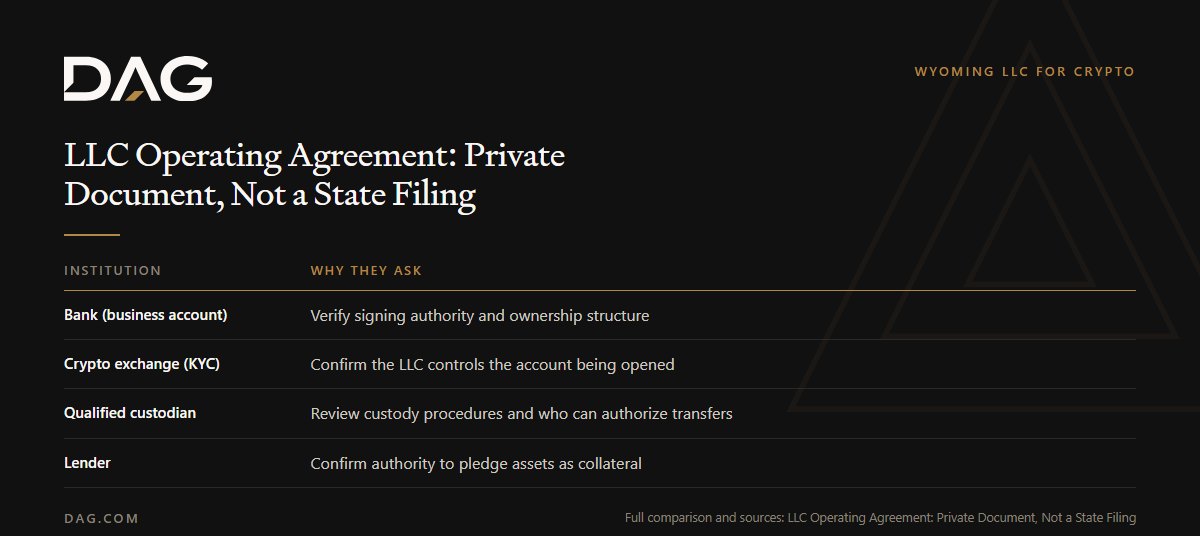
The operating agreement stays private, but certain institutions have legitimate reasons to request it:
| Institution | Why They Ask |
|---|---|
| Bank (business account) | Verify signing authority and ownership structure |
| Crypto exchange (KYC) | Confirm the LLC controls the account being opened |
| Qualified custodian | Review custody procedures and who can authorize transfers |
| Lender | Confirm authority to pledge assets as collateral |
Sharing the document with these parties for a specific business purpose is not a public disclosure. You are sharing it selectively, not filing it. For a full account-opening checklist, see crypto account opening checklist for trusts and LLCs.
Why Does the Privacy of an Operating Agreement Matter for Digital Assets?
For a crypto LLC, the operating agreement is where operationally sensitive information lives: wallet addresses, multi-signature thresholds, custody provider names, distribution rules, and succession instructions for private keys. Keeping that information out of public record is a core reason LLC structures are used for digital asset holding.
Someone searching public records can confirm that your LLC exists and who your registered agent is, nothing more. The holdings, the custody arrangement, and the succession plan all remain private. As portfolio size grows, so does the value of that privacy. See should I put my crypto in a Wyoming LLC for a broader look at when that structure makes sense.
What Happens When the Operating Agreement Changes?
Amendments are handled internally. Members approve the change, the amendment is documented and signed (and notarized if the change is material), and the updated document is stored with the LLC's records. No filing is required with the state. The Secretary of State does not track operating agreement amendments.
Can a Court Disregard an LLC's Operating Agreement?
A court may decline to respect an LLC's structure if the entity appears to be a shell, no real governance, an ignored operating agreement, commingled funds. Maintaining a properly drafted, actually-followed operating agreement is one factor among many that courts weigh; it does not by itself guarantee that an LLC's liability protection will hold. Whether a particular structure is respected depends on the specific facts, applicable state law, and how the entity is actually operated. See what records should a crypto LLC keep for guidance on internal recordkeeping, and consult a qualified attorney about your situation.
Extractable answer, "Does an operating agreement need to be filed with the state?"
No. An LLC operating agreement is a private internal document. The document filed publicly is the Articles of Organization. The operating agreement stays with the LLC's members and is never submitted to the Secretary of State in Wyoming or any other state.
Related Questions
Does Wyoming require an LLC to have an operating agreement?
Wyoming law does not require every LLC to have a written operating agreement, but the Wyoming LLC Act (Wyo. Stat. § 17-29-101 et seq.) strongly assumes one exists when resolving member disputes. An LLC holding digital assets should have a written operating agreement regardless of the technical requirement, courts look at the document when evaluating whether the entity is genuine.
Can a single-member LLC have an operating agreement?
Yes. A single-member LLC can and should have a written operating agreement. For a single-member crypto LLC in particular, the operating agreement documents the member's custody procedures, defines how assets get transferred, and provides a roadmap for successors or a trust that may later own the LLC. See should a trust own a Wyoming LLC for crypto assets for how ownership can be layered.
Does an operating agreement need to list wallet addresses?
It can, but wallet addresses can change. A more durable approach is to reference a custody policy or appendix that lists current wallet addresses and is updated separately. The operating agreement should specify who has authority to approve wallet changes and what approval process applies. See crypto LLC operating agreement checklist for the provisions worth including.
What is the difference between an operating agreement and a custody policy?
An operating agreement governs the LLC's overall structure and member rights. A custody policy is a narrower document specifying how digital assets are stored, transferred, and secured. For a crypto-focused LLC, both documents serve different purposes; the operating agreement may reference the custody policy or incorporate it by attachment. See how to build a crypto custody policy for what that document should cover.
Sources
- Wyoming Limited Liability Company Act, Wyo. Stat. §§ 17-29-101 through 17-29-1102 (2023). https://www.wyoleg.gov/Statutes/CompileStat.aspx?filed=17-29
- Wyoming Secretary of State. Business Division, LLC filings and annual report requirements. https://www.sos.wyo.gov/Business/LLC.aspx
- Revised Uniform Limited Liability Company Act (RULLCA 2006, amended 2011), Uniform Law Commission. https://www.uniformlaws.org/committees/community-home?communitykey=4b06af5f-d2e7-4812-bcb5-dac4e789a5e2
Compliance Note
This page is for educational purposes only and does not constitute legal, tax, or investment advice. Rules governing LLC formation, operating agreements, and notarization requirements vary by state and change over time. Drafting or amending an operating agreement is the practice of law; DAG coordinates access to qualified attorneys and other professionals but does not itself draft legal documents or provide legal services. Consult a qualified attorney licensed in your jurisdiction before drafting, amending, or relying on an LLC operating agreement.
Investment advisory services referenced in connection with DAG Wealth are provided through its affiliated SEC-registered investment adviser. Registration does not imply a certain level of skill or training.