
You can amend LLC or trust documents after setup, but the path depends on the document. A revocable trust grantor signs a written amendment referencing the original. An LLC follows the approval threshold in its operating agreement, a process that begins at crypto LLC formation. Irrevocable trusts generally cannot be freely amended; changes usually require court approval, beneficiary consent, or a trust protector with express authority.
Amendment vs. Restatement: What Is the Difference?
An amendment modifies one or more specific provisions of an existing document while leaving the rest in place. A restatement replaces the original document entirely with a clean version that incorporates all prior amendments. Restating is common after multiple rounds of amendments have made the original document difficult to follow.
For LLCs, there is also a distinction between:
- Operating agreement amendment, changes governance, ownership, or operational rules between members.
- Articles of Organization amendment, changes the public-facing record filed with the state (name, registered agent, management type). Requires filing the amendment form with the Wyoming Secretary of State and paying the current filing fee (confirm the amount on the Secretary of State website, as fees are subject to change).
How Do I Amend an LLC Operating Agreement?
Single-Member LLC
- Draft a written amendment document.
- Reference the original operating agreement by name and execution date.
- Identify the specific section(s) being changed and state the new language precisely.
- Sign and date the amendment as sole member.
- Notarize if the change affects ownership, custody procedures, succession, or signing authority on financial accounts.
- Attach the amendment to the original operating agreement; retain all prior versions.
Multi-Member LLC
Follow the same steps, but the approval threshold is whatever your crypto LLC operating agreement checklist specifies, typically majority or unanimous written consent. Document the consent through a written resolution or written action signed by all required members.
How Do I Amend a Revocable Trust?
- Draft a written amendment referencing the original trust by name and date.
- Identify the specific article or section being modified.
- State the replacement language clearly.
- Sign as grantor and have the amendment notarized.
- File the amendment with the original trust document so any future trustee or successor can read the full history.
A revocable trust can be amended any number of times while the grantor is alive and competent, because the grantor retained full control at formation. If the trust has accumulated multiple amendments, a full restatement may be cleaner: the restated document supersedes the original and all prior amendments.
Can an Irrevocable Trust Be Amended?
Generally, no, not unilaterally. When you created an irrevocable trust, you gave up control. Limited amendment mechanisms may be available depending on:
- Express modification provisions in the trust instrument itself.
- Trust protector authority, if the trust designates a trust protector with power to modify administrative or distribution provisions. Wyoming domestic asset protection trusts often include this. See trust protector for a crypto trust.
- Consent of all beneficiaries, in some circumstances and jurisdictions.
- Court approval (judicial modification or decanting, depending on state law).
Whether any of these paths is available, and how it works, depends heavily on your state and the exact terms of your trust instrument. Check what modification authority your specific document grants, and consult a qualified attorney before relying on any mechanism, amending an irrevocable trust is a legal determination, not a do-it-yourself task.
What Should an Amendment Document Include?
Every amendment, for an LLC or a trust, should contain:
- Name of the original document and its execution date.
- Identification of the specific section or provision being changed.
- The new replacement language (not just a description of the change).
- Effective date of the amendment.
- Signatures of all required parties.
- Notarization where warranted.
Do I Need to Update Other Documents After an Amendment?
Yes. An amendment to the governing document is only half the work. Depending on what changed:
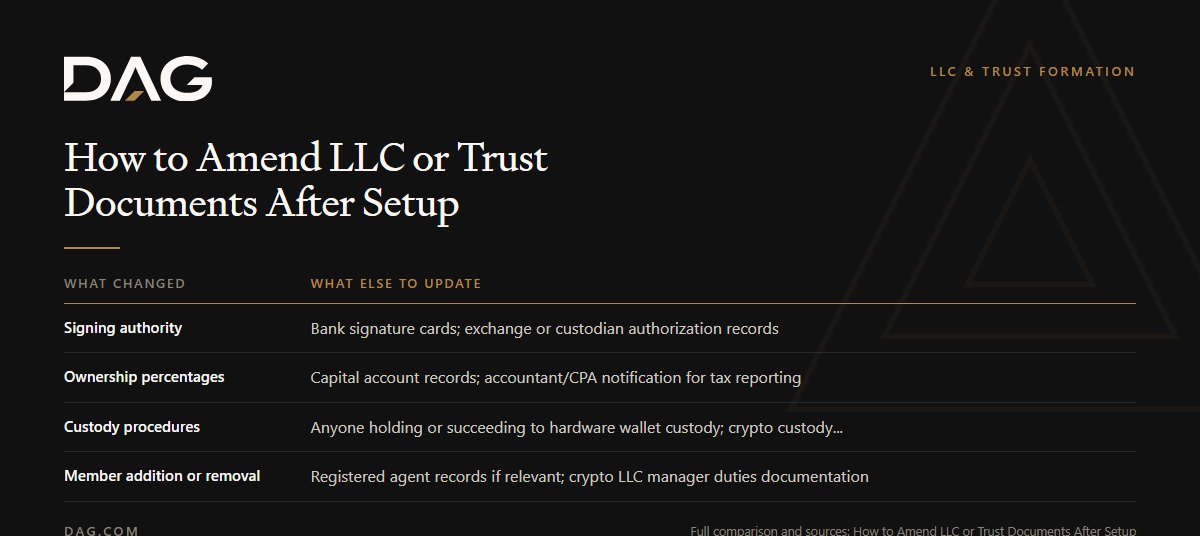
| What changed | What else to update |
|---|---|
| Signing authority | Bank signature cards; exchange or custodian authorization records |
| Ownership percentages | Capital account records; accountant/CPA notification for tax reporting |
| Custody procedures | Anyone holding or succeeding to hardware wallet custody; crypto custody policy template for family offices |
| Member addition or removal | Registered agent records if relevant; crypto LLC manager duties documentation |
Failing to cascade an amendment through related documentation is one of the most common errors, the document says one thing and the tax return, bank account, or custody arrangement says another.
Do Beneficiaries Need to Be Notified?
For revocable trusts, beneficiaries generally have no current rights during the grantor's lifetime, so notification is typically not required while the grantor is alive and competent.
For irrevocable trust amendments, beneficiaries whose interests are affected may need to receive notice, and in some cases their consent. These requirements depend on state law and the trust instrument, so confirm what applies in your jurisdiction with counsel before acting.
What About Asset Schedules for Crypto Holdings?
Operating agreements for Wyoming digital asset LLCs typically attach a schedule listing wallet addresses and holdings. This schedule is designed to be updated without a formal amendment to the operating agreement itself. When wallet addresses change materially or significant holdings move:
- Create a new dated schedule.
- Attach it to the original operating agreement.
- Retain the prior schedule as a historical record.
Keeping the schedule current is especially important for succession, heirs and successors need an accurate inventory to locate and access assets.
Numbered Steps: Amending an LLC Operating Agreement End-to-End
- Identify the specific provision to change.
- Draft the amendment naming the original agreement and execution date.
- Circulate for member approval per the required threshold.
- Collect signatures; notarize if the change is material (ownership, signing authority, custody, succession).
- Notify banks, custodians, and exchanges of any authority changes.
- Update capital account records and notify your CPA if ownership percentages changed.
- File the signed amendment with the original operating agreement.
- Note the amendment in annual meeting minutes.
Related Questions
Can I cross out and handwrite changes on an operating agreement?
No. Crossing out text and handwriting revisions is not a valid amendment, it creates ambiguity about what the governing document actually says and can be challenged. Always create a separate, formally executed amendment document.
How long should I keep old amendments?
Indefinitely, or at least for the life of the entity plus any applicable statute of limitations. Amendment history may be needed to reconstruct ownership structure at a specific point in time for tax audits, disputes, or successor administration.
Does amending a trust trigger gift or estate tax consequences?
Amending a revocable trust generally does not trigger transfer tax consequences because the grantor retains full control. Amending an irrevocable trust, particularly changing beneficiaries or distribution provisions, can create gift or estate tax exposure depending on the facts. This is not tax advice; review any irrevocable trust change with a qualified CPA or tax attorney before acting.
What is decanting, and when is it used?
Decanting is a process available in some states (including Wyoming) that lets a trustee distribute trust assets into a new trust with modified terms, effectively rewriting provisions of an irrevocable trust without court approval. In Wyoming, a trustee's authority to distribute property in further trust is found among the specific powers of a trustee under Wyo. Stat. § 4-10-816, and it requires specific conditions to be met. Confirm current statutory authority and your trustee's specific powers with a qualified attorney before relying on decanting.
Do LLC amendments need to be filed with the state?
Most operating agreement amendments are internal governance documents and are not filed with the state. However, if the amendment changes information that appears in the Articles of Organization, the LLC name, registered agent, or management structure, those changes must be reflected in an Articles of Organization amendment filed with the Wyoming Secretary of State.
Sources
- Wyoming Limited Liability Company Act, Wyo. Stat. §§ 17-29-101 et seq. (2021 ed.), governing formation, amendment authority, and operating agreements. Available at: https://wyoleg.gov/statutes/compress/title17.pdf
- Wyoming Uniform Trust Code, Wyo. Stat. §§ 4-10-101 et seq., governing trust modification, decanting, and trust protector authority. Available at: https://wyoleg.gov/statutes/compress/title04.pdf
- Wyoming Secretary of State, Business Division. Articles of Organization amendment filing requirements. Available at: https://sos.wyo.gov/Business/
Compliance Note
This page is educational only and does not constitute legal, tax, or investment advice. LLC and trust amendment requirements vary by state, by the terms of your specific documents, and by the nature of the change. Consult a qualified attorney before amending any legal entity document, particularly irrevocable trusts, documents affecting ownership or tax reporting, or changes that may trigger notification or consent requirements. DAG coordinates family office services and document administration; it does not practice law. Investment advisory services are offered through DAG Wealth, a registered investment adviser. Registration does not imply a certain level of skill or training.