
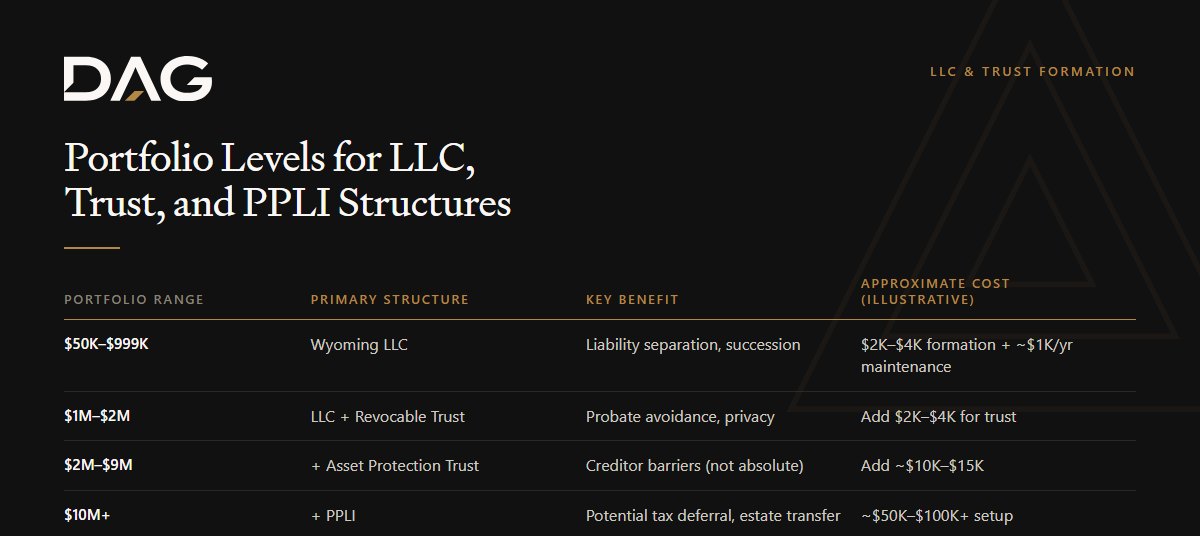
Choosing portfolio levels for LLC, trust, and PPLI structures means matching each wrapper to portfolio size, as part of a thoughtful crypto LLC formation strategy. A Wyoming LLC typically fits low six figures for liability separation. A revocable trust often makes sense near $1 million. An asset protection trust may suit mid-seven figures, and PPLI is generally weighed only in eight figures. Thresholds are illustrative.
What Is a Tiered Wealth Structure?
A tiered wealth structure means adding legal and tax wrappers around digital assets in stages, each layer timed to the point where its benefits outweigh setup and maintenance costs. The underlying principle: structure should solve problems you actually have, not problems you might have someday.
How Should I Structure My Crypto Portfolio by Size?
The tiers below are illustrative guidelines, not rigid thresholds. Your profession, liability exposure, family situation, and tax bracket all modify the timing. Consult a qualified attorney and CPA before acting.
Tier 1: Low Six Figures. Wyoming LLC
When crypto holdings reach roughly $50,000–$100,000, a Wyoming LLC for crypto assets addresses the core problems at this asset level:
- Liability separation. LLC assets are legally distinct from personal assets, limiting exposure in a lawsuit or creditor claim. Note: asset protection is not absolute; courts may pierce the corporate veil for inadequate capitalization, commingled funds, or fraud.
- Ownership documentation, the operating agreement establishes clear title.
- Tax reporting clarity, a single-member LLC disregarded for tax purposes reports on Schedule C or Schedule E; multi-member LLCs file Form 1065.
- Basic succession, the operating agreement can direct membership interest on death without a trust.
Tax note: Contributing crypto to a wholly-owned single-member LLC is generally not a taxable event because the entity is disregarded for federal tax purposes. Contributing to a multi-member LLC taxed as a partnership is generally tax-free under IRC § 721, subject to exceptions. Consult a CPA on your specific contribution structure.
Illustrative costs (verify current figures): Formation may run roughly $2,000–$3,000 with annual maintenance near $1,000. Rates vary by provider and state; confirm before budgeting.
Stop here if portfolio stays in the low six figures. The LLC delivers what matters at this level.
Tier 2: Seven Figures. Revocable Living Trust
At roughly $1 million or more in digital assets, adding a revocable living trust that owns the LLC membership interest adds:
- Probate avoidance, trust assets transfer to beneficiaries without court proceedings.
- Privacy, trust ownership does not appear in public records the way probate filings do.
- Multi-generational transfer foundation, the trust can contain provisions for subsequent generations.
Funding a revocable trust with LLC membership interest is generally not a taxable event. The grantor remains the owner for tax purposes. See how to fund a trust with crypto for mechanics.
Illustrative costs (verify current figures): Professional trust drafting may run roughly $2,000–$4,000, depending on the attorney and complexity.
For investors in high-liability professions at this tier, a Wyoming domestic asset protection trust may be worth evaluating, charging-order protection and spendthrift provisions can add creditor barriers that a revocable trust alone does not provide. These protections are not absolute: they can be undone as fraudulent transfers, are not recognized uniformly across states, and may require a seasoning period before they apply. See revocable vs irrevocable trusts for crypto assets.
Tier 3: Mid-Seven Figures. Asset Protection Trust and Family Office Coordination
Around $2 million or more, the question shifts from "do I need a trust?" to "what type and how do I coordinate across entities?" At this level:
- Domestic asset protection trusts (DAPTs). Wyoming and several other states permit self-settled trusts with spendthrift provisions. These can provide creditor protection, but timing matters: contributions made to defeat existing creditors may be undone as fraudulent transfers, and protection is not absolute across all jurisdictions.
- Multi-entity coordination, you may hold different asset types in different entities (operating LLC, holding LLC, trust), requiring tax and legal coordination to avoid unintended income recognition or veil-piercing risk.
- Crypto tax planning for HNW investors becomes material, entity selection, cost-basis methodology, and harvest timing interact across a more complex structure.
Illustrative costs (verify current figures): DAPT setup may run roughly $10,000–$15,000, varying widely by attorney, state, and structure.
Tier 4: Eight Figures. Private Placement Life Insurance (PPLI)
PPLI is an institutional-grade insurance wrapper around an investment portfolio. It is generally considered cost-effective starting around $5–$10 million in liquid assets, depending on policy structure.
Educational overview, this is not an insurance recommendation. PPLI is a complex product with significant suitability considerations. Work with a licensed insurance professional and tax attorney.
How PPLI is designed to work:
- An investment portfolio is held inside a life insurance policy.
- Growth inside the policy is generally tax-deferred.
- Death benefit proceeds to beneficiaries may be income-tax-free under IRC § 101(a), subject to the modified endowment contract (MEC) rules and the investor-control doctrine.
- The policy must comply with IRC § 7702 to maintain its insurance characterization.
PPLI and crypto: appreciated crypto can generally be contributed to the policy at current fair market value. Whether that contribution is a taxable realization event depends on the policy structure and contribution mechanics, consult a tax attorney before contributing.
Illustrative costs (verify current figures): Setup may run roughly $50,000–$100,000 including legal and insurance company fees, with ongoing costs that can fall near 1–1.5% of policy assets annually between insurance charges and investment management. These figures are illustrative and vary by carrier, policy size, and structure.
PPLI is generally discussed at scale because potential tax deferral may compound over decades; outcomes depend entirely on policy structure, holding period, and individual tax circumstances, and are not assured. At lower portfolio levels the cost structure is generally high relative to any potential tax savings.
Structure Decision Matrix
| Portfolio Range | Primary Structure | Key Benefit | Approximate Cost (Illustrative) |
|---|---|---|---|
| $50K–$999K | Wyoming LLC | Liability separation, succession | $2K–$4K formation + ~$1K/yr maintenance |
| $1M–$2M | LLC + Revocable Trust | Probate avoidance, privacy | Add $2K–$4K for trust |
| $2M–$9M | + Asset Protection Trust | Creditor barriers (not absolute) | Add ~$10K–$15K |
| $10M+ | + PPLI | Potential tax deferral, estate transfer | ~$50K–$100K+ setup |
All cost figures are illustrative estimates and not current quotes. Actual costs vary by attorney, state, carrier, and complexity. Verify current figures and do not rely on these for budgeting.
Personal Factors That Shift the Thresholds
The tiers above are starting points. Several factors move the line:
- High-liability profession, physicians, contractors, or executives with significant personal exposure may justify asset protection structures at lower portfolio values.
- Tax bracket, investors facing high combined federal and state tax rates on investment income may find PPLI cost-effective at lower portfolio sizes.
- Family complexity, multiple beneficiaries, blended families, or minor children may warrant trust structures earlier.
- Volatility, if your portfolio regularly swings between $300K and $800K, size the structure to your more stable range, not the peak.
- Geography, your home state's creditor protection laws interact with the structures you choose. Wyoming offers strong charging-order protection and permits DAPTs; other states offer weaker defaults.
- International holdings, assets in multiple countries require coordinated structures; this is generally a mid-to-upper seven-figure concern.
Related Questions
Does putting crypto in an LLC trigger a taxable event?
Generally no. A single-member LLC disregarded for federal tax purposes is treated as the same taxpayer. Contribution to a multi-member LLC is generally tax-free under IRC § 721, provided no exceptions apply (e.g., where liabilities exceed basis, or where the partnership has contributed services). Consult a CPA before contributing, especially if the crypto carries significant unrealized gain or if the LLC will have multiple members.
Can I skip the LLC and put crypto directly in a trust?
A revocable trust can hold crypto directly, but holding crypto in a trust vs an LLC involves trade-offs. An LLC provides liability separation that a revocable trust does not, the trust is still treated as owned by the grantor for creditor purposes. The trust-owned LLC structure combines both layers.
What happens if my crypto portfolio drops significantly in value after I set up a PPLI?
PPLI involves ongoing insurance charges and investment management fees regardless of portfolio performance. If a crypto position drops sharply after contribution, the cost structure may no longer be justified relative to policy value. PPLI is illiquid and difficult to unwind without tax consequences, suitability and liquidity needs should be evaluated carefully before entering a policy. This is a key reason PPLI is generally reserved for assets investors have a long time horizon on.
Is a Wyoming LLC or trust effective against all creditors?
No. Asset protection is not absolute. Courts may pierce the LLC veil for inadequate capitalization, failure to observe formalities, or commingled personal and entity funds. Fraudulent transfer law can unwind contributions made when the transferor was insolvent or intended to delay creditors. DAPT protections are not recognized universally across states. An asset protection attorney familiar with your state's laws should evaluate your specific situation.
Sources
- Wyoming Statute Title 17, Chapter 29 (Wyoming Limited Liability Company Act), https://wyoleg.gov/statutes/compress/title17.pdf
- IRC § 721. Nonrecognition of Gain or Loss on Contribution, https://www.law.cornell.edu/uscode/text/26/721
- IRC § 7702. Life Insurance Contract Defined, https://www.law.cornell.edu/uscode/text/26/7702
- IRC § 101(a). Exclusion of Life Insurance Proceeds, https://www.law.cornell.edu/uscode/text/26/101
- IRS, Virtual Currencies, https://www.irs.gov/businesses/small-businesses-self-employed/virtual-currencies
- Wyoming Domestic Asset Protection Trust statute, Wyo. Stat. § 4-10-510 et seq., https://wyoleg.gov/statutes/compress/title04.pdf
Compliance Note
This page is for educational purposes only. It does not constitute legal, tax, investment, or insurance advice. Portfolio thresholds and cost figures are illustrative; your situation may differ materially. PPLI and trust structures involve complex legal, tax, and insurance considerations that require review by a licensed attorney, CPA, and insurance professional familiar with your jurisdiction and circumstances. Asset protection structures do not provide absolute protection and may be challenged in court. Digital Ascension Group coordinates with your attorney, CPA, and insurance professionals; it does not draft legal documents or provide legal or tax advice. Advisory services are provided by DAG Wealth, an SEC-registered investment adviser. Registration does not imply a certain level of skill or training.