
There are no true crypto tax haven strategies for US residents: US citizens and residents owe federal income tax on worldwide cryptocurrency income regardless of where assets are held or what entity owns them. Offshore accounts do not avoid US tax and trigger reporting. The legitimate, fully disclosed strategies are domestic: long-term holding, loss harvesting, charitable giving, and entity structure, the latter beginning with crypto LLC formation.
What "Crypto Tax Haven" Actually Means for US Residents
A tax haven, as typically promoted online, refers to a jurisdiction with low or zero capital gains tax where crypto holders park assets to avoid taxation. For US citizens and permanent residents, this framing is wrong at the root. Under IRC §61, the US taxes its citizens and residents on worldwide income, the location of the asset is irrelevant.
The IRS has been explicit: cryptocurrency held on a foreign exchange, in a foreign entity, or in a self-custody wallet abroad is still a US taxable asset if the owner is a US person. The Foreign Account Tax Compliance Act (FATCA) and the Bank Secrecy Act require both US persons and foreign financial institutions to report these holdings.
Why Offshore Structures Do Not Eliminate US Crypto Tax
Does holding crypto in a foreign LLC avoid US capital gains?
No. A US person who owns or controls a foreign corporation or LLC that holds crypto must report the entity and its income. Depending on the structure, it may trigger Controlled Foreign Corporation (CFC) rules under Subpart F (IRC §951–965), requiring income inclusion even without a distribution. The entity adds reporting obligations, not tax savings.
Required filings that apply to US persons with offshore crypto structures include:
- FBAR (FinCEN 114): Required if aggregate foreign financial account balances exceed $10,000 at any point during the year.
- Form 8938 (FATCA): Required for specified foreign financial assets above threshold amounts ($50,000 single; $100,000 married filing jointly at year-end, or $75,000/$150,000 at any point).
- Form 5471 or 8865: Required for ownership interests in foreign corporations or partnerships.
- Form 3520: Required for certain transactions with foreign trusts.
Failure to file these forms carries substantial civil penalties, often starting in the five figures per violation, and, in willful cases, potential criminal exposure. Penalty amounts are set by statute and adjusted over time; confirm current figures with a tax professional. The "tax haven" saves nothing while creating real legal risk.
Does moving to Puerto Rico eliminate crypto taxes?
Puerto Rico's Act 60 (formerly Acts 20/22) offers a 0% Puerto Rico tax rate on new capital gains accrued after an individual establishes bona fide Puerto Rico residency. The key word is new. Gains that accrued before residency remain subject to US federal tax.
Illustrative example (figures hypothetical): Suppose a US resident bought Bitcoin worth $15,000, and it is worth $60,000 on the day they establish bona fide Puerto Rico residency, then they sell it for $90,000 two years later. The portion of gain that accrued before residency, the "built-in gain", generally remains subject to US federal tax, while only the appreciation after residency may qualify for Puerto Rico's preferential rate, and only if all Act 60 residency requirements are continuously met. The exact treatment of pre-residency gain is governed by IRC §937 and related rules and is highly fact-specific. Confirm any allocation with a cross-border tax attorney before relying on it.
Bona fide residency under IRS Notice 2004-22 and IRC §937 requires genuine physical presence (183+ days), a closer connection to Puerto Rico than to the US or any other country, a Puerto Rico tax home, and severance of meaningful connections to prior US state of residence. Spending weekends on the island while maintaining a Miami apartment and a US social life does not qualify. IRS audits of Puerto Rico Act 60 claims have increased materially since 2021.
Consult a cross-border tax attorney before any Puerto Rico residency plan. State income tax clawback rules (notably California and New York) may apply to gains accrued during prior residency.
Legitimate Strategies That Do Reduce Crypto Taxes for US Residents
The following strategies are fully legal, fully disclosed, and effective. None involve offshore secrecy or evasion.
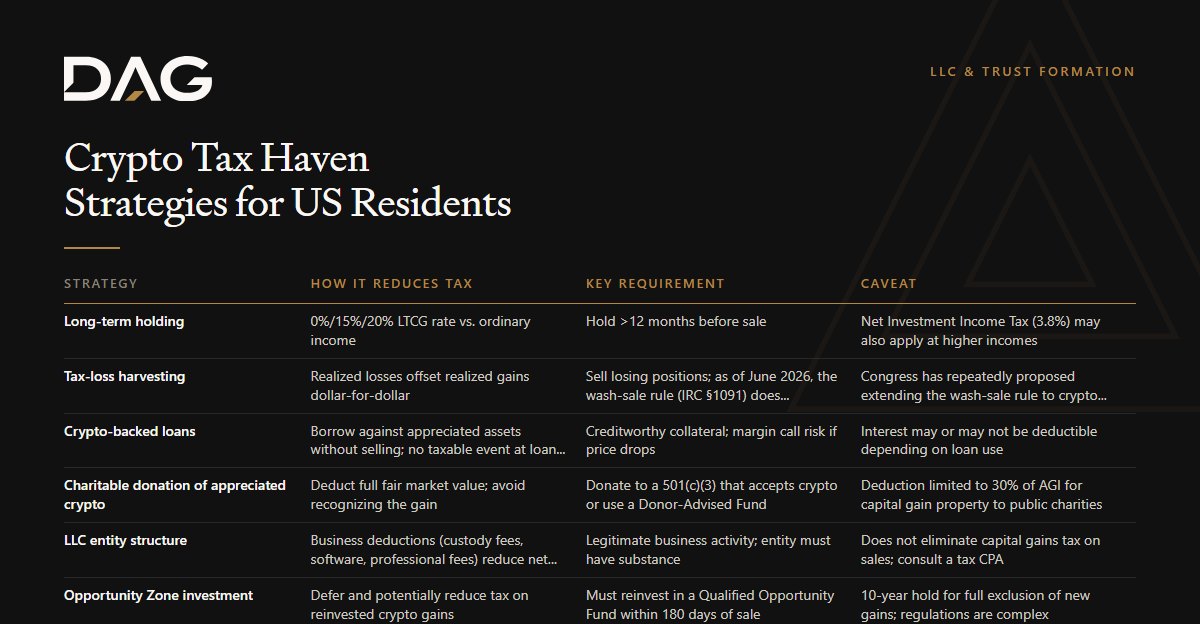
| Strategy | How It Reduces Tax | Key Requirement | Caveat |
|---|---|---|---|
| Long-term holding | 0%/15%/20% LTCG rate vs. ordinary income | Hold >12 months before sale | Net Investment Income Tax (3.8%) may also apply at higher incomes |
| Tax-loss harvesting | Realized losses offset realized gains dollar-for-dollar | Sell losing positions; as of June 2026, the wash-sale rule (IRC §1091) does not apply to crypto under current law | Congress has repeatedly proposed extending the wash-sale rule to crypto; verify current status before relying on it, and track cost basis carefully |
| Crypto-backed loans | Borrow against appreciated assets without selling; no taxable event at loan origination | Creditworthy collateral; margin call risk if price drops | Interest may or may not be deductible depending on loan use |
| Charitable donation of appreciated crypto | Deduct full fair market value; avoid recognizing the gain | Donate to a 501(c)(3) that accepts crypto or use a Donor-Advised Fund | Deduction limited to 30% of AGI for capital gain property to public charities |
| LLC entity structure | Business deductions (custody fees, software, professional fees) reduce net taxable income | Legitimate business activity; entity must have substance | Does not eliminate capital gains tax on sales; consult a tax CPA |
| Opportunity Zone investment | Defer and potentially reduce tax on reinvested crypto gains | Must reinvest in a Qualified Opportunity Fund within 180 days of sale | 10-year hold for full exclusion of new gains; regulations are complex |
| Multi-year gain timing | Sell in lower-income years to access the 0% or 15% LTCG bracket | Requires income forecasting and planning before the taxable year ends | Cannot retroactively time a sale already executed |
| Charitable Remainder Trust (CRT) | Sell appreciated crypto inside the trust; trust pays no tax at sale; income stream to donor over time | Irrevocable; complex setup; remainder to charity | Must use a qualified attorney; no-recapture rules apply |
What this table is not: a guarantee of outcome or legal advice. Each strategy requires professional implementation. Tax law changes regularly.
What About Renouncing US Citizenship?
Expatriation (renouncing US citizenship or surrendering a long-term green card) is a permanent, irreversible decision. Under IRC §877A, a "covered expatriate", broadly, someone meeting a net-worth test (a $2 million threshold) or an average-net-income-tax test, both with annually adjusted figures, is treated as having sold all worldwide assets at fair market value on the day before expatriation. Unrealized crypto gains are taxed at that point. A net-gain exclusion (an inflation-adjusted amount in the high six figures) applies, but large crypto positions can generate exit-tax bills in the millions before the holder receives a dollar of actual sale proceeds. Confirm the current-year thresholds and exclusion amount with a cross-border tax attorney.
After renouncing, the former citizen loses the right to live and work in the US and may face the "Reed Amendment" bar on reentry. This is not a tax planning tool for most people.
Related Questions
Can a US person use a Cayman Islands or BVI company to hold crypto tax-free?
No. A US person who controls a Cayman or BVI company holding crypto is a US shareholder of a foreign corporation. The income is either taxed currently under Subpart F/GILTI rules or taxed at distribution. The foreign company does not shield the gain from US tax, it adds complexity and reporting obligations on top of it.
Are there US states with no crypto capital gains tax that can reduce my overall bill?
Yes, but only if you actually relocate and establish domicile there. States like Texas, Florida, Nevada, Wyoming, and Washington have no state income tax. A genuine move, changing your driver's license, voter registration, domicile, and primary residence, eliminates your former state's tax claim on future gains. It does not affect federal tax. High-tax states like California aggressively audit departing residents who continue to have significant business ties or spend time in-state.
Does holding crypto in a self-directed IRA reduce taxes?
A self-directed IRA can hold certain crypto assets. Gains inside a Traditional IRA grow tax-deferred; gains inside a Roth IRA grow tax-free (on qualified distributions). Annual IRA contribution limits (a few thousand dollars, with a catch-up amount for those 50 and older, both adjusted periodically for inflation) make this most effective as a long-term accumulation strategy, not a vehicle for sheltering existing large crypto positions. Prohibited transaction rules apply; using IRA-held crypto for personal benefit triggers immediate distribution and penalties. See Crypto IRA vs Crypto Family Office Structure for a comparison of these approaches.
Should I use an LLC to hold crypto for tax purposes?
An LLC used for legitimate crypto business activities can deduct ordinary and necessary business expenses against income, reducing net taxable income. It does not eliminate capital gains tax when you sell crypto held in the LLC. For crypto tax planning for HNW investors, an LLC is typically one layer of a broader structure that also includes a trust and multi-year timing strategy. See Should Crypto Be Held Personally, in an LLC, or in a Trust? for a side-by-side comparison.
Sources
- IRS, Topic No. 409: Capital Gains and Losses, https://www.irs.gov/taxtopics/tc409 (accessed June 2026)
- IRS, Virtual Currencies, https://www.irs.gov/businesses/small-businesses-self-employed/virtual-currencies (accessed June 2026)
- IRS Notice 2014-21, IRS Virtual Currency Guidance, https://www.irs.gov/pub/irs-drop/n-14-21.pdf
- IRS Notice 2004-22, Bona Fide Residence in Puerto Rico, https://www.irs.gov/pub/irs-drop/n-04-22.pdf
- IRC §877A, Tax Responsibilities of Expatriation, https://uscode.house.gov/view.xhtml?req=granuleid:USC-prelim-title26-section877A
- IRC §957 / Subpart F. Controlled Foreign Corporations, https://uscode.house.gov/view.xhtml?req=granuleid:USC-prelim-title26-section957
- FinCEN, FBAR Filing Requirements, https://www.fincen.gov/report-foreign-bank-and-financial-accounts
- IRS, Form 8938 and FATCA Overview, https://www.irs.gov/businesses/corporations/foreign-account-tax-compliance-act-fatca
- Puerto Rico Department of Economic Development and Commerce, Act 60-2019 (formerly Acts 20/22), https://ddec.pr.gov/en/act-60/ (accessed June 2026)
- IRC §1400Z-2, Opportunity Zones. Special Rules for Capital Gains, https://uscode.house.gov/view.xhtml?req=granuleid:USC-prelim-title26-section1400Z-2
Compliance Note
This page is published by Digital Ascension Group (DAG Wealth) for educational purposes only. It does not constitute legal, tax, investment, or financial advice and does not create an attorney-client, CPA-client, or adviser-client relationship. Investment advisory services are offered through DAG Wealth, a registered investment adviser. Registration does not imply a certain level of skill or training.
Cryptocurrency tax law is complex, rapidly evolving, and fact-specific. Penalties for non-compliance with offshore reporting requirements (FBAR, FATCA, Form 5471, Form 3520) can be severe. Nothing on this page should be read as endorsing tax evasion, offshore secrecy, or any strategy that involves failing to report income or foreign financial accounts to the IRS. Consult a qualified cross-border tax attorney and CPA before implementing any strategy discussed here.
Past tax outcomes do not guarantee future results. Tax rates, thresholds, and rules referenced in this article are subject to legislative and regulatory change.