
A family limited partnership for cryptocurrency is a legal structure in which a general partner, typically a parent or founder, keeps full management authority over contributed digital assets while transferring ownership interests to family members over time. It is an advanced alternative to standard crypto LLC formation that suits high-net-worth estate plans. The general partner controls buy, sell, and custody decisions; limited partners hold economic interests but cannot direct the assets.
How Does an FLP Work for Crypto Assets?
You contribute cryptocurrency to the partnership. You retain a small general partner interest, commonly 1–2%, which grants complete management authority. The remaining 98–99% is divided into limited partnership interests that you gift to family members, generally using annual gift tax exclusions to stay within IRS limits each year.
Family members accumulate ownership without gaining control. You continue to decide when to transact, which custody solution to use, and how to manage the portfolio. When you die, only the general partner interest passes through your estate; the limited interests your family already holds transfer outside probate.
What Are the Potential Tax Benefits?
Limited partnership interests may qualify for valuation discounts when gifted, because they lack both marketability and control relative to the underlying assets. Discount figures sometimes cited in practice (illustratively, in a 20–40% range) are not guaranteed, are fact-specific, and the IRS may challenge them. Any actual discount depends heavily on the specific facts, the strength of the non-tax business purpose, a qualified independent appraisal, and proper documentation.
The IRS has long challenged aggressive FLP discounts, particularly under IRC §2036, which can pull transferred assets back into a decedent's taxable estate if the transfer lacked a legitimate non-tax purpose or if the transferor effectively retained economic benefits. Courts have disallowed discounts where the FLP was formed shortly before death, assets were commingled, or no genuine business purpose was demonstrated. This is an area where independent tax and legal counsel is essential before relying on any discount.
When Does an FLP Actually Make Sense?
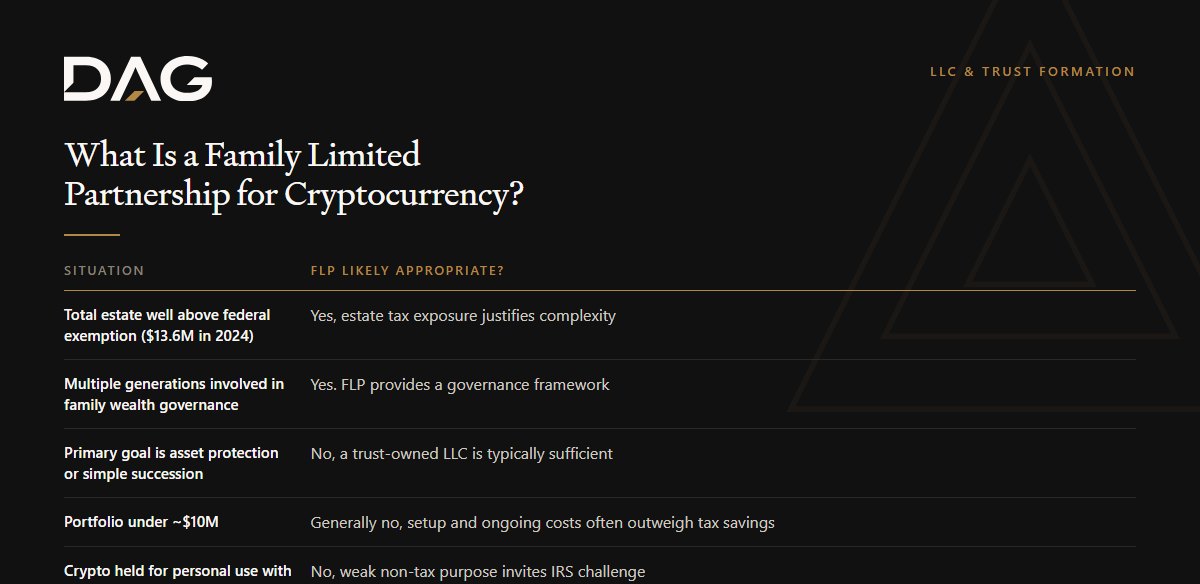
| Situation | FLP Likely Appropriate? |
|---|---|
| Total estate well above federal exemption ($13.6M in 2024) | Yes, estate tax exposure justifies complexity |
| Multiple generations involved in family wealth governance | Yes. FLP provides a governance framework |
| Primary goal is asset protection or simple succession | No, a trust-owned LLC is typically sufficient |
| Portfolio under ~$10M | Generally no, setup and ongoing costs often outweigh tax savings |
| Crypto held for personal use with no business purpose | No, weak non-tax purpose invites IRS challenge |
What Are the Ongoing Requirements?
An FLP is a functioning partnership, not a filing shelf. Ongoing obligations typically include:
- A formal, detailed partnership agreement drafted by a qualified attorney
- Annual federal partnership tax returns (Form 1065) and Schedule K-1s for each partner
- Formal meeting minutes and governance records
- Clear documentation of every contribution, distribution, and gifting transaction
- Arm's-length dealings between the partners to support the non-tax business purpose
Failure to observe these formalities is a primary basis for IRS challenges. Courts look for evidence that the FLP was a genuine business arrangement rather than a tax-motivated formality.
How Does an FLP Compare to a Trust-Owned LLC?
For most crypto holders planning for succession and liability protection, a trust-owned LLC for crypto assets accomplishes the core goals with materially less complexity. The LLC holds the digital assets, a trust owns the LLC membership interest, and heirs inherit through the trust without probate. Annual compliance is limited to LLC maintenance and trust administration, no partnership returns, no multi-party gifting program.
An FLP adds value specifically where estate tax reduction through valuation discounts is a meaningful objective and the portfolio size justifies the legal and accounting overhead. Any asset-protection benefit is jurisdiction-specific and not absolute, creditor protection varies by state and can be set aside in fraudulent-transfer cases. If you are evaluating these structures, a thorough review of crypto trust structures compared is a useful starting point.
Related Questions
Can I Use an FLP to Avoid Estate Tax on Crypto Entirely?
No. An FLP can reduce the taxable value of transferred interests if discounts are properly supported and withstand IRS scrutiny. It does not eliminate estate tax, and the IRS may include transferred assets in your estate under IRC §2036 if the structure lacks genuine non-tax purpose or if you retained economic control. Overstated discounts are one of the more frequently litigated estate planning issues.
Is an FLP the Same as an LLC for Crypto?
No. A limited liability company and a limited partnership are separate legal entities with different governance, tax treatment, and formation requirements. An LLC's membership interests can provide somewhat similar gifting flexibility, but an LLC does not use the GP/LP structure that generates the control- and marketability-based valuation discounts central to FLP strategy. For a comparison, see crypto LLC vs trust.
Does Contributing Crypto to an FLP Trigger a Taxable Event?
Contributing appreciated cryptocurrency to a partnership in exchange for a partnership interest is generally not a taxable event under IRC §721, provided the contribution meets partnership tax requirements. However, exceptions apply, for example, if the partnership is treated as an investment company or if disguised-sale rules are triggered. Confirm the contribution structure with a crypto-knowledgeable CPA before transferring assets. See also crypto tax planning for HNW investors.
Who Manages the Cold Wallet in an FLP?
The general partner controls all custody arrangements. The partnership agreement should explicitly address wallet governance: who holds private keys, what custody solution is used, how signers are designated, and what happens to custody authority on GP succession. For families using hardware wallets, hardware wallet estate planning covers the succession mechanics that apply regardless of entity structure.
What Is the Minimum Portfolio Size Where an FLP Makes Financial Sense?
There is no fixed threshold, but the combination of formation costs (attorney fees for a properly drafted partnership agreement), annual accounting (Form 1065 plus K-1s), and ongoing governance overhead typically means that tax savings only outpace costs for estates meaningfully above the federal estate tax exemption, often cited as $10M or more in total assets. For portfolios below that range, crypto estate planning for high-net-worth families outlines structures that may be more cost-effective.
Sources
- IRS, Estate and Gift Tax. Family Limited Partnerships: https://www.irs.gov/businesses/small-businesses-self-employed/family-limited-partnerships (IRS guidance page, accessed 2024)
- IRC §2036. Transfers With Retained Life Estate: 26 U.S.C. § 2036, statutory basis for inclusion of FLP assets in the taxable estate where the transferor retained economic benefit or control; https://uscode.house.gov/view.xhtml?req=granuleid:USC-prelim-title26-section2036
- IRC §721. Nonrecognition of Gain or Loss on Contribution: 26 U.S.C. § 721, general nonrecognition rule for partnership contributions; https://uscode.house.gov/view.xhtml?req=granuleid:USC-prelim-title26-section721
- IRC Subchapter K (§§ 701–777). Partners and Partnerships: Governs partnership taxation, including allocation rules, disguised sales, and investment company exceptions; https://uscode.house.gov/view.xhtml?path=/prelim@title26/subtitleA/chapter1/subchapterK
- IRS Notice 2003-72: IRS position on FLP transactions lacking non-tax business purpose; https://www.irs.gov/pub/irs-drop/n-03-72.pdf
Compliance Note
This page is for educational purposes only. It does not constitute legal, tax, or investment advice. Family limited partnerships involve complex federal tax rules, including §2036 inclusion risk and Subchapter K partnership taxation, and state law requirements that vary by jurisdiction. Valuation discounts are subject to IRS challenge and are not automatic or guaranteed. Before forming or funding an FLP with cryptocurrency, consult a qualified estate attorney and a CPA with experience in both partnership tax and digital assets. Investment advisory services for digital assets are provided by DAG Wealth, an SEC-registered investment adviser. Registration does not imply a certain level of skill or training.