
For a living will, trust, and digital assets, no single document makes the others obsolete. A revocable trust does not replace a last will and testament, and neither replaces a living will (an advance healthcare directive). All three coexist: the trust controls crypto through an LLC formed as part of crypto LLC formation, while the will catches whatever was not transferred to it.
Key Terms Before Going Further
These three documents are frequently confused:
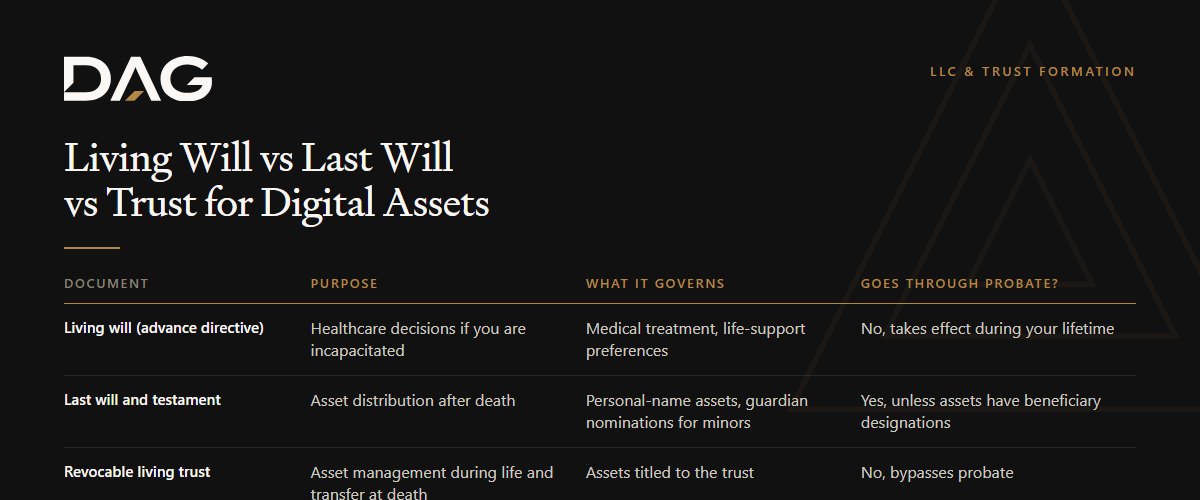
| Document | Purpose | What it governs | Goes through probate? |
|---|---|---|---|
| Living will (advance directive) | Healthcare decisions if you are incapacitated | Medical treatment, life-support preferences | No, takes effect during your lifetime |
| Last will and testament | Asset distribution after death | Personal-name assets, guardian nominations for minors | Yes, unless assets have beneficiary designations |
| Revocable living trust | Asset management during life and transfer at death | Assets titled to the trust | No, bypasses probate |
A living will is a medical document, not an estate-distribution document. Adding a revocable trust to your plan has no effect on your living will whatsoever.
Does a Revocable Trust Replace a Last Will and Testament?
No. The two documents do different jobs, and most people with a trust still need a will.
The trust controls only assets that are properly titled to it. Your LLC holding cryptocurrency passes through the trust at death because the trust owns the LLC membership interest, no probate required. But assets that were never retitled into the trust, assets acquired after the trust was created, personal property, and guardian nominations for minor children all fall outside the trust's reach.
That gap is what the will covers.
What is a pour-over will, and why does every trust need one?
A pour-over will is the standard companion document to a revocable trust. It states that any assets you own personally at death "pour over" into the trust and get distributed under the trust's terms. It acts as a safety net for anything that was never transferred into the trust while you were alive.
The pour-over provision still goes through probate for assets it captures. This is why proper trust funding, transferring ownership of assets into the trust before death, matters. The goal is to have the pour-over will catch as little as possible.
Why does trust funding matter more than the documents?
Two people can have identical trust documents, but the one who never retitled assets gets no probate-avoidance benefit. The trust controls what is owned by the trust.
For digital assets, the typical structure is: the LLC holds the exchange accounts and wallets; the trust owns the LLC. Document the LLC membership transfer with an assignment of membership interest, and update the LLC operating agreement to name the trust as member. When you die, your successor trustee assumes control of the trust, inherits the LLC, and can access the digital assets, no court involvement.
If the LLC is still in your personal name when you die, the pour-over will can send it to the trust, but only after probate proceedings. Your family may wait months before they can establish control of the LLC and access the underlying digital assets.
How the Three Documents Work Together in a Digital Asset Estate Plan
A complete plan for digital asset holders generally includes:
- Revocable living trust, holds the LLC membership interest; governs successor trustee succession and distribution.
- LLC operating agreement, names the trust as member; includes succession provisions for the manager role.
- Pour-over will, catches any personal-name assets; nominates guardians for minor children.
- Living will / advance healthcare directive, separate from all of the above; governs medical decisions while you are alive and incapacitated.
- Beneficiary designations, retirement accounts (401(k), IRA) and life insurance stay in your personal name with named beneficiaries; they pass outside both the will and the trust.
These pieces address different legal pathways. Changing or adding the trust does not disturb the living will or beneficiary designations.
What assets belong in the trust versus the will?
Assets with significant value and clear title. LLC membership interests, real property, brokerage accounts, are worth retitling into the trust. Tangible personal property (jewelry, vehicles, household goods) commonly transfers through the will, often via a personal property memorandum that can be updated without formally amending the will.
Retirement accounts and life insurance should generally stay outside the trust and pass by beneficiary designation, for tax and administrative reasons, though specific circumstances may call for trust ownership of life insurance. Whether a given account should be trust-owned is a legal and tax question specific to your situation; DAG provides educational context and coordinates the review, while a qualified estate attorney and tax advisor make the call.
Why Crypto Exchanges Complicate Trust Ownership
Many centralized exchanges do not accept trust-owned accounts. Some prohibit account transfers entirely. The LLC structure addresses this: the LLC opens and holds exchange accounts as a business entity. The trust then owns the LLC rather than the exchange account directly. Platforms interact with a business entity, not a trust, which fits standard business account onboarding.
For hardware wallet estate planning, physical custody of the device does not change when assets move from personal ownership into a trust-owned LLC. What changes is the legal pathway your successor trustee follows to establish control. Trust ownership means access through the trust succession process; personal ownership means waiting for probate.
When Should You Update Both Documents?
Both the trust and the will require attention when circumstances change materially: having or adopting a child, divorce, significant asset acquisition, or change in who you want as trustee or executor. Provisions in one document that contradict the other create ambiguity for your family and potential litigation.
For married couples, trust coordination becomes more complex. Some couples use a joint trust; others use separate trusts with coordinated terms. Either way, the wills need to align with the chosen trust structure, and beneficiary designations need to be reviewed alongside both documents. Choosing between joint and separate structures depends on state law, estate tax exposure, and the couple's goals. DAG coordinates this review as part of its family office services; document drafting and structure decisions are made with a licensed estate attorney.
For a broader overview of planning structures, see crypto trust structures compared and crypto will vs crypto trust.
Related Questions
Can I have a living will and a trust at the same time?
Yes, without conflict. A living will (advance healthcare directive) governs medical decisions while you are alive and incapacitated. A revocable trust governs asset management and transfer at death. They operate in completely different legal domains and do not interact.
Does adding a trust require changing my beneficiary designations?
Not necessarily, but you should review them. Retirement accounts and most life insurance policies pass by beneficiary designation regardless of what your trust or will says. If your designations name individuals who have since died, or if your intent has changed, update them separately. In some cases, a trust can be named as beneficiary of life insurance for estate planning reasons, an estate attorney can advise on when that makes sense for your situation.
What happens to digital assets if I die before retitling the LLC into my trust?
If the LLC is in your personal name at death, the pour-over will can direct it into your trust, but only after probate is completed, which can take months. During that period, your family may have limited ability to transact on the LLC's exchange accounts or wallets. This is why transferring the LLC membership into the trust while you are alive is the most important step in a digital asset estate plan. See how to fund a trust with crypto for the mechanics.
Does a trust protect digital assets from creditors during my lifetime?
A revocable trust generally does not provide creditor protection while you are alive, because you retain control and the ability to revoke it. Irrevocable trust structures may offer creditor protection in certain circumstances. See revocable vs irrevocable trusts for crypto assets for a comparison. An estate attorney can advise on which structure fits your circumstances.
What trust provisions should specifically address digital assets?
Trust documents may need provisions covering: the trustee's authority to hold and transact digital assets, procedures for accessing private keys or seed phrases, appointment of a digital asset advisor or directed trustee role, and valuation methodology for illiquid tokens. See what trust provisions should cover digital assets for detail.
Should crypto be listed in a will?
Listing specific cryptocurrency holdings in a will creates risk: by the time the will is admitted to probate and the estate is administered, account balances will have changed. A better approach is to reference the structure (the LLC and trust) rather than specific holdings, and maintain a separate letter of instruction with access details. See should crypto be listed in a will.
Sources
- Uniform Probate Code §§ 2-501 to 2-517 (will execution and revocation), §§ 2-701 to 2-707 (rules of construction); National Conference of Commissioners on Uniform State Laws, https://www.uniformlaws.org/committees/community-home?CommunityKey=a539920d-c477-44b8-84fe-b0d7b1a4cca8
- Uniform Trust Code (2000, as amended), National Conference of Commissioners on Uniform State Laws, https://www.uniformlaws.org/committees/community-home?CommunityKey=193ff839-7955-4846-8f3c-ce74ac23938d
- Revised Uniform Fiduciary Access to Digital Assets Act (RUFADAA, 2015), enacted in most U.S. states; text available at https://www.uniformlaws.org/committees/community-home?CommunityKey=f7237fc4-74c2-4728-81c6-b39a91ecdf22
- IRS, "Retirement Plans FAQs regarding Beneficiary Designations," https://www.irs.gov/retirement-plans/plan-participant-employee/retirement-plans-faqs-regarding-beneficiary-designations
- IRS Publication 559, "Survivors, Executors, and Administrators," https://www.irs.gov/forms-pubs/about-publication-559
Compliance Note
This page is for educational purposes only and does not constitute legal, tax, or investment advice. Estate planning, including trust drafting, will preparation, and beneficiary designation strategy, is a legal service. DAG coordinates estate planning as part of its family office services; document drafting and structure decisions should be made with a qualified estate attorney licensed in your state. Investment advisory services are provided through DAG Wealth, the SEC-registered investment adviser operating under the DAG Wealth brand. Individual circumstances vary significantly. Nothing here should be relied upon as a substitute for professional legal or tax counsel. Registration does not imply a certain level of skill or training.