
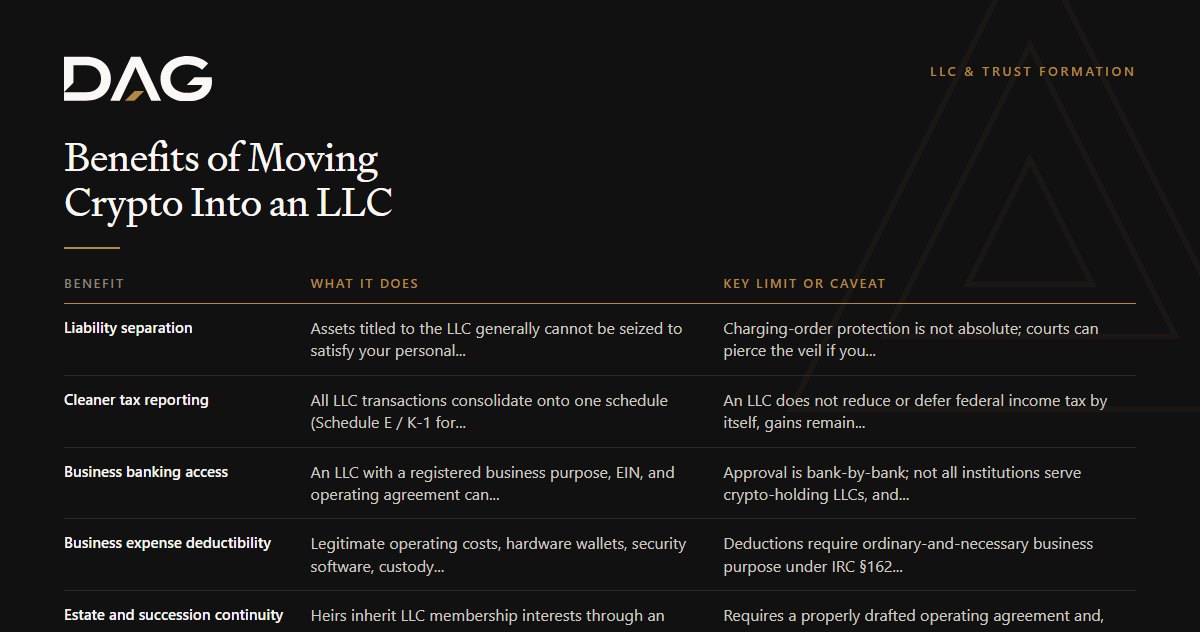
The benefits of moving crypto into an LLC can include separating personal liability from your holdings, consolidating tax reporting, opening business banking access, and building a succession path for heirs, all of which depend on crypto LLC formation being done correctly. None are automatic, and an LLC does not by itself reduce federal income tax. Each benefit has limits covered below. Educational only, consult a qualified attorney and CPA.
What Does It Mean to "Move Crypto Into an LLC"?
An LLC (limited liability company) is a state-chartered legal entity that can own property separately from its members. When you transfer cryptocurrency to an LLC you own, the LLC, not you personally, becomes the record holder of those assets. For a single-member LLC treated as a disregarded entity for federal tax purposes, this transfer is generally not a taxable event under IRS pass-through rules; the LLC is ignored for federal income tax and all gain/loss continues to flow through to your personal return. Multi-member LLCs taxed as partnerships may also receive contributed property without immediate gain under IRC §721, but that nonrecognition rule is not unconditional, it does not apply where the contribution is treated as a disguised sale, where the LLC would be an investment company under §721(b), or in other fact-specific situations. Whether §721 covers a given crypto contribution depends on the entity's structure and the members' circumstances. Consult a CPA before transferring; specific facts matter.
What Are the Core Benefits, and Their Limits?
| Benefit | What It Does | Key Limit or Caveat |
|---|---|---|
| Liability separation | Assets titled to the LLC generally cannot be seized to satisfy your personal debts or judgments | Charging-order protection is not absolute; courts can pierce the veil if you commingle funds, ignore formalities, or undercapitalize the entity |
| Cleaner tax reporting | All LLC transactions consolidate onto one schedule (Schedule E / K-1 for partnerships; Schedule C or disregarded passthrough for SMLLCs) rather than flooding your personal return | An LLC does not reduce or defer federal income tax by itself, gains remain taxable; a disregarded SMLLC is transparent for federal purposes |
| Business banking access | An LLC with a registered business purpose, EIN, and operating agreement can open business accounts at banks that decline personal crypto holders | Approval is bank-by-bank; not all institutions serve crypto-holding LLCs, and documentation requirements vary |
| Business expense deductibility | Legitimate operating costs, hardware wallets, security software, custody fees, professional services, may be deductible against LLC income | Deductions require ordinary-and-necessary business purpose under IRC §162; personal-use items do not qualify; documentation required |
| Estate and succession continuity | Heirs inherit LLC membership interests through an operating agreement or trust, bypassing probate and the private-key access problem | Requires a properly drafted operating agreement and, ideally, a trust owning the LLC interest; continuity is only as good as the legal drafting |
| Institutional credibility | Lenders and counterparties treat a structured entity more seriously than a personal holder | Does not guarantee lending approval; lenders still underwrite the borrower and the collateral |
Does an LLC Avoid Federal Income Tax on Crypto?
No. A single-member LLC classified as a disregarded entity is invisible to the IRS, your crypto gains and losses pass through to your Form 1040 exactly as if you held them personally. A multi-member LLC taxed as a partnership files Form 1065 and issues K-1s; members still pay tax at personal rates. An LLC does not create tax deferral, shelter, or exemption on its own.
For tax planning strategies tied to crypto gains, see crypto tax planning for HNW investors and crypto tax reporting for LLCs.
How Does an LLC Help With Crypto Succession?
The clearest succession benefit comes from combining an LLC with a trust. The trust owns the LLC membership interest; the LLC holds the cryptocurrency. At death, the trust's successor trustee steps in under the trust document's terms, no probate, no court order needed to access the wallet, no family dispute over who controls the keys. Without this structure, heirs may face a slow probate process that assumes paper assets, not private keys on a hardware device.
For related detail, see should a trust own a Wyoming LLC for crypto assets and how to fund a trust with crypto.
What Are the Costs of Maintaining a Crypto LLC?
Wyoming LLC formation and annual report fees are generally modest relative to other costs, historically in the low hundreds of dollars, but these figures are illustrative and change over time. Verify the current schedule with the Wyoming Secretary of State before relying on any number. The larger ongoing costs are typically professional: legal counsel for the operating agreement, a CPA for annual tax compliance, and a registered agent fee. Weigh those against the potential cost of probate administration or personal liability exposure on a significant crypto position.
Related Questions
Does moving crypto into an LLC protect it from lawsuits?
An LLC can provide a liability shield, but protection depends on whether you respect the entity as a separate business: maintain a dedicated LLC wallet and bank account, document contributions and distributions, and avoid treating LLC assets as personal funds. Courts can disregard the entity ("pierce the veil") when these formalities are ignored. Wyoming's charging-order statute provides additional creditor protection for LLC membership interests, but it is not a blanket shield. See does a Wyoming LLC protect crypto from lawsuits for a full treatment.
Is there a minimum portfolio size where an LLC makes sense for crypto?
There is no fixed threshold, but the cost/benefit calculation shifts as holdings grow. For small speculative positions, the compliance overhead likely exceeds the benefit. When digital assets represent a material portion of net worth, and when liability exposure, estate complexity, or institutional banking access become real concerns, the structure starts to justify itself. The decision depends on your specific facts, not a universal dollar number.
Can an LLC hold crypto staked or deployed in DeFi protocols?
Yes, an LLC can hold crypto that earns staking rewards or interacts with DeFi protocols, but this introduces additional tax complexity. Staking rewards are generally treated as ordinary income at receipt under current IRS guidance; DeFi interactions may trigger gain recognition events. The LLC wrapper does not change the federal tax treatment of these activities. See crypto staking tax reporting for current guidance.
What happens if I transfer crypto to the LLC incorrectly?
Contributing crypto to an LLC without proper documentation, no contribution agreement, no updated ledger, no wallet address tied to the LLC, can undermine both the liability protection and the estate plan. It can also create ambiguity about whether the transfer occurred at all, which matters at death, in a lawsuit, or during a tax audit. See how should a crypto LLC document contributions.
Sources
- Wyoming LLC Act, Wyo. Stat. § 17-29-101 et seq. (2024 ed.), wyoleg.gov
- IRS, "Single Member Limited Liability Companies" (disregarded entity treatment), irs.gov/businesses/small-businesses-self-employed/single-member-limited-liability-companies
- IRC § 721 (nonrecognition of gain or loss on contribution to partnership), uscode.house.gov
- IRS Notice 2014-21, IRS Rev. Rul. 2023-14 (crypto as property; staking income), irs.gov
- Treasury Reg. § 301.7701-3 (check-the-box entity classification)
Compliance Note
This page is for educational purposes only. It does not constitute legal, tax, investment, or financial advice, and it does not establish an advisory relationship. Laws, regulations, and IRS guidance applicable to cryptocurrency held in LLCs change frequently. Consult a qualified attorney and CPA before forming an entity, transferring assets, or making decisions based on this content.
Investment advisory services, where referenced, are provided by DAG Wealth, a registered investment adviser. Registration does not imply a certain level of skill or training.