
An anonymous LLC keeps your name off state public business registries by listing a registered agent or nominee manager in place of your personal identity. For crypto holders, this creates meaningful distance between their name and their on-chain holdings, reducing exposure to database searches and opportunistic targeting, while leaving all tax obligations, KYC requirements, and regulatory reporting fully intact.
What Is an Anonymous LLC?
An anonymous LLC is a standard limited liability company formed in a state that does not require member names to appear in its public registry. The filing lists a registered agent or nominee manager; the beneficial owner's identity is held in private formation documents rather than disclosed publicly.
This is not an offshore arrangement or legal loophole. Wyoming, New Mexico, Delaware, and several other states explicitly permit this structure. The IRS, state revenue agencies, and regulated financial institutions (exchanges, banks, custodians) still obtain identity information through standard KYC and tax-reporting channels. The privacy operates at the layer of public records, not government records.
Why Do Crypto Holders Use Anonymous LLC Structures?
How Does Blockchain Transparency Create Targeting Risk?
Blockchain transactions are permanently public. Wallet addresses carry no names by default, but the chain of custody is straightforward to reconstruct: an exchange with your identity on file processes a withdrawal to a wallet, linking your identity to that address. Every subsequent on-chain movement from that address is attributable.
Common threat vectors this creates:
- Theft and extortion targeting: Attackers who can confirm you hold $500K+ in a wallet have reason to pursue SIM-swap attacks, phishing, or physical approaches.
- Scam targeting: Visible crypto wealth invites impersonation attempts and social-engineering campaigns.
- Reputational exposure: Clients, employers, or counterparties may discover net-worth details that an investor would prefer to keep private.
An anonymous LLC does not make you untraceable. It removes your personal name from the top of public search results and on-chain attribution, which is sufficient to deter the opportunistic threats that represent the vast majority of risk.
What Privacy Protection Does an Anonymous LLC Actually Provide?
Public Registry Shielding
State business registries are free and searchable by anyone. Without an anonymous structure, typing your name into Wyoming's or Delaware's registry returns a list of entities you own. An anonymous LLC substitutes a registered agent, so that search returns nothing tied to your personal identity.
On-Chain Separation
You establish the LLC, open a bank account in its name, and fund exchange or custody accounts through the entity. On-chain, transactions appear under the LLC's name rather than your personal identity. Your name may still appear on KYC documentation as the controlling person, but the asset-holding layer is the entity.
Document-Level Separation
Custody agreements, exchange account titles, and transaction records list the LLC. This can also simplify crypto estate planning for high-net-worth families: a properly structured LLC is transferable without requiring heirs to recover personal seed phrases or wallet keys.
For holders weighing the full structural decision, see should crypto be held personally, in an LLC, or in a trust? and should a trust own a Wyoming LLC for crypto assets?.
Which States Allow Anonymous LLC Formation?
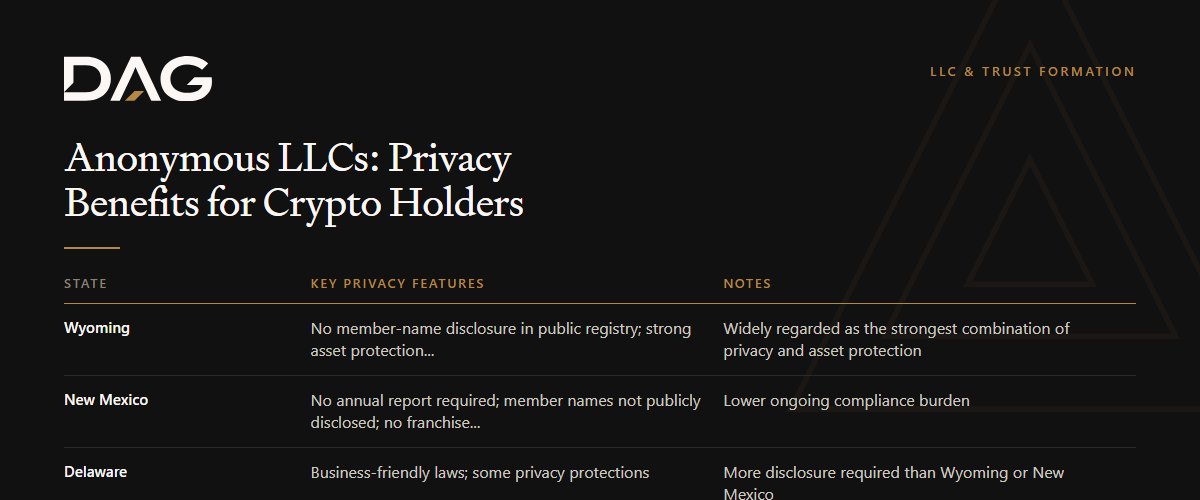
| State | Key Privacy Features | Notes |
|---|---|---|
| Wyoming | No member-name disclosure in public registry; strong asset protection statutes; no state income tax | Widely regarded as the strongest combination of privacy and asset protection |
| New Mexico | No annual report required; member names not publicly disclosed; no franchise tax | Lower ongoing compliance burden |
| Delaware | Business-friendly laws; some privacy protections | More disclosure required than Wyoming or New Mexico |
State choice affects more than privacy: annual fees, franchise tax, registered-agent costs, and exchange/banking friction vary. Wyoming LLC vs Delaware LLC for crypto covers the trade-offs in detail.
DAG coordinates anonymous LLC formation in privacy-focused jurisdictions, including registered agent services and ongoing compliance support. Formation does not constitute legal or tax advice; DAG Wealth works alongside qualified legal and tax professionals.
Who Should Consider an Anonymous LLC for Crypto?
Stronger fit:
- Holders with significant long-term crypto positions who prefer not to advertise holdings publicly
- Crypto-community participants using their real name who want financial activity separated from public identity
- Founders or entrepreneurs who need a formal entity for custody arrangements, partnerships, or exchange accounts
- High-profile individuals (executives, public figures) seeking financial privacy separate from professional identity
- Holders incorporating crypto into estate planning who want a transferable entity rather than personal wallets
Weaker fit:
- Holders with positions small enough that exposure risk is minimal
- Investors comfortable with public attribution of their holdings
- Those unwilling to maintain ongoing LLC compliance requirements
What Does Compliance Require Once the LLC Is Formed?
An anonymous LLC does not change tax obligations. The entity is typically a pass-through for federal income tax purposes; profits flow to the member's personal return. Filing and payment requirements remain identical to a standard single-member LLC.
Key points:
- IRS: The beneficial owner's identity is disclosed via EIN application and tax filings. There is no tax-reporting exemption.
- KYC/AML: Exchanges, custodians, and banks require identity verification for the controlling person. The LLC does not bypass KYC; it changes which layer of documentation your name appears on.
- Beneficial ownership reporting: Under FinCEN's Corporate Transparency Act rules (effective 2024), most LLCs must file a Beneficial Ownership Information (BOI) report identifying controlling persons. This information is held by FinCEN, not published publicly, but it is accessible to law enforcement. Anonymous LLC structures remain subject to BOI filing requirements.
- Court orders and subpoenas: Registered agents and formation attorneys can be compelled to disclose ownership under legal process. The privacy is from public records, not from judicial authority.
- Anti-money laundering rules: Apply without exception. An anonymous structure does not reduce AML exposure and will not shield illegal activity.
For guidance on LLC-level tax reporting see crypto tax reporting for LLCs.
How to Avoid Common Formation Mistakes
Formation errors that undermine privacy, or the LLC's legal standing, are predictable:
- File with an experienced formation agent, not DIY. Errors in paperwork can cause your name to appear in public records by default.
- Maintain a registered agent continuously. Lapsing registered-agent service triggers administrative dissolution in most states.
- Keep complete internal records: operating agreement, ownership documentation, capitalization records. These prove the LLC owns the assets when it matters.
- Meet annual filing requirements. Missing state renewal filings causes loss of good standing and can dissolve the entity.
- Open entity accounts before transacting. Assets need to be held in the LLC's name from the start; retrofitting an existing personal account is more complicated.
See what records should a crypto LLC keep? for documentation specifics.
Practical Costs and Limits
Formation costs typically run $500–$2,000, including first-year registered agent fees. Ongoing annual maintenance runs approximately $200–$500 depending on state.
Operational friction points:
- Some banks require additional documentation (operating agreement, ownership disclosure) before opening accounts for nominee-managed LLCs. This is additional paperwork, not a barrier.
- Some crypto exchanges impose enhanced due diligence on business accounts, requesting operating agreements or ownership certification.
- Privacy protections depend on current state law. Wyoming and New Mexico have strong track records, but statutes can change. Structures built today may face additional disclosure requirements in the future.
Related Questions
Does an anonymous LLC protect crypto from lawsuits?
Privacy and asset protection are related but distinct. An anonymous LLC can reduce the ability of potential plaintiffs to identify assets prior to filing suit, but actual asset-protection strength depends on the state's charging-order statutes and the LLC's legal maintenance. See does a Wyoming LLC protect crypto from lawsuits? for the charging-order analysis.
Does the Corporate Transparency Act eliminate the benefit of an anonymous LLC?
Not entirely. The BOI report goes to FinCEN, a non-public federal database accessible to law enforcement, not to state business registries or the general public. State-level public-record privacy is preserved. The practical effect is that federal investigators can identify beneficial owners; casual searchers and database scrapers cannot.
Can a trust own an anonymous LLC to add another layer of privacy?
Yes, and this is a common structure for high-net-worth holders. A trust is named as the LLC member, with the trust's terms governing beneficial interest. This can provide additional estate planning benefits alongside the privacy layer. See should a trust own a Wyoming LLC for crypto assets? and trust-owned LLC for crypto assets.
Is an anonymous LLC the same as an offshore shell company?
No. Anonymous LLCs are domestic U.S. entities formed under state law, subject to federal tax law, IRS reporting, KYC requirements, and FinCEN's BOI rules. Offshore shell companies operate under foreign jurisdiction and typically involve different (and often more complex) reporting obligations such as FBAR and FATCA. The two structures serve different purposes and carry different compliance profiles.
Sources
- Wyoming Secretary of State. LLC formation and registered agent requirements: https://sos.wyo.gov/Business/LLCInformation.aspx
- New Mexico Secretary of State. LLC filing requirements: https://www.sos.nm.gov/business-services/
- FinCEN. Beneficial Ownership Information reporting (Corporate Transparency Act): https://www.fincen.gov/boi
- IRS. Single-member LLC tax treatment: https://www.irs.gov/businesses/small-businesses-self-employed/single-member-limited-liability-companies
- FinCEN. Customer Due Diligence (CDD) Rule: https://www.fincen.gov/resources/statutes-regulations/rules-regulations/customer-due-diligence-requirements-financial
Compliance Note
This page is educational and does not constitute legal, tax, investment, or financial advice. LLC formation requirements, privacy protections, and beneficial ownership reporting rules vary by state and are subject to legislative and regulatory change. The Corporate Transparency Act BOI reporting requirements in particular have been subject to ongoing litigation and regulatory guidance updates as of the date of this article; readers should verify current requirements with qualified legal counsel. Consult a licensed attorney and qualified tax professional before forming any entity or implementing a privacy strategy.