
An LLC for small crypto holders often costs more than it protects, and banking the entity is one of the first practical hurdles covered in the crypto banking and exchange setup guide. Formation, annual state fees, a registered agent, and separate bookkeeping can run a few hundred to a couple thousand dollars yearly (illustrative; verify current figures). For passive holders with little active-trading liability and few personal assets, that overhead rarely solves a real problem.
What Does an LLC Actually Do for a Crypto Holder?
An LLC creates a legal boundary between the assets held inside the entity and your personal property. Three benefits apply specifically to crypto:
Liability shield. If the LLC is sued, plaintiffs generally reach only the LLC's assets, not your personal accounts or property. The shield is real but not absolute, courts can disregard it ("pierce the veil") if you commingle funds, skip corporate formalities, or treat the LLC as a shell.
Privacy. The LLC's name appears on exchange accounts and custody arrangements instead of yours, keeping your identity one step removed. How much that matters depends on your threat model and jurisdiction.
Tax structuring options. A single-member LLC is a disregarded entity by default, income and losses pass through to your personal return. Contributing crypto to a disregarded single-member LLC is generally not a taxable event, but tax treatment depends on facts, entity elections, and applicable law. Multi-member LLCs can elect partnership or corporate treatment. Whether any structure helps depends on your specific tax situation, confirm with a tax professional.
The protection exists only if you maintain the LLC correctly: separate bank account, separate records, annual filings, and no commingling of personal and entity funds. A neglected LLC can be worse than no LLC at all.
When Does an LLC Make Sense for Crypto?
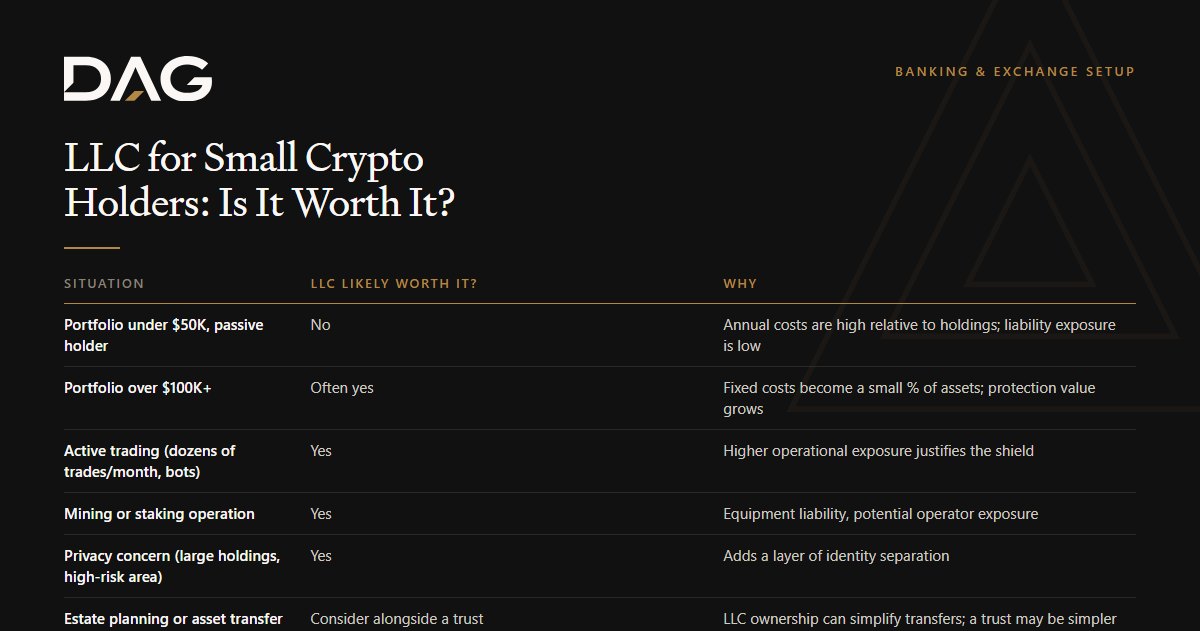
| Situation | LLC likely worth it? | Why |
|---|---|---|
| Portfolio under $50K, passive holder | No | Annual costs are high relative to holdings; liability exposure is low |
| Portfolio over $100K+ | Often yes | Fixed costs become a small % of assets; protection value grows |
| Active trading (dozens of trades/month, bots) | Yes | Higher operational exposure justifies the shield |
| Mining or staking operation | Yes | Equipment liability, potential operator exposure |
| Privacy concern (large holdings, high-risk area) | Yes | Adds a layer of identity separation |
| Estate planning or asset transfer | Consider alongside a trust | LLC ownership can simplify transfers; a trust may be simpler and cheaper |
| Passive holder, few personal assets | No | Nothing significant to protect |
The portfolio figures above are directional illustrations, not legal minimums or bright-line rules, there is no required holding size to form an LLC.
How to Run Your Own Numbers
- Estimate your annual LLC cost. Add: state filing fee (amortized over years) + annual state fee + registered agent fee (if needed) + bookkeeping or accounting time. A realistic range for most states is roughly a few hundred to a couple thousand dollars per year (illustrative; verify current figures).
- Divide by portfolio value. If the result exceeds 1% of your holdings, the cost burden is high relative to the protection.
- Assess your liability exposure. Are you trading on behalf of others? Running mining equipment? Operating a staking validator for third parties? If not, your personal crypto exposure is close to zero and the shield solves a problem you don't have.
- Weigh your personal asset base. The liability shield protects personal assets. If you have few of them, there is little to protect.
- Decide if you will actually maintain it. If you know you'll skip annual filings or commingle personal and LLC funds, don't form one. A poorly maintained LLC offers no protection and still costs money.
Alternatives Worth Comparing
Before forming an LLC, consider whether these alternatives address your actual goals:
- Crypto LLC vs Trust. A revocable living trust can provide estate planning benefits (bypass probate, simplify transfers) without LLC overhead. Trusts do not provide liability protection.
- Hardware wallet + documented estate plan. For smaller holders, hardware wallet estate planning combined with a digital asset letter of instruction covers most of what you need at minimal annual cost.
- Should Crypto Be Held Personally, in an LLC, or in a Trust?. A direct comparison of the three structures.
- Should a Trust Own a Wyoming LLC for Crypto Assets?. If both estate planning and liability protection matter, a trust-owned LLC may be worth evaluating.
Common Mistakes
Forming in a favorable state but not living there. Delaware and Wyoming have business-friendly laws, but if you live in another state you typically must register the LLC there as a foreign entity and pay that state's fees too. You've added cost without adding benefit. See Wyoming LLC vs Delaware LLC for Crypto for a direct comparison.
Assuming an LLC avoids federal tax. An LLC does not shield crypto gains from IRS reporting or federal tax liability. It may affect how income is taxed, not whether it is.
Mixing personal and LLC crypto. This is the fastest path to losing liability protection. See What Happens If I Mix Personal and LLC Crypto?
Skipping the dissolution process. Closing an LLC requires final tax returns, closing the business bank account, and distributing assets properly. Abandoning it without formal dissolution can leave you with ongoing fee obligations and potential liability.
Related Questions
Does an LLC eliminate crypto taxes?
No. An LLC does not eliminate or hide federal tax liability. A single-member LLC is a disregarded entity, income flows to your personal return exactly as if you held crypto directly. The entity may provide different structuring options depending on elections and facts, but taxes are still owed. Consult a tax professional for your specific situation.
Is there a minimum portfolio size required to form a crypto LLC?
No legal minimum exists. Any individual can form an LLC regardless of how much crypto they hold. The question is whether the annual costs are justified relative to the benefits, a cost/benefit decision, not a legal threshold.
What does it cost to maintain a crypto LLC each year?
Ongoing costs typically include state annual fees (variable by state), a registered agent if you don't live in the formation state, bookkeeping or accounting, and your own time for compliance. Total recurring costs for a simple single-state LLC commonly fall in the range of a few hundred to a couple thousand dollars per year, though this varies significantly by state and whether you use professional help (illustrative; verify current figures).
Can I transfer crypto into an LLC without triggering a tax event?
Contributing crypto to a disregarded single-member LLC is generally not treated as a taxable disposition under current IRS guidance, because the SMLLC is not treated as separate from its owner for federal tax purposes. Multi-member LLC contributions and other entity elections involve different rules. Confirm your specific structure with a qualified tax professional before transferring assets.
Sources
- IRS: Single Member Limited Liability Companies (treatment of disregarded entities)
- IRS Publication 544: Sales and Other Dispositions of Assets (taxable events for property)
- Wyoming Secretary of State: LLC Annual Report and Fee Schedule (verify current fees)
- Delaware Division of Corporations: LLC Formation and Annual Franchise Tax (verify current fees)
Compliance Note
This page is educational and does not constitute legal, tax, or investment advice. LLC formation, entity structure, and tax treatment depend on your specific facts, jurisdiction, and applicable law. Fee figures cited are illustrative and may be out of date, verify current state fees before making decisions. Consult a licensed attorney for entity formation and a qualified tax professional for tax treatment. DAG coordinates with attorneys and tax professionals; it does not provide legal or tax advice directly.