
Opening a crypto-friendly bank account for a Wyoming LLC is one of the core challenges covered in crypto banking and exchange setup. It requires clean formation documents (Articles of Organization, EIN, operating agreement), a clearly stated business purpose, and choosing a fintech or crypto-tolerant bank category that conducts enhanced due diligence rather than declining digital asset businesses outright. Approval is never guaranteed, and AML and KYB scrutiny is normal.
Why Most Banks Decline Crypto LLCs
Most traditional banks classify digital asset activity as high-risk under Bank Secrecy Act and FinCEN guidance. That classification triggers enhanced due diligence (EDD) requirements that many community and regional banks are not staffed to handle, so they decline rather than invest in the compliance infrastructure. It is not personal; it is a resource and risk-tolerance decision on the bank's side.
Wyoming-chartered Special Purpose Depository Institutions (SPDIs) are a separate category established under Wyoming law for businesses that handle digital assets. By statute, an SPDI must hold customer deposits in full reserve, may provide digital asset custody, and is supervised by the Wyoming Division of Banking; SPDIs are not structured around FDIC deposit insurance the way conventional banks are. Only a limited number of SPDI charters have been granted and the category is still developing, so confirm current charter holders and which are accepting new business with the Wyoming Division of Banking before relying on this option (verify current status).
What Bank Categories Generally Accept Wyoming Crypto LLCs
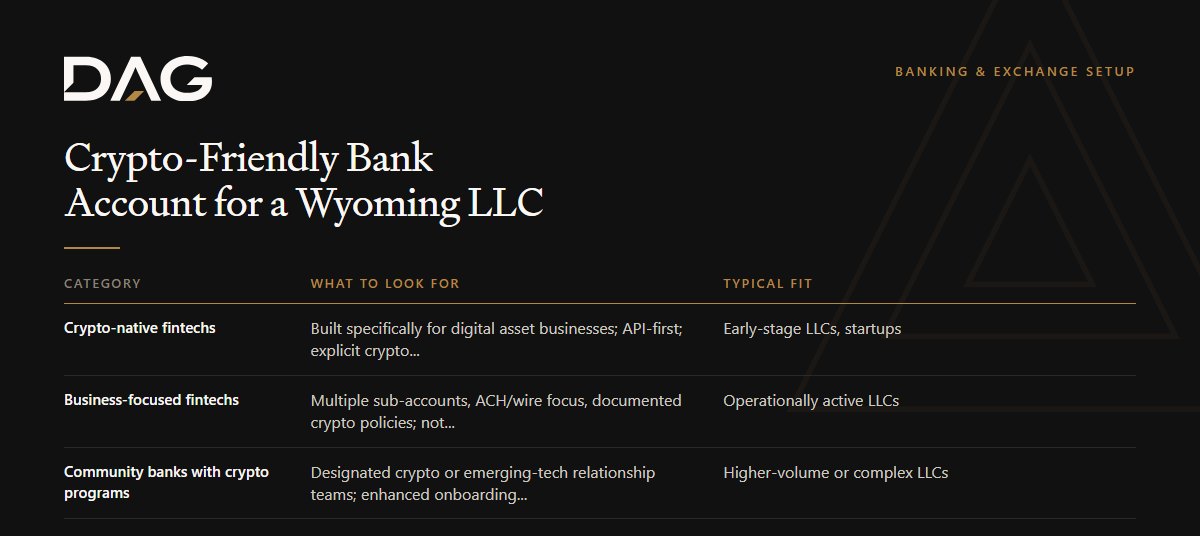
Rather than naming specific institutions (availability changes frequently and individual approvals are not guaranteed), look for institutions in these categories:
| Category | What to Look For | Typical Fit |
|---|---|---|
| Crypto-native fintechs | Built specifically for digital asset businesses; API-first; explicit crypto policy in their terms | Early-stage LLCs, startups |
| Business-focused fintechs | Multiple sub-accounts, ACH/wire focus, documented crypto policies; not crypto-native but crypto-tolerant | Operationally active LLCs |
| Community banks with crypto programs | Designated crypto or emerging-tech relationship teams; enhanced onboarding but human underwriting | Higher-volume or complex LLCs |
| Wyoming SPDIs | State-chartered, digital-asset-native, can custody crypto; limited availability | Larger operations needing integrated banking + custody |
No category guarantees approval. Each bank sets its own policies, and those policies change. A bank that accepted similar accounts six months ago may have tightened restrictions or paused new crypto account openings.
How to Open a Crypto-Friendly Bank Account: Step-by-Step
Assemble formation documents. You need: Wyoming Articles of Organization, IRS EIN confirmation letter, signed operating agreement, and any certificates of authority if you are registered in other states.
Write a clear business purpose statement. Banks' compliance teams read these carefully. Describe the actual business activity, what the LLC does, how it generates or manages value, and what kind of transactions will flow through the account. Vague descriptions ("cryptocurrency activities") raise flags; specific descriptions ("digital asset portfolio management for the LLC's own account") read as lower risk.
Document your source-of-funds narrative. Where did the assets originate? How were they acquired? For AML purposes, banks need to trace funds to a legitimate source. Have records ready, not just verbal answers.
Prepare for KYC/KYB on all beneficial owners. Any individual owning 25% or more (and the controlling person) must provide government-issued ID, proof of address, and often a personal financial profile. Wyoming LLC privacy provisions protect your name from the public record, but they do not exempt you from bank KYB requirements.
Apply to multiple banks in sequence or parallel. Rejections happen even with strong documentation. Build in time for multiple attempts. A single denial does not mean you cannot get banked; it may mean that specific bank has closed its crypto onboarding.
Keep your fiat banking and crypto custody entirely separate. Your LLC bank account holds USD and handles fiat transactions. Your digital assets belong in a custody solution, institutional qualified custody, hardware cold storage, or a combination, not mixed into the business checking account. See Crypto Custody for LLCs for what custody structure fits your situation.
What to Expect During Enhanced Due Diligence (EDD)
Banks that do accept crypto LLCs run a more intensive onboarding than standard business accounts. Expect:
- Written questions about expected transaction volume (monthly USD in/out)
- Questions about counterparties (exchanges, custodians, OTC desks you will transact with)
- Requests for screenshots or statements from existing crypto accounts
- Possible follow-up calls with a compliance officer
- Longer approval timelines (days to weeks, not minutes)
AML and KYB scrutiny at this level is normal, it is not a signal that you are being targeted or that the bank suspects wrongdoing. It is standard operating procedure for any institution taking on digital asset business.
Bank Account vs. Crypto Custody: A Critical Distinction
Your LLC bank account and your digital asset custody are two separate, non-interchangeable functions:
- Bank account = holds USD; processes payroll, vendor payments, fiat in/out; subject to FDIC insurance limits on eligible deposits
- Crypto custody = holds digital assets on-chain; can be self-custody (hardware wallet) or institutional (qualified custodian); not FDIC-insured
Never store digital assets in an exchange account you treat as a "bank." Exchange insolvencies, hacks, and account freezes have caused significant losses. For the custody layer, review Cold Storage vs Qualified Custody and What Is a Qualified Crypto Custodian? to understand your options.
For LLCs with meaningful assets, a structured custody policy matters. See Crypto Account Opening Checklist for Trusts and LLCs for a pre-application checklist.
How This Fits Into Broader LLC Structure
Banking is one operational layer. If you are holding digital assets in a Wyoming LLC for asset protection or estate-planning purposes, see Should I Put My Crypto in a Wyoming LLC? for the structural rationale, and Crypto LLC Operating Agreement Checklist to confirm your operating agreement is properly drafted before you approach banks.
For families coordinating multiple entities, LLCs, and wealth management needs, Digital Asset Wealth Management for High-Net-Worth Families covers how these layers fit together.
Related Questions
Can a Wyoming LLC get a bank account if the owner lives outside the United States?
Generally yes, but the documentation burden increases. Banks must satisfy KYC on foreign beneficial owners, often requiring notarized or apostilled identity documents, proof of US business activity, and sometimes an in-person meeting or video KYC. Some crypto-tolerant fintechs accommodate non-resident US LLC owners; others do not. Verify each bank's policy before applying.
Will opening a bank account affect my Wyoming LLC's privacy?
Wyoming does not require member names in public filings, but banks are legally required to collect and verify beneficial owner information under FinCEN's Customer Due Diligence rule (31 CFR 1010.230). That information is held by the bank and shared with regulators on request, it is not public, but it is not invisible. Privacy from the public record and privacy from regulators or financial institutions are two different things.
What happens if my bank account gets frozen or closed after opening?
Banks can close accounts at will under their terms of service, sometimes with little notice. If an account is frozen or closed, request the reason in writing, retrieve any funds promptly once released, and begin applications at alternate institutions in parallel. For time-sensitive operations, having a backup banking relationship before you need it is sound practice. See What Should I Do If My Crypto Exchange Freezes My Account? for adjacent guidance on exchange account freezes.
Does DAG's team help with bank account applications?
DAG Wealth works with digital asset holders on investment advisory, custody coordination, and wealth planning. Opening a business bank account and preparing the supporting documents are operational tasks that fall outside investment advice, and whether DAG or an affiliated provider can assist with any part of that depends on the specific engagement. We do not open bank accounts on your behalf or guarantee that any institution will approve an application. Contact DAG directly to discuss what a given service arrangement includes.
Sources
- FinCEN Customer Due Diligence Requirements for Financial Institutions, 31 CFR Part 1010 (effective 2018): https://www.ecfr.gov/current/title-31/subtitle-B/chapter-X/part-1010/subpart-B/section-1010.230
- Wyoming Division of Banking. Special Purpose Depository Institutions: https://wyomingbankingdivision.wyo.gov/banks-and-trust-companies/special-purpose-depository-institutions
- Bank Secrecy Act / Anti-Money Laundering (BSA/AML) Examination Manual, FFIEC (verify current edition): https://bsaaml.ffiec.gov/manual
- Wyoming Statutes Title 17, Chapter 29 (Wyoming Limited Liability Company Act): https://law.justia.com/codes/wyoming/title-17/chapter-29/
Compliance Note
This page is educational only and does not constitute legal, tax, banking, or investment advice. Banking policies change frequently; the availability of accounts at any institution for any business type is not guaranteed. AML and KYB requirements are set by each institution and by federal regulators and may differ from what is described here. Consult a qualified attorney, compliance professional, or banking specialist before making decisions about your LLC's banking structure. DAG Wealth and its affiliates do not guarantee outcomes in bank account applications or any other regulatory process. Advisory services are provided by DAG Wealth, an SEC-registered investment adviser. Registration does not imply a certain level of skill or training.