
Banks refuse crypto business accounts mainly because of BSA/AML compliance burden, difficulty tracing on-chain revenue, and reputational risk from prior bad actors, a foundational challenge in crypto banking and exchange setup. Choosing a NAICS code that accurately reflects your real business function, never one chosen to hide crypto activity, can improve your application, though approval is never guaranteed.
Why Banks Decline Crypto Business Accounts
What is "de-risking" and why does it affect crypto businesses?
De-risking is a regulatory compliance strategy where banks exit entire client categories rather than building transaction-by-transaction monitoring for high-scrutiny sectors. Crypto businesses fall into this category because:
- BSA/AML burden is asymmetric. The Bank Secrecy Act requires banks to know their customers and monitor transactions. On-chain flows, moving between exchanges, wallets, and chains, do not map cleanly onto the correspondent banking model. Compliance staff must manually review what legacy software auto-rejects.
- Regulatory pressure is real. FinCEN, the OCC, and state banking regulators have scrutinized banks with crypto-concentrated books. Banks weigh that examination risk against revenue from any single business account.
- Fraud and scam history. Crypto's earlier years produced genuine bad actors, money laundering schemes, fraud operations, sanctioned-entity evasion. Banks that opened accounts without sufficient due diligence absorbed losses and regulatory censure. That institutional memory shapes current underwriting.
None of these reasons mean a legitimate crypto-holding LLC cannot be banked. They mean the underwriting bar is higher and the application package must be structured to pass both automated and human review.
Does the bank see my crypto activity directly?
Not initially. Banks see the NAICS code and your application narrative first. If automated scoring flags the application as high-risk, it may never reach a human compliance officer. That is why NAICS code selection and your business purpose description matter before any conversation about on-chain activity occurs.
NAICS Codes: Accuracy and Practical Guidance
What NAICS codes are appropriate for a digital asset holding company?
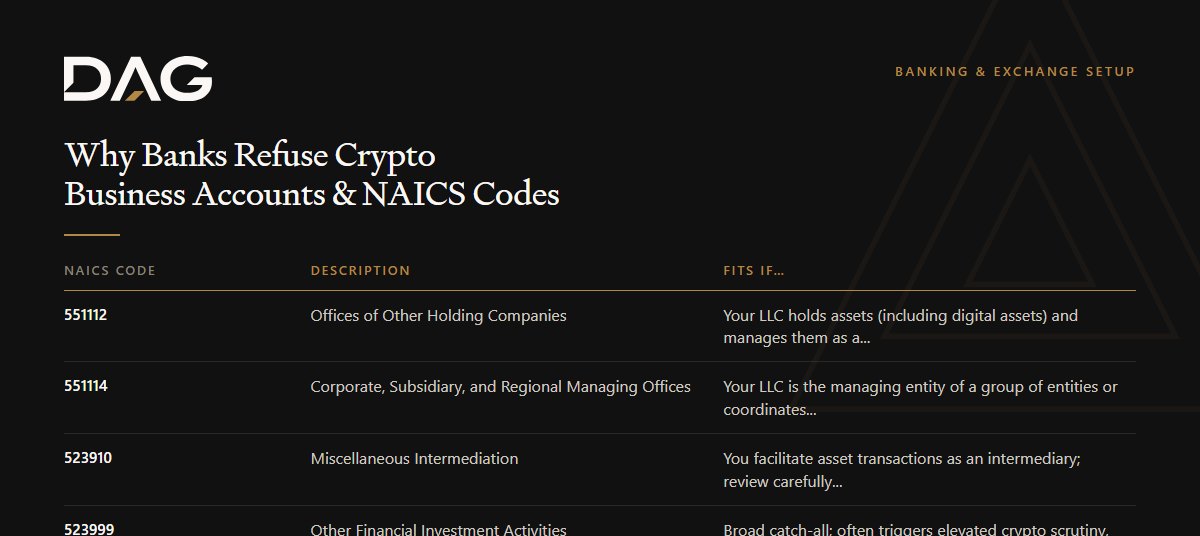
The NAICS code you select should accurately describe what your entity actually does. For a Wyoming LLC that holds and manages digital assets, rather than operating an exchange, providing money transmission, or running a trading desk, the following codes describe that function accurately:
| NAICS Code | Description | Fits if… |
|---|---|---|
| 551112 | Offices of Other Holding Companies | Your LLC holds assets (including digital assets) and manages them as a portfolio; no external customers |
| 551114 | Corporate, Subsidiary, and Regional Managing Offices | Your LLC is the managing entity of a group of entities or coordinates decisions across entities you control |
| 523910 | Miscellaneous Intermediation | You facilitate asset transactions as an intermediary; review carefully against actual activity |
| 523999 | Other Financial Investment Activities | Broad catch-all; often triggers elevated crypto scrutiny, use only if the more specific codes don't fit |
Important accuracy constraint: Select the code that matches what you actually do. Using a holding-company code for an entity that is operationally a crypto trading desk or money services business is misrepresentation, it creates BSA/AML risk for both you and the bank, and can expose you to regulatory liability. Banks will ask about business activities in detail. If your described activity does not match your NAICS code, the application is flagged or denied.
Code 551112 may be accurate for an LLC that genuinely operates as a personal asset-holding company, because holding companies hold and manage assets by definition. The point is not to hide crypto activity, you still disclose that the assets held are digital assets, and you must not choose a code to disguise what your entity actually does. Used correctly, an accurate code simply categorizes your business function, which can reduce algorithmic rejection before a human reviews the application. If your entity trades actively or serves outside customers, a holding-company code does not fit and should not be used.
Can I describe my business in a way that avoids triggering compliance flags?
Yes, and this is not deception, it is accuracy. "We manage a portfolio of digital assets for long-term appreciation" and "we trade crypto on a daily basis" may describe the same underlying holdings, but they describe fundamentally different business functions, risk profiles, and transaction patterns. Describe what you actually do in plain language, specifically and completely.
Checklist for your application narrative:
- State the business purpose in one clear sentence
- Identify the asset types held (Bitcoin, Ethereum, stablecoins, be specific)
- Describe expected monthly transaction volume and average transaction size
- Name the exchanges or custodians you transact with
- Explain how fiat enters and exits the business (funding from personal account, withdrawals to operating expenses)
- Confirm the entity has no external customers (if true)
- Attach the operating agreement and formation documents
- Ensure the NAICS code, operating agreement purpose clause, and application narrative tell the same story
Inconsistencies between these documents, not the crypto exposure itself, are the most common cause of application denial that a well-structured application can prevent.
Which banks currently work with crypto businesses?
Bank policies change frequently and vary by jurisdiction, account type, and business volume. As of publication, several crypto-friendly banks and fintechs have demonstrated willingness to onboard crypto-related LLCs and can handle the volume patterns common to digital asset portfolios. Any specific institution's current policy should be verified directly before applying. This is not an endorsement, and banking relationships are not guaranteed.
Factors that influence crypto-friendly bank selection:
- Account volume limits (some neobanks cap daily or monthly transaction totals)
- Multi-account features for separating operating expenses from asset-holding functions
- Familiarity of the compliance team with crypto business models
- Ability to receive and send ACH/wire from crypto exchanges
Related Questions
Will my bank account be closed if I later receive large crypto-to-fiat transfers?
Possibly, without advance preparation. Banks monitor for sudden changes in transaction patterns. An account opened with modest activity that suddenly receives six-figure wires from a major crypto exchange can trigger a Suspicious Activity Report review and account closure even if the funds are entirely legitimate. Establishing account history with consistent, documented activity before large transactions, and notifying your banker in advance of material changes in volume, reduces this risk. See also: deposit seasoning practices.
Does my NAICS code affect my tax classification?
NAICS codes are used for banking risk classification and census/economic reporting. They do not determine your federal tax treatment, which is governed by how the entity is structured (disregarded entity, partnership, S-corp election) and how activity is reported on your tax returns. Your CPA and the IRS do not rely on the NAICS code your bank has on file. Consult a qualified tax professional for entity-level tax elections.
Is there a difference between banking my LLC and custody of the actual digital assets?
Yes, these are entirely separate functions. A bank account holds fiat currency and facilitates USD transactions. The digital assets themselves should be held in qualified custody or hardware cold storage entirely separate from the banking relationship. Holding crypto on an exchange or in a hot wallet is a custody decision independent of your banking setup. For guidance on separating these functions, see crypto custody for LLCs and cold storage vs qualified custody.
What if every bank denies my application?
A pattern of denials usually signals one of three problems: (1) the business description is inconsistent across documents, (2) the entity's actual activity (trading volume, customer base) is genuinely high-risk for standard banking, or (3) the application is reaching the wrong banks. Neobanks with crypto experience, credit unions, and community banks in crypto-friendly jurisdictions (Wyoming, Wyoming-chartered trust companies) may be more appropriate than national retail banks. Professional help structuring the application package can address problem (1); the others require business-model or banking-partner changes.
Sources
- Financial Crimes Enforcement Network (FinCEN), "Guidance on Existing AML/CFT Obligations for Virtual Currency," FIN-2019-G001 (May 9, 2019): https://www.fincen.gov/sites/default/files/2019-05/FinCEN%20Guidance%20CVC%20FINAL%20508.pdf
- U.S. Census Bureau, North American Industry Classification System (NAICS) 2022 Manual. Sector 55 (Management of Companies and Enterprises): https://www.census.gov/naics/
- Bank Secrecy Act, 31 U.S.C. §§ 5311–5336
- OCC Interpretive Letter 1174 (Jan. 4, 2021), national banks and permissible cryptocurrency activities: https://www.occ.gov/topics/charters-and-licensing/interpretations-and-actions/2021/int1174.pdf
Compliance Note
This article is for educational purposes only and does not constitute legal, tax, banking, or investment advice. NAICS code guidance reflects general industry practice; your specific situation may require a different classification. Misrepresenting business activities on a bank application carries legal and regulatory risk, consult a qualified attorney before submitting applications if your business model is complex. Bank policies, personnel, and account availability change frequently; verify current policies directly with each institution. DAG Wealth does not provide banking services and makes no representations about the availability of banking relationships for any specific client or entity type.
Internal links used:
- crypto custody for LLCs, custody guidance sibling
- cold storage vs qualified custody, custody sibling
- crypto account opening checklist for trusts and LLCs, direct sibling
- should I put my crypto in a Wyoming LLC?. Wyoming LLC cluster sibling
- what is a Wyoming digital asset LLC?. Wyoming LLC cluster sibling Registration does not imply a certain level of skill or training.